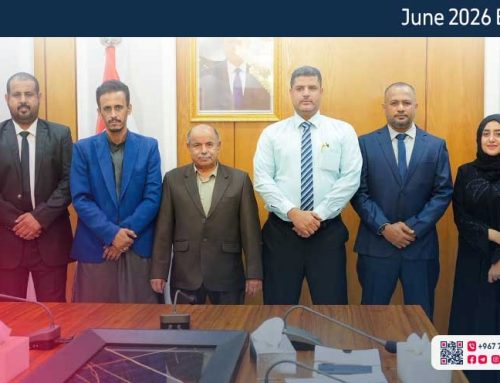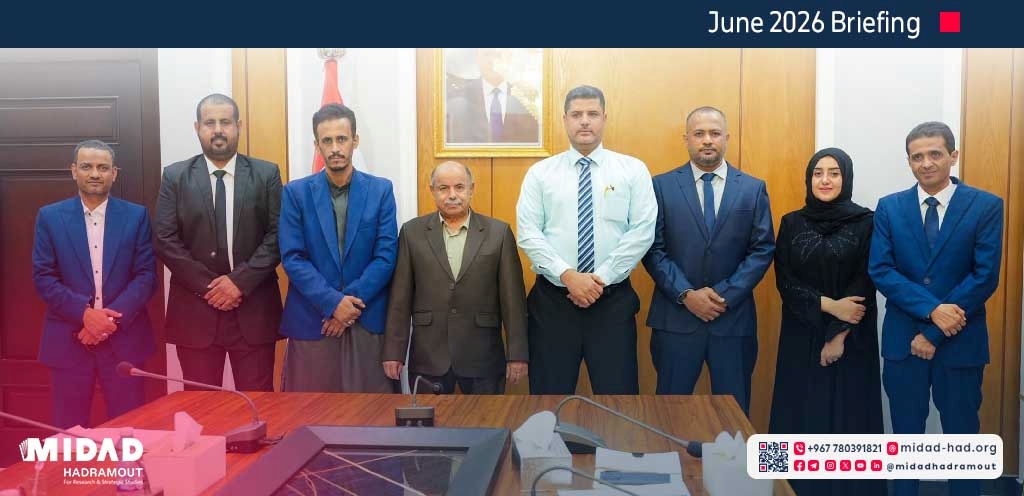


In Hadhramout, all focus was on the nature of the upcoming agreement between the tribal alliance on one side and Governor Bin Madhi on the other. Although there were some signs of a deal, this optimism quickly collapsed after the alliance accused the local authorities of delaying action, which could lead to renewed tension in the governorate. Even though the terms of the agreement were covered in some secrecy and lack of clarity, there was speculation about an agreement on sharing oil revenues.
In other eastern regions, Sheikh Al-Huraizi of Al-Mahra Sit-in Committee emphasized his rejection of the presence of the National Shield Forces, considering them foreign forces. In other regions of Yemen, the focus was mainly on economic reforms and revenue generation for the legitimate government. As for the Houthis, their political speech was dominated by a spirit of threat and suspicion. Abdul Malik al-Houthi accused UN employees of being agents, which led to the arrest of a large number of them. They also held consultations with the UN envoy to implement the road map, while some figures continued their campaign of threats against Saudi Arabia and the coalition, which may indicate a new wave of political tension that could develop into military tension.
October, 1:
- The Houthi group has imposed sanctions on American companies.
- The governor of Hadhramout has issued a resolution appointing a general manager for Doan district.
October, 2:
- Houthi group announces targeting 228 ships as part of their operations in the Red Sea
October, 3:
- The Yemeni prime minister discusses with the UAE president about supporting economic recovery in the face of delays in salary payments.
October, 5:
- The Transitional Council has issued a statement rejecting the agreement between the local authority in Hadhramout and the tribal alliance. It described the agreement as “an attempt to conclude suspicious agreements to legitimize corruption and share interests among the parties involved.”
October, 9:
- The governor of Hadhramout discusses with the Republic’s electricity leadership ways to improve service and solve power generation cuts.
- Southern leader Salah Al-Shanfara criticized Aidrous Al-Zubaidi for his recent statements about adding some areas of Marib and Taiz to the coming southern state
October, 10:
- Presidential Leadership Council affirms its commitment to partnership and solidarity among its members
October, 12:
- The governor of Hadhramout; Mubarak Bin Madhi, has met with a number of members of the parliamentary group of the governorate in a meeting dedicated to discussing the general situation, service issues, and the conditions of citizens.
October, 13:
- Rashad al-Alimi: The legacy of October will remain a flowing lifeline in the minds of Yemeni generations
October, 14:
- The historic city of Shibam in Hadhramout Governorate witnesses a massive public festival on the 62nd anniversary of the October 14 Revolution.
October, 20:
- Bin Habrish discusses with those living abroad the establishment of a coordination framework for the sons of Hadhramout in America
- The commander of the Second Military Region receives a delegation from the UN envoy’s office and discusses with them the latest military and security developments in Hadhramaut
October, 21:
- Hadhramout Governor; Bin Madhi calls on the United Nations to represent Hadhramout in any future settlement
- Inclusive Hadhramout to Grundberg delegation: Self-rule is a “national” option to empower the people of the governorate to take charge of its administration
October, 25:
- Inclusive Hadhramout holds the “Presidential Council” responsibility for the deterioration of conditions in the governorate
October, 26:
- The Presidential Council has approved a set of measures to support the efforts of the government and the Central Bank in promoting fiscal discipline, expanding the revenue base, and proceeding with the preparation of a general state budget with specific spending limits and sources of financing, and requiring all authorities and institutions to transfer funds to the Central Bank in accordance with the law.
October, 28:
- Governor of Hadhramout urges to facilitate customs procedures and increase revenues
October, 29:
- The tribes of Hadhramout and Mahra have signed a “code of honor” that criminalizes smuggling, terrorism, and robbery, and supports the government and the coalition.
October, 30:
- Presidential Leadership Council orders governors to control resources and prohibit collecting fees
October, 31:
- Parliament: State institutions are witnessing corruption in the absence of a system of oversight and accountability
The economic scene in Yemen shows the dark side of the war. The situation is bad in every way. Governorates on both sides of the conflict are suffering from constant or partial salary suspensions. Basic services remain unstable. This month, Aden suffered a complete power failure, which is particularly disastrous for patients with chronic and incurable diseases. The electricity situation in Al-Mahra was not much better. Although conditions in Hadramaut may be better regarding water availability and the absence of disease outbreaks, the difficult economic situation, particularly the interruption of salaries for several months, has had a clear impact on the economic conditions of citizens.
October, 2:
- After prosecution calls have been ignored, 48 illegal commercial facilities in Aden are closed.
October, 3:
- Madooda bridge, education, health, and water projects funded by the UAE in Wadi Hadhramout.
October, 5:
- Anti-corruption agency announces 200 government agencies refuse to deposit their revenues in the Central Bank in Aden
October, 7:
- Import Control Committee urges government agencies to facilitate import financing transactions
October, 9:
- Yemeni government begins paying delayed salaries to employees in the civil and military sectors
- Governor of Hadhramout launches “River of Life” project funded by the Emirates Red Crescent to support children’s treatment
October, 11:
- After its inability to control revenues, the Yemeni government turns to borrowing to pay salaries
October, 13:
- Al-Mahra Gov.: Power station shutdowns have paralyzed life in Al-Ghaydah
October, 16:
- Al-Mahra Gov.: Customs fees increase leads to crisis at shipping port
- Governor of Hadhramout chairs meeting to control prices and activate trade and investment
October, 18:
- Hadhramout Coast Guard rescues fishing boats swept away by floods in Al-Dais Al-Sharqiya landing center
October, 21:
- Partial return of electricity in Aden after securing emergency fuel supplies
October, 25:
- Aden Air (Fly Aden) announces the launch of its first regular flights from Cairo to Aden on October 27
October, 27:
- Governor of Hadhramout instructs to increase electricity supply to Doan to alleviate citizens’ suffering
- Governor of Hadhramout adopts a number of infrastructure projects in Tarim district
October, 29:
- Hadhramout: Traders complain of illegal charges on trucks departing from Shehin customs
The social situation in Hadhramout and Yemen in general remains very difficult. The human rights situation continues to be a major failure for various officials and ruling authorities due to the ongoing arrests, enforced disappearances, and silencing of voices. In Hadhramout, the Yemeni Journalists’ Union branch in Hadhramout, Shabwah, and Al-Mahra have expressed their full solidarity with journalists Fahmi Barmaadah, Abdullah Mumin, Haddad Misaad, and Abdulmajeed Bakhrisa, after they were called by security forces in Seiyun, which led to community mediation to resolve their problem.
However, the difficult situation regarding human rights can be seen more clearly, especially in areas controlled by the Houthi group, with the recent campaign of arrests against United Nations employees. This situation of arrests and human rights reports calling for the release of detainees and those who have been disappeared reveals a deteriorating state of freedoms and rights, which also affects individuals’ ability to express their opinions freely.
As for the humanitarian situation, it has not been any better, with protests continuing in various regions, indicating widespread discontent that could erupt in the near future. These two aspects clearly reflect the worsening conditions throughout Yemen.
In addition, Yemen continues to suffer from water shortages in various regions, particularly in Taiz and Hajjah, threatening the life of thousands, if not millions, of people. We are also seeing this in Aden due to power cuts, which have led to a water crisis. International organizations continue to warn of malnutrition among Yemenis, making the humanitarian crisis in Yemen one of the worst in the world today.
October, 2:
- Hadhramout: Court orders education authorities and local government to pay teachers’ salaries to end strike
- Houthi group releases Asma Al-Omisi after nine years of kidnapping
October, 4:
- UN report: Severe food crisis threatens half of Yemen’s population until 2026
October, 6:
- Human rights agency: Houthi group kidnapped more than 230 citizens during September celebrations
October, 7:
- Houthi group detains 53 UN employees and calls for their immediate release
October, 8:
- Medical staff strike paralyzes health services at Seiyun General Hospital in Hadhramout
- Houthis kidnap Amal Najeeb Qahtan Al-Shaabi, granddaughter of the first president of South Yemen, and the government demands her release
October, 11:
- Governor of Hadhramout sponsors tribal reconciliation ending the case of “the killing of the sons of Al-Talib”
- Al-Mahra police arrested smuggling networks and deported more than 400 illegal immigrants in Shahn
October, 12:
- Order to prohibit hunting of Arabian Ibex (mountain goat) to preserve wildlife in Hadhramout
- Journalists’ Union condemns arrest of Yazid al-Faqih in Taiz and demands his immediate release
- Human rights network: Houthi group commits more than 5,000 violations against the health sector in Yemen
October, 14:
- UN report: Around 15,000 Yemenis IDPs since the beginning of 2025
October, 15:
- Security forces in Aden arrest former Buraika district director Hani al-Yazidi in Aden, then release him
- UN Special Rapporteur warns of escalating torture in armed conflicts, including Yemen
October, 16:
- UN report: More than 470,000 people affected and 82 deaths in Yemen due to heavy rains in two months
- Two boats carrying hundreds of illegal immigrants have been arrested in Shabwa
October, 18:
- Security forces in Aden have arrested Captain Mohammed al-Mutawakel, a civilian pilot, on charges of handing over a Yemeni aircraft to the Houthis. He was later released.
- The Journalists’ Union renewed its demand for the release of journalists Majid Zayed and Oras al-Iryani, who are being held by the Houthis, as well as the rest of those who have been kidnapped.
October, 21:
- 55 modern agricultural machines delivered to promote production in Hadramaut
- Houthi group breaks into offices of three international organizations in Hajjah
- UN announces releasing 20 UN staff members days after they were detained by Houthi group
October, 22:
- Hadhramout Criminal Court sentences six Iranians to death in drug dealing case
October, 25:
- Prisoners and Abductees Commission: Houthi group issues new death sentences against civilians from Saada
- Socotra: Acts of destruction target historic cave and wipe out rare artifacts dating back thousands of years
- Without Restrictions calls on Houthi group to release journalist Al-Sadawi after more than nine years of abduction
- Red Sea Mills announces complete consumption of wheat stocks
October, 26:
- Yemen’s representative to UNESCO warned of the consequences of raising Southern Transitional Council slogans on the walls of the historic city of Shibam, saying that such practices could prevent the city from getting international support and projects to protect its world heritage.
- Intisar Al-Hammadi released after long arbitrary detention and torture in Houthi prisons
October, 27:
- Hodeidah: A 56-million-riyal cash project to support 800 families on Kamran Island
- Houthi group breaks into an area in Taiz twice in two days and kidnaps four citizens
- Houthi group kidnaps Sheikh Ahmed Hamoud Sharhan, one of the tribal sheikhs in Bani Matar in Sana’a
- Yemeni Journalists’ Union calls for an official investigation into the circumstances surrounding the arrest of journalist Mujahid Al-Hayqi in Saudi Arabia.
October, 28:
- The Houthi group kidnaps a number of citizens in Dhamar, including the former deputy for administrative affairs in Dhamar Governorate, Mohammed Ahmed al-Hajri.
- The World Food Programme confirms the suspension of its activities in areas controlled by the Houthi group and the kidnapping of 29 of its employees.
- The International Federation of Journalists calls on the Houthi group to release a journalist and a writer who were detained in Sana’a.
October, 30:
- Amnesty International: US strike on migrant detention center in Saada is a “war crime”
October, 31:
- Houthi group announces the trial of 43 UN employees accused of colluding in the assassination of their leaders
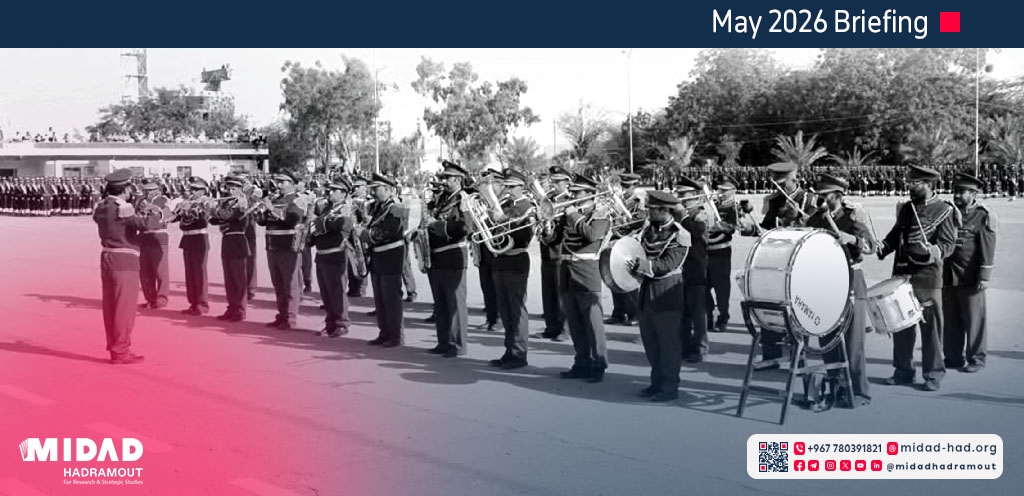
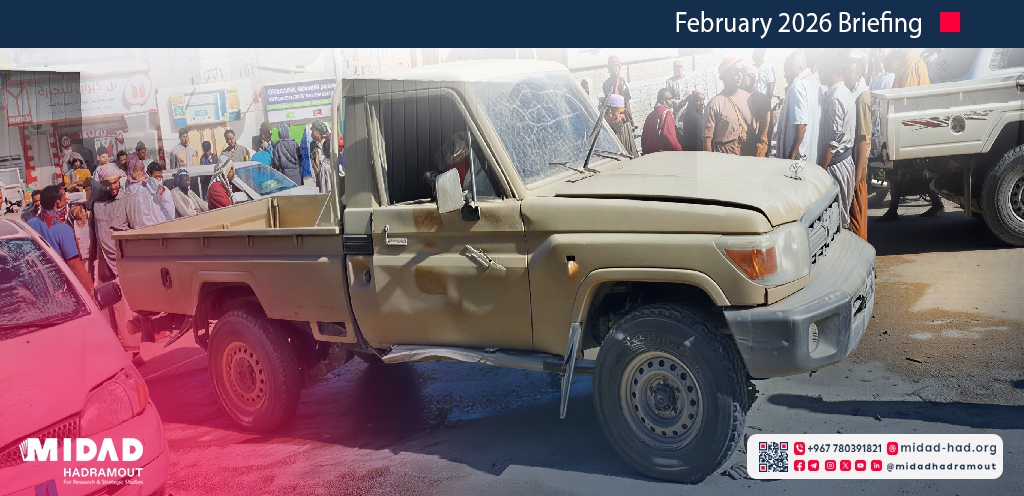
Despite the general calm that prevailed in Hadhramout during October, with the exception of the mysterious killing of Awad Al-Awbthani and the attempted killing of Sheikh Amer Bin Habish, director general of Al-Wadiah land port, Hadhramout has generally remained stable. Perhaps the most important news on the military and security front in Hadhramout was the graduation of the second batch of Hadhramout Protection Forces. This news caused quite a stir and sparked much debate in Hadhramout society.
In the areas surrounding Hadhramout; Shabwah and Al-Mahra, the incidents are limited to clashes in Al-Mahra with drug smuggling gangs and roadblocks on the international highway in Shabwah. We can also observe the efforts of the security forces to seize smuggled drugs, alcohol, and medicines, which has resulted in several successful security operations. There have also been arrests of Houthi smugglers in Al-Mahra and Lahj.
However, the stable situation witnessed some incidents in other areas, particularly in Taiz and Marib, due to the return of irregular clashes in Taiz between the legitimate government and the Houthi group, which led to some human casualties on both sides. At the same time, two assassination attempts took place against important leaders in the national army, including Brigadier General Adnan Razig, commander of the 5th Presidential Guard Brigade in Taiz, and Brigadier General Abdo Al-Mukhlafi, commander of the 22nd Infantry Brigade in Marib. Both attempts failed. However, the assassination attempt was succeed against the staff officer of the Third Battalion in the Third Support and Reinforcement Brigade, Muhammad Al-Fah Al-Yafai, in Mudiyah District, Abyan Gov. As for the Houthi group, it announced the death of several of its members, including Colonel Ibrahim Mansour al-Sudi, as well as Brigadier General Yahya Al-Mutawakkil, in fighting against government forces. The Houthi group also continued its attacks on Israel without achieving any significant success.
The most significant event was the Houthi group’s announcement that their commander, Al-Ghamari, had been killed in an Israeli airstrike. Israel confirmed that it had targeted him in an airstrike in late August.
October, 1:
- The Houthi group claims responsibility for attacking a Dutch-flagged cargo ship as part of their operations in the Red Sea.
October, 16:
- 147 civilians killed and injured in Hodeidah Gov. by Houthi mines over eight months
- The Houthi group confirms the killing of its chief of staff; Mohammed Abdulkarim Al-Ghamari, in an airstrike at the end of August.
October, 18:
- The governor of Hadhramout, Mubarak bin Madhi, has instructed the security services to quickly track down the killer of 17-year-old Awad Al-Aubthani, who was found dead in his car after being missing for several days.
October, 19:
- The governor of Taiz announces the arrest of all those wanted in connection with the murder of Afthan al-Mashhari, excluding the motorcycle driver. This statement comes a month after Afthan’s murder, which sparked widespread condemnation.
October, 20:
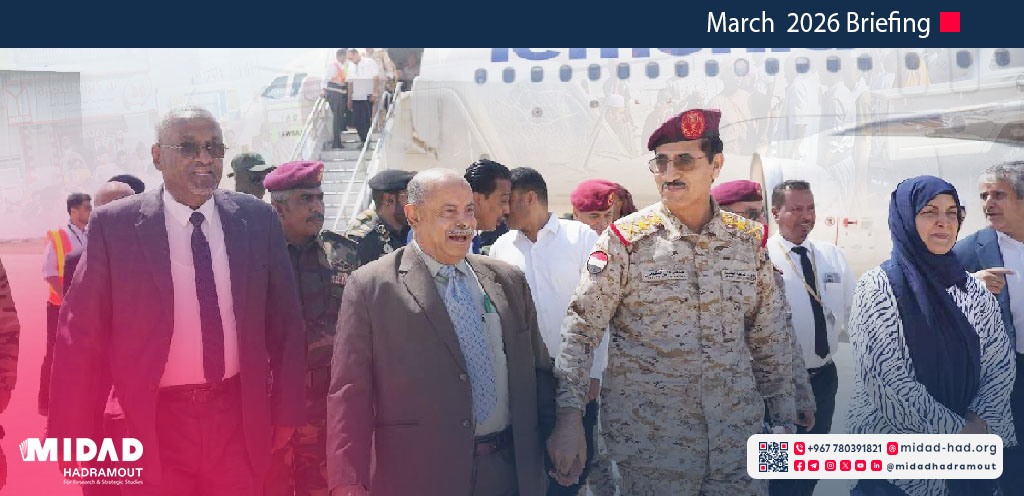
- The Minister of Defense of the legitimate government, Lieutenant General Mohsen al-Daari, visits Taiz and attends a military parade. This visit comes after rising tensions in Taiz between government forces and the Houthi group.
- Forces belonging to the Sixth Military Region of the National Army deployed in the eastern areas of Al-Jawf Governorate to cut off smuggling lines and secure international roads and supply lines for the armed forces. These movements were accompanied by the spread of the First Military Region in Wadi Hadhramout to Al-Mahra in an attempt to cut off smuggling roads.
October, 21:
- Al-Qaeda attacked the government complex in Al-Mahfad District, Abyan Governorate, which is the headquarters of the First Support and Reinforcement Brigade. The attack was conducted using two car bombs, along with armed clashes led by five members of the organization, resulting in the death of four security forces.
- On the occasion of the defection of Brigadier General Salah al-Salahi, commander of the Houthi group’s 10th Brigade, the government army renewed its call for Houthi fighters to drop their weapons and avoid involvement in terrorist crimes committed against Yemenis.
- Armed elements broke into a prison in the temporary capital, Aden, and violently took one of the prisoners.
October, 22:
- The temporary capital of Aden witnessed one of the largest drug destruction operations in recent years, where the Specialized Criminal Prosecution burned more than a ton of drugs that had been seized in separate security campaigns over the past few months.
- Security forces have arrested a wanted man accused of blackmailing a minor over a period of three years and stealing large sums of money of more than 40 million Yemeni riyals.
October, 26:
- Security forces in the temporary capital of Aden arrest Sameh Saif, director of sewage in the Sheikh Othman district, while he is performing his daily duties.
- Masam project announces the removal of 805 mines and unexploded explosive devices in Yemen in one week.
October, 27:
- The National Army announced the shooting down of a Houthi drone in Al-Jawf Governorate.
October, 28:
- Armed men in military uniforms break into a currency exchange company in Marib and steal 4 million Saudi riyals.
- Tribal gunmen cut the international road linking Aden, Shabwah, and Al-Abr, and blocked government trucks from passing through the Habban district in Shabwah Governorate, demanding the release of Sheikh Saleh bin Daabi al-Qamishi, who is being held by security forces.
October, 29:
- Abyan Governorate Police Department announced the arrest of security checkpoint members involved in blackmailing an Egyptian truck driver in Ludr District, after video footage documenting the incident was shared online. Abyan Police said in a statement that it had arrested the checkpoint commander and five other members.
October, 30:
- The commander of the Sixth Military Region visited a number of army units and sites located in the eastern desert sector of Al-Jawf Governorate. He stressed the importance of securing the desert road against smuggling.