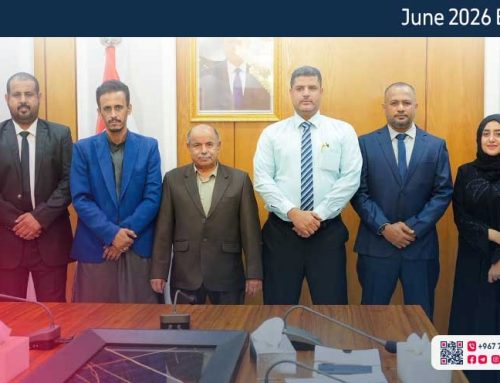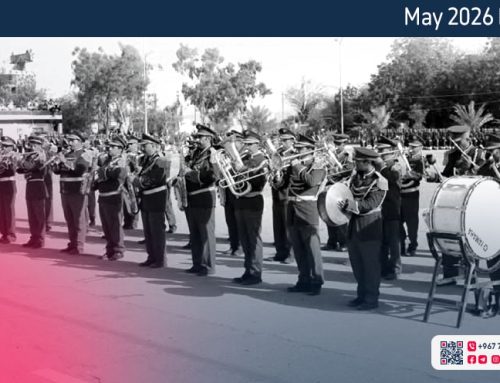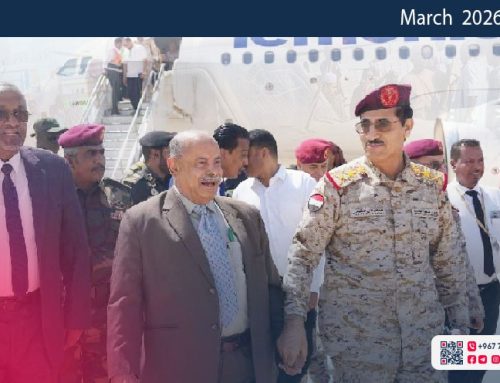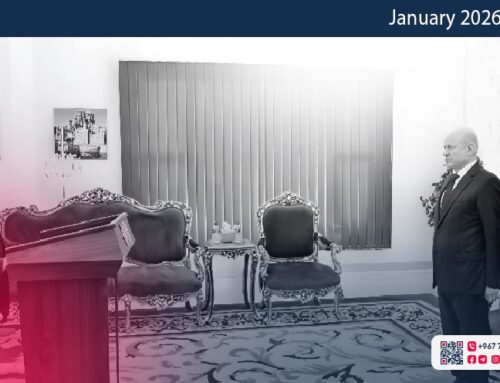

February was the month that marked a political coup resulting from military events in the previous month, particularly the removal of Southern Transitional Council (STC) forces from the eastern governorates. Following this, there were rapid political developments, most significantly the dissolution of STC. All of the political events in February were the result of the major political and military changes that took place last month.
The most remarkable event was the establishment of a new government, which was formed after a long period of discussions and nominations from various parties. Although the establishment of the new government marked the beginning of a new chapter and a new phase, turning the page on STC. There are many expectations and sensitive issues that the government must resolve, perhaps most importantly the regular payment of salaries to citizens in all sectors, the improvement of services, the cessation of public money bleeding and illegal tax collection, and the restructuring of the armed forces. These are complex issues that previous governments have been unable to resolve.
However, there has been much criticism aimed at the government. The most prominent criticism following the announcement of the government was due to its large number of members; the new government consists of thirty-five ministers. This makes it the third largest government in terms of numbers since reunification in 1990 to date. The main reason for this criticism is that the country is at war and in a difficult economic situation, with millions of Yemenis suffering from difficult economic conditions. Therefore, establishing a large government in these circumstances is a grave mistake.
Another criticism was the re-appointment of many old officials, especially those who had previously failed to make any progress during their time in previous governments and who are suspected of financial and administrative corruption, as well as figures involved in supporting the rebellion of STC. Many ministers who were considered part of the transitional government were appointed to certain ministries in the new government. Some of them still refuse to raise the Yemeni flag or put up a picture of the president of the Presidential Leadership Council. These criticisms mainly focus on the fact that reappointing these figures is a reward for their support of the transitional rebellion. Furthermore, it is impossible to form an effective government if some of its ministers do not recognize the state, nor do they recognize the head of the Presidential Leadership Council.
The Deputy Foreign Minister justified this by saying that this government includes all political parties, which guarantees fair representation for all sides. It is possible that this broad political formation will be used to ensure support for any future military operation against the Houthis.
Internally, however, STC group loyal to Aidrous rejected the resolution to dissolve the council and called for several mass demonstrations in various areas of the south. STC demonstrations took place in Al-Dhale, Seiyun, Mukalla, Aden, and Ataq, with minor movements in Al-Mahra as well.
These actions indicate a state of inflexibility on the part of STC members who reject the dissolution of STC, as this group continues to call for further escalation. Although the government has included some figures loyal to STC, the Council continues to reject any kind of settlement. These steps by STC put a lot of pressure on the government, especially since they led to security chaos and a number of injuries and deaths, which we’ll talk about in more detail in the security section. However, STC has shown a degree of resistance to any attempt to reach a solution, rejecting the governor of Shabwah’s resolution to form a committee to investigate the events.
In the context of the Transitional Council, a broad group of leaders and members of what is known as the “National Assembly and Council of Advisors of STC” in Aden renewed their support for the resolution to dissolve STC, preparing the step to give priority to the higher interest and avoid conflicts. They called for engagement in Riyadh dialogue as a path to resolving the southern issue, unifying ranks, and ensuring stability. This step has deepened divisions within STC itself, which is split between a group that rejects the resolution to dissolve the Council and another that sees it as a logical step. This could undermine the Council’s ability to mobilize and convince people in the southern regions.
Hadramaut forces also expressed their rejection of the new government, represented by the Hadhramout Tribal Confederacy and Inclusive Hadhramout Conference, who believed that the government was formed on the basis of parity between the north and south, ignoring the significance and role of Hadhramout. This has increased the number of voices rejecting the newly formed government.
In another context, the Presidential Leadership Council announced several resolutions to change some military and service positions in Hadhramout and other regions in general, in an attempt to normalize the situation in line with the political and military changes that have taken place.
In areas under Houthi control, the Houthis have escalated their threatening discourse against Israel, especially with the start of the Israeli-Iranian war. Houthis have declared their willingness to engage in any battle against Israel and its allies, which may indicate a new campaign of escalation.
Top News:
February 2:
- The Yemeni presidency describes the Houthis’ prevention of a plane from landing at Mokha airport as a terrorist act and calls for international action.
- The European Union condemns the breaking into Adan Al-Ghad newspaper office.
February 3:
- Al-Khanbashi discusses the latest developments in Hadhramout and Yemen with the UN envoy’s team.
February 4:
- The government negotiating delegation is heading to Jordan to finalize the biggest prisoner exchange deal with Houthis.
February 9:
- The UN Special Envoy for Yemen welcomes the establishment of the new government and emphasizes the importance of creating a stable environment for its work.
February 10:
- Hadhramout governor has issued a package of resolutions appointing new officials to a number of vital positions in the governorate, including maritime affairs, Seiyun district, National Women’s Committee, social affairs, industry and trade, and legal affairs.
- The President of the Presidential Leadership Council: Dealing with Houthis as a political party is a mistake that prolongs the war. Yemen is closer to recovery than it has been in years.
February 11:
- A large public festival in Marib to celebrate the anniversary of the February Revolution.
February 13:
- Britain before the Security Council: Full support for the new Yemeni government and the unity of Yemen.
February 14:
- The dissolved STC rejects the committee formed by the governor of Shabwah to investigate the latest events in Ataq.
February 16:
- STC announces its rejection of any ministers from the northern governorates in Aden.
- Al-Khanbashi emphasizes the unity of Hadhramout to support the governorate’s demands.
February 19:
- Prime Minister: Regular payment of salaries is a top priority… We will remove the camps from Aden to unify security decisions.
February 20:
- National Coalition of Parties: Chaos threatens government and obstructs improvement of services in Aden.
- Yemeni presidency promises to bring those behind the chaos in Aden to justice.
February 23:
- Announcement of “Aden Federal Council” to promote stability and unify Aden’s political components.
- Closure of the General Secretariat building of the dissolved STC in Aden.
February 26:
- Al-Khanbashi reveals an expanded Hadrami meeting in Saudi Arabia to present a Hadrami vision for the Southern Dialogue Conference.
February 28:
- The Presidential Leadership Council warns Houthis and rejects the use of Yemeni territory as a platform for cross-border attacks.
The economic part is one of the most essential parts through which the political changes experienced by the liberated areas in recent times can be assessed, as it is most closely related to the daily lives of citizens. In particular, the economic reforms begun by Prime Minister Ben Brik have so far failed to achieve sustainable economic results.
The Prime Minister and the President of the Presidential Leadership Council have previously emphasized that economic reforms and improving living conditions are the priorities for the government and the Presidential Leadership Council at this time. This concern has been reflected in the immediate focus on providing salaries to citizens, which has been accompanied by significant Saudi funding to cover these salaries.
The continued payment of salaries across all sectors will be the most crucial step, not only to gain popularity and secure citizens’ support for the new government and the Presidential Leadership Council, but also to normalize conditions in the liberated areas. It may even convince citizens in areas controlled by the Houthi group of the success of the legitimate government model.
Meanwhile, the government announced its budget for 2026, which is an significant step in its attempt to control the country’s public budget. This includes drying up sources of revenue evasion, which is the most serious economic problem facing the legitimate government. Despite the government’s focus on this aspect and repeated instructions at various political and economic levels from the government and the Presidential Council. However, this issue is also linked to deep-rooted lobbies and many parties that benefit from these collections and huge economic resources, which may be an obstacle to any urgent solution.
As for services, despite the general improvement in various regions, including Hadramaut and Aden, the eastern and southern governorates suffered from a domestic gas crisis during the holy month of Ramadan, which may cause public discontent. Socotra also suffers from problems with electricity sustainability. Due to the repercussions of UAE withdrawal, UAE has regained control of power stations, using remote encryption devices. This has created a challenge for local authorities to provide stable electricity to the archipelago. The impact of the UAE’s withdrawal was also reflected in the withdrawal of a Canadian company from UAE-funded Hassan Dam project in Abyan, which is one of the most significant strategic projects in the governorate. This opens the door to a threat to the lives of citizens.
In Hadhramout, as well, a broad monitoring campaign has been launched in the markets of Wadi Hadhramout to control prices and protect consumers, especially with Ramadan coming at the end of February, which requires greater monitoring efforts by the relevant authorities. Mr. Al-Khanbashi also announced the signature of an agreement to increase Hadhramaut’s electricity capacity by 200 megawatts. Despite the significance of this news, the reality of the electricity situation will be the deciding factor.
The liberated areas also suffered from a shortage of local currency liquidity. The main reasons for this crisis are psychological factors and a lack of confidence in the official banking system and the economy in general, which are the main causes of the continuing local liquidity crisis. This means that any economic reforms are primarily linked to solving this problem. The Central Bank has taken steps to resolve this problem. It has ordered commercial banks and major money changers to buy foreign currency from citizens with a daily limit of 10,000 Saudi Riyals per person, at a fixed exchange rate of 410 Yemeni Riyals to one Saudi Riyal, to provide liquidity in the national currency. It also confirmed its commitment to buy back foreign currency from banks and money changers to cover import bills and strengthen the stability of the money market.
Top News:
February 3
- Yemenia launches “Jeddah-Socotra” line to promote tourism and connect the archipelago internationally.
February 4:
- The first shipment of domestic gas arrives in Socotra.
- With German funding, $2 million pier project for a fish market in Aden.
February 6:
- The European Union announces the completion of a relief bridge with about 300 tons of medical aid to Yemen.
February 10:
- Start of the final phase of rehabilitation of the strategic Al-Abr-Marib road, funded by Saudi Arabia.
February 16:
- The Minister of Transportation promised to end the suffering of travelers and gave Yemenia Airways one week to reduce ticket prices.
- United Nations: 64% of Yemeni families do not have enough food.
February 17:
- Badr Baslama, Minister of Local Administration, gives orders to cancel illegal taxes and fees.
February 18:
- A government source announces the start of salary payments for employees for the month of January.
February 25:
- Saudi Arabia dedicates 1.3 billion Saudi riyals to fund salaries for Yemeni government employees.
February 26:
- The Minister of Electricity confirms that there is a government plan to improve the stability of the electricity supply in Aden.
On the social part, human rights reports dominated the news following the break-in of Aden Al-Ghad newspaper by armed men belonging to STC. Many human rights organizations condemned this attack, especially since the newspaper has a wide presence and significant influence.
Ministry of Legal Affairs of the legitimate government was also very active during the month, attempting to focus on crimes committed over the past few years. National Investigation Committee conducted several field visits to prisons and detention centers in various regions, including Shabwah, Taiz, Marib, and Aden. It also conducted an investigation into crimes committed in Al-Hodeidah.
The National Commission intensified its field visits to prisons and detention centers in Marib, Shabwah, Aden, and Taiz, and inspected the conditions of hundreds of prisoners and detainees, including more than 620 detainees in Aden. It also listened to the families of detainees from Al-Mokha, Al-Shamaytin, and Al-Maqatrah. Its activities included inspecting Criminal Investigation Prison and military detention centers.
The significance of these actions lies in the fact that they reveal the human rights situation of a large number of forcibly disappeared persons and prisoners who have served their sentences but remain in prison. This is a complex issue, with much of it still kept secret.
Solving this issue will reinforce citizens’ trust in the security authorities, which will be clear evidence of the new approach taken by the new government with regard to security issues and the promotion of the rule of law. Despite all these measures, no prisoners have been released, nor have any security or military leaders been charged with crimes related to enforced disappearances. In addition, there are still many unresolved cases involving hidden figures whose fate remains unknown despite media coverage and public pressure.
This also came at a time when popular demands and public gatherings calling for the disclosure of the fate of those forcibly disappeared. Despite visible government action and popular mobilization, nothing tangible has been achieved so far.
Meanwhile, the health sector is facing even greater difficulties. Health Minister has warned of a funding crisis that threatens the operation of most health facilities in Yemen, especially as this comes at a time when a large number of diseases such as malaria, cholera, measles, dengue fever, and others are spreading. This makes any collapse of the already fragile health system an even greater threat to the lives of citizens.
Top News:
February 1:
- Aden Al-Ghad calls for an investigation into the armed attack on its headquarters.
February 2:
- Yemeni Ministry of Legal Affairs: Serious crimes and grave violations committed by officials, Emirati officers, and foreign mercenaries.
- More than 1,000 measles cases and eight deaths in government-controlled areas during January.
February 4:
- Human Rights Watch: Parties to the Yemeni conflict committed serious human rights violations in 2025.
- More than 2,800 people internally displaced in Yemen during January.
- Families of enforced detainees hold a protest in front of the judicial complex in Mukalla.
February 8:
- Aden: Protest in front of the coalition headquarters demanding disclosure of dozens of disappeared persons.
February 10:
- Death of a UN employee in Houthi prisons.
February 15:
- The National Committee for Investigation listens to dozens of testimonies in Shabwah from victims of torture and enforced disappearance.
- 41 prisoners are released in Hadhramaut under the direction of the Attorney General.
- 14,000 confirmed cases of malaria in Taiz in 2025, with warnings of a health disaster.
February 17:
- An organization documents more than 8,000 Houthi violations in Al-Jawf during 2025.
- Hajjah: Drought strikes, and the district’s residents race against time to find water.
- United Nations: Climate crisis in Socotra threatens food security and livelihoods.
February 26:
- World Health Organization announces the arrival of a shipment of medicines to Aden to combat malaria.
- The Houthis release journalist Al-Mayahi after detaining him for about 17 months in Sana’a.
After the security and military upheaval that occurred in January, particularly in the eastern regions, represented by the battle to take control of the camps and expulsion of STC forces. February was quietest in all respects. Despite STC’s movements and its continuous calls for demonstrations and gatherings, February did not bring many surprises.
STC’s actions began on February 1 in Seiyun in Wadi Hadhramout. These actions were accompanied by an attempt to break into Seiyun International Airport to raise the southern flag, which in turn led to a number of injuries. On February 5, Al-Dhale witnessed a gathering of supporters of STC, before it returned to Hadhramout again on February 10, specifically in Mukalla city, to condemn the resolution to dissolve the Council. The most violent demonstration in February left at least five people dead and around 30 wounded. The local authority in Shabwah accused armed persons among the demonstrators of opening fire on security forces in an attempt to storm the local authority building.
STC also expressed its rejection of the return of the government and ministers from the northern regions to Aden, which resulted in an attempt to break into Al-Mashik on February 19, resulting in one death and several injuries. STC concluded its actions against the dissolution of the Council and the return of the government with protests in Aden’s Demonstration Square on February 27.
The actions of STC, its attempts to break into the governorate headquarters in Shabwah, and its use of live fire against security forces indicate a clear desire to cause confusion and create chaos and insecurity. These actions also show that STC has become a source of instability rather than a political entity seeking to achieve political gains.
In another context, the legitimate government today faces two major challenges. The first is normalizing conditions in the liberated areas, and the most prominent challenge in this regard is that STC is still actively working to undermine any attempt to establish security and stability. The most difficult challenge is restructuring the forces. Indeed, despite repeated assurances from the legitimate government and the leadership of the Presidential Council, progress remains extremely slow. The difficulty arises from the multiplicity of forces and militias and their loyalties. A large number of these forces remain loyal to the separatist project, even if they have formally joined under the flag of unity and the republican logo.
Security forces also closed a number of headquarters of the dissolved STC in Aden. The main aim of this campaign is to politically isolate STC and reduce or end its political presence as an independent political entity in the temporary capital, Aden. In other words, it aims to return STC to its early stages before it became a mini-state within a state in Aden.
The government is moving on both paths; it is bringing in more military reinforcements to any area where any kind of instability arises. Significant military reinforcements have arrived in Aden and Ataq after the chaos that the two cities experienced due to the demonstrations by STC
Meanwhile, restructuring appears to be a more difficult process. Although the government has removed a number of top leaders who identified with or supported the transitional rebellion, such as Defense Minister; Al-Da’ari and other influential military leaders, including those in the Second Military Region, the most significant challenge will be breaking up the forces loyal to the transitional government in Aden.
The Presidential Leadership Council issued several resolutions to replace a number of powerful military commanders loyal to STC, such as Jalal Al-Rabie, who was appointed commander of the Special Security Forces in Aden. It is clear that the Leadership Council is not attempting to confront these leaders, but rather to gradually reduce their influence and power. Obviously, restructuring the forces and bringing together all the forces, including those that support Aidrous Al-Zubaidi’s project that rejects reconciliation with Saudi Arabia, is the most difficult minefield facing the legitimate government. However, it is the most important decision at the present time.
In the same context, Al-Mahrami’s decisions regarding the replacement of military commanders in Abyan were widely controversial. Abdulrahman Abu Zarah Al-Mahrami, a member of the Presidential Leadership Council, appointed Colonel Hani Hussein Al-Sunaidi as commander of the National Security Forces in Abyan Governorate. The first controversy concerned Al-Mahrami’s position when he made these decisions, in his capacity as commander-in-chief of the southern armed forces, which is clearly incompatible with his duties as deputy in the Presidential Leadership Council. The second controversy was the general rejection of these decisions in Abyan, which has increased the chaos and rebellion against government decisions.
As for the battlefronts against the Houthi group, there has been a significant escalation on the Hays/western coast front, where the Houthi group attempted to break through the front using heavy and medium weapons, but their attempt ended in failure. This escalation comes in light of the Houthi group’s general state of military mobilization. The group declared a state of emergency and military and central preparations. Measures included raising the readiness of government and private hospitals, equipping emergency departments, and requiring medical staff to sign written pledges. Furthermore, the role of civil defense in rescue operations and in limiting human and material losses was strongly emphasized. These measures may be linked to some kind of military escalation, or perhaps preparations for the impact of regional war on the group as well.
Top News:
February 3:
- Taiz security and military leaders announce a comprehensive coordination plan to counter any potential threats.
February 9:
- Lahj: Forces of the Fourth Brigade prevent a national committee from reaching disappeared prisoners.
February 10:
- More than 21,000 African migrants arrive in Yemen within a month.
February 11:
- Rashad Al-Alimi issued a resolution to appoint new leaders in the First Military Region, including; Fahd Salem Bamoumen as commander of the region with promotion to the rank of major general, Amer Bin Hatian as chief of staff, and Mohammed Bin Ghanem as chief of operations.
February 13:
- Emergency Forces units arrive in Shabwah after an armed attack on the local government building.
- Graduation of a new batch of Yemeni Emergency Forces, consisting of the largest number of members.
February 15:
- The Houthi group surrounds Sheikh al-Ahmar’s house in Sana’a and commits widespread harassment.
- Tribal pressure obliges the Houthis to release prisoners in Ibb Gov.
February 16:
- Minister of Defense, operations indicator heading towards the capital Sana’a.
- Four hundred and fifty thousand Captagon pills seized in Lahj
- Taiz, The army announces the opening of the “Al-Madina-Al-Hoban” road 24 hours a day during the month of Ramadan.
February 17:
- Deputy President of the Presidential Leadership Council Al-Sabihi chairs a meeting to discuss arrangements for combining military units.
February 18:
- Al-Salib military checkpoint in Hadhramout prevents the smuggling of prohibited weapons and arrests a suspect wanted by security forces.
February 20:
- National Shield Forces secure vital points in Aden after an attempt by supporters of the dissolved Transitional Council to break into Al-Ma’ashiq.
- The Houthi group announces the death of one of its officers in clashes with government forces.
- The Giants Brigades send large military reinforcements from Lahj to Aden.
February 21:
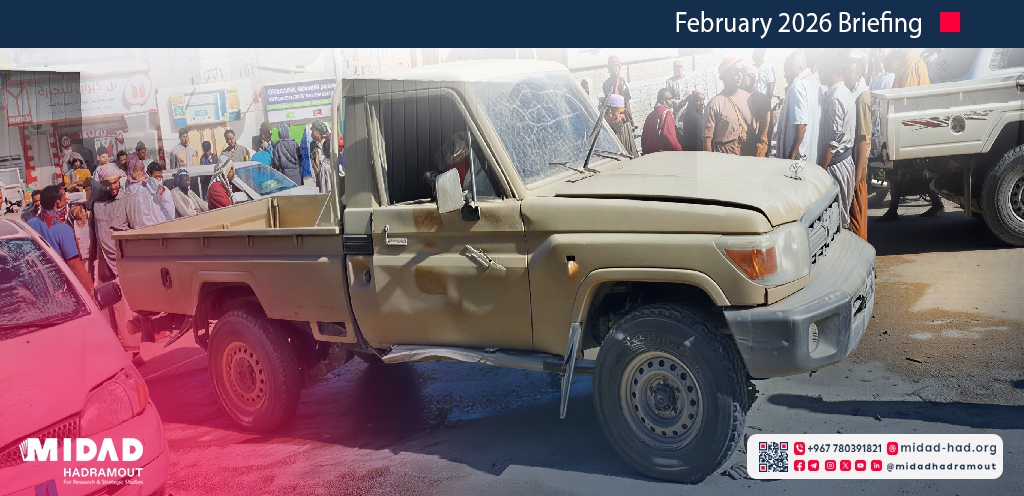
- An explosive bomb exploded in a military vehicle in Seiyun – Hadhramout.
- STC said that some of its activists were arrested after breaking out Al-Ma’ashiq building.
February 24:
- Al-Alaimi issues two resolutions appointing a commander for Special Security Forces and a head of Civil Defense Authority.
February 25:
- A quantity of smuggled weapons has been seized in Hadhramout, Yemen.
February 26:
- Members of the dissolved STC are protesting against the closure of the headquarters which they used for their activities.
February 28:
- Hadhramout: 1,681 mines destroyed in Mukalla.
Your Content Goes Here