

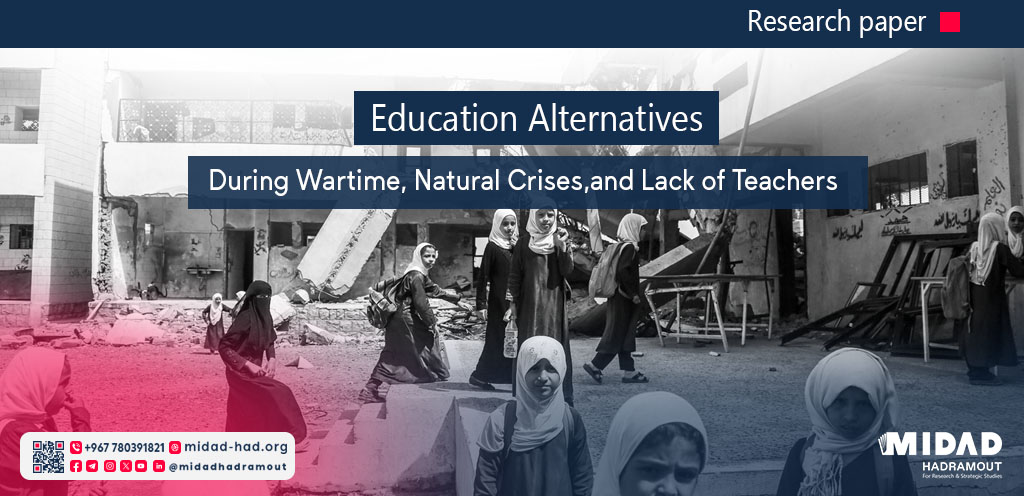
Education Alternatives During Wartime, Natural Crises,
and Lack of Teachers
Review Paper
Research Paper to Participation in the Second Conference under the
Theme of Education and War in Yemen, Reality and Challenges
Researcher Dr. Hussein Salem Mubarak Barabwd.
PhD in Educational Administration
Assistant Professor, Hadhramout University
Senior Researcher at the Midad Hadhramaut Center for Research and Strategic Studies, specializing in education and upbringing issues
Executive Director of Al-Ahqaf International Schools in Mukalla
———————————————————————————-
Cover photo: One of the schools in the conflict-affected areas of Yemen.
Abstract
It is a political and ethical commitment of countries to protect students, educators, educational institutions, and communities during wartimes and or crises. Not only that but countries also should maintain education during conflicts or natural crises through multiple educational alternatives. The major goal of the current review paper is to identify the educational alternatives during wartime, natural crises, and lack of teachers from the published papers during the past six years. The identified educational alternatives could be implemented by countries during such situations to maintain education. The researcher utilized the descriptive approach, particularly the integrative literature review for the published papers from (2019-2024) that fall under the keywords of the current research. Then a purposive sample was used to select the papers that cover one or more of the three sub-questions of this research. (12) out of (20) papers were selected and analyzed to identify the educational alternatives during war, natural crises, and lack of teachers. The results revealed (22) educational alternatives can be used by countries during war, natural crises, and lack of teachers. The most impactful 10 of them are mentioned here as follows: Radio-Enabled Learning, Community-Based Learning or Popular Education, Multigrade Teaching, Mobile Schools, Online Learning, Homeschooling, WhatsApp Messenger, Open Distance Learning (via social media education), Remote and Hybrid Learning, and E-Learning Applications. Discussion of every one of these alternatives was provided and further studies were recommended.
Keywords: Educational alternatives during war, crisis, and lack of teachers.
- Introduction
Education is a crucial service to be provided to individuals and communities by their countries; not only that, but it has to be one of the main priorities of countries either during peace or wartime. (Porowski et al., 2014; Salha et al., 2024a). Therefore, countries launched education alternatives during wartime or long natural crises like the era of the COVID-19 Pandemic in 2019 (Byun & Slavin, 2020; Castilla et al., 2022; Charalambous & Papademetriou, 2024), or during the Bosnian War 1992–1995 (Salha et al., 2024a) lastly during Israel’s war on the Gazza Strip in 2024 (Schultz et al., 2024). Scant data about how education is maintained during wartime shows the right to education even during such contexts. The relationship between education, security, and stability is highly acknowledged. Therefore, during war or natural crises, access to quality education becomes more challenging, and conversely. (Salha et al., 2024). However, researchers have coined the terms education in emergencies like emergency remote education, emergency remote teaching, online education, and online teaching as educational approaches that can be implemented during emergencies. (Bozkurt et al., n.d.; Geovanny et al., 2022). However, it is not an easy task to implement online education or teaching, especially in poor countries due to the need for technological infrastructure (Geovanny et al., 2022). However, some studies provided multiple education alternatives that can be executed during wartime or long natural crises like the studies of (Porowski et al., 2014; Salha et al., 2024a). The current research, therefore, addresses this gap by reviewing the literature to identify multiple education alternatives during wartime, natural crises, and lack of teachers.
- Problem Statement
In the context of armed conflict, traditional education systems always face major disruption, severely undermining their ability to provide consistent and effective learning environments. This is because wars may close educational institutions, infrastructure might be damaged, and educators may become displaced. This conflict not only limits access to education but also hampers the social and psychological life of children caught in that area (Barnes, 2005). Also, in national crises there has been a drastic change in how teaching and learning happen while learners are physically out of school like the time of the Covid-19 pandemic (Bozkurt et al., n.d.) Therefore, the shift from conventional education to alternative models can appear as a necessary response to these challenges. Thus, the problem statement of the current research could be stated clearly in the following question.
- Research Questions
What are the education alternatives during wartime, natural crises, and lack of teachers?
The main question was broken out into three sub-questions to focus on the three domains of the research problem.
- What are the education alternatives during wartime?
- What are the education alternatives during natural crises?
- What are the education alternatives during lack of teachers?
- Research Objectives
The major purpose of the current research is to identify education alternatives during wartime, crises, and lack of teachers. It will be broken out into three sub-objectives as follows:
- To find out the education alternatives during wartime.
- To find out the education alternatives during national crises.
- To find out the educational alternatives during lack of teachers.
- Research’s Significance
The present research’s significance comes from the difficult situation of children under the age of school who are out of school due to the war either in Yemen for almost one decade or in any other country. So, it sheds light on educational alternatives that can be used during war, natural crises, or even a lack of teachers.
- Definition of Research Terms
6.1 Education alternatives
Education alternatives are often used to describe educational approaches that are different from those offered in mainstream schools. However, there is a shortage of a commonly accepted definition of alternative education that reflects the fluidity of related policies and diversity of contexts and settings and the various groups of those who are targeted by alternative education (Aron, 2006; Porowski et al., 2014). Also, it is crucial to mention that in some studies the “term education alternative” is used interchangeably with “alternative education” which was defined as “alternative education in its broadest sense and covers all educational activities that fall outside the traditional K-12 school system (including homeschooling, special programs for gifted children, charter schools, etc.)” (Aron, 2006).
The U.S.A. Department of Education defines an alternative education school as “a public elementary/secondary school that addresses needs of students that typically cannot be met in a regular school, provides nontraditional education, serves as an adjunct to a regular school, or falls outside the categories of regular, special education or vocational education” (Aron, 2006).
For this research, the researcher defines the term education alternatives as all approaches, programs, techniques, learning applications, and activities that can maintain education during wartime, crises, and lack of teachers for students under the age of k-12.
6.2 War
Some researchers defined war as a political act between countries and others as an armed conflict between populations; for instance, Sorel defined war as a “political act using which States, unable to adjust a dispute regarding their obligations, rights or interests, resort to armed force to decide which is the stronger and may therefore impose its will on the other” (Van Der Dennen, n.d.).
However, Johnson defined war as “armed conflict between population groups conceived of as organic unities, such as races or tribes, states or lesser geographic units, religious or political parties, economic classes” (Van Der Dennen, n.d.). This definition is more general because it does not limit the armed conflict to political units only but includes any type of population unit that is capable of resorting to arms as a method of settling disputes. Therefore, the researcher adopted this definition for the current research because it is equivalent to Yemen’s situation.
6.3 Crisis
A crisis is identified as an abnormal situation that shows a high business risk and may trigger speed public policy changes since it draws public and media attention and threatens public trust (Sawalha et al., 2013). Also, Beall (2007) has mentioned that in an organizational context “crises are usually new situations to the organization, often defined as unexpected, definitely unstructured and outside the typical operational framework of the organization”.
For the sake of this research, crisis means all-natural disasters that can take a long time such as Covid-19 which hit the entire world in 2019 (McNamee et al., 2024).
6.4 Lack of Teachers
Teachers lack and subsequent teacher recruitment initiatives are not new to the K-12 education system. For example, in the early and mid1980s, a series of highly publicized reports trumpeted an almost identical series of diagnoses and prescriptions (Ingersoll, 2003). Indeed, the lack of teachers has been a cyclic threat for decades even in the United States (Ingersoll, 2003). Due to the difficulty in finding a definition for this term, the researcher defines it to be understood for this research as follows: Lack of teachers means the shortage of the numbers of teachers against the number of students aged from K -12 during the war and natural crises. Yemen particularly, has experienced different types of reasons behind the lack of teachers one the most important is war and the economic status of the country.
- Research Methodology
The researcher will use the descriptive approach content analysis, particularly the integrative literature review. An integrative review is a type of non-systematic review aiming to cover “new or emerging topics that would benefit from a holistic conceptualization and synthesis” (Salha et al., 2024b). This integrative review research will present education alternatives from literature to shed light on the education alternatives during wars, crises, and the lack of teachers. The justification for selecting the integrative literature review is that it covers knowledge from several sources in different types (Almeida & Goulart, 2017; Kordzadeh & Ghasemaghaei, 2022). The researcher googled the keywords of the research namely “education alternatives during wars, education alternatives during crises, and education alternatives during lack of teachers” in the two platforms ERIC and Google Scholar. Then a form was designed to summarize the themes that emerged from education alternatives in the reviewed papers. The identified education alternatives can serve the situation in Yemen due to its suffering from war, natural crises, and a lack of teachers at the same time and it might serve other countries as well those who fall under the same catastrophes.
7.1 Research Community and Sample
The community of the research is all papers that fall under the results of googling the keywords of this research and they reached 20 papers. However, which was utilized a purposive sample for the papers that cover one or more of the three sub-questions of this research and they reached 12 papers.
7.2 Research Limitations
7.2.1 Topic Limitation
The topic limitation of the current research is limited to the published papers that can be reached under the following keywords “education alternatives during wars, education alternatives during crises, and education alternatives during lack of teachers”.
7.2.2 Time Limitation
The time limitation for this research is limited to the published papers within the last six years only from (2019-2024) in the two platforms Education Resources Information Center ERIC and Google Scholar.
7.3 Research Validity
For validity, the researcher has gone through all related published papers and after getting the main themes for the three concepts concerning education alternatives during wars, crises, and lack of teachers then he asked another researcher to read the papers to get her themes to be compared for the sake of validity.
7.4 Data Collection and Analysis
The research googled research keywords in both ERIC and Google Scholar platforms and selected each paper that falls under these keywords using a purposive sample. Then all chosen papers were read and classified based on the three sub-questions of this research. To report the results a form was designed to have the following items (the paper’s title, country of the field study, educational alternatives stated in the paper, author and publication year of the paper). After that, the extracted themes were discussed as education alternatives during the war, natural crises, and lack of teachers. The data analysis used descriptive approach content analysis, particularly the integrative literature review(Salha et al., 2024a).
- Results and Discussion
In this section, the themes extracted from reviewed papers were shown on tables and then briefly discussed for an in-depth understanding of the education alternatives during the war, crises, and lack of teachers. The results were shown based on the three research sub-questions respectively as follows.
8.1 Education Alternatives During Wartime.
- What are the education alternatives during wartime?
Table (1) Shows the Themes of Education Alternatives During Wartime
| Author and Publication Year | Themes of Education Alternatives | Country of Research | Paper’s Title | No. |
|---|---|---|---|---|
| (Byun & Slavin, 2020; Salha et al., 2024a; Sharifian & Kennedy, n.d.-a; Tauhidah et al., 2021; Turner & Hinojosa, 2020) | Radio-Enabled Learning Community-Based Learning or Popular Edu. Multigrade Teaching Mobile Schools Self-Guided Learning from Home Online Learning Hands-on and Practical Learning Low-Bandwidth Learning Psychosocial Support Education Few But Crucial Learning Inspirational Learning Learning To Survive Flexible Learning Large Classes Learning Fun Based Learning |
Multiple Countries: Somal, Sudan, Vietnam, Palestine, Yemen, Japan, and China |
How to Maintain Education During Wars? An Integrative Approach to Ensure the Right to Education | 1 |
| Syria | Teachers in War Zone Education: Literature Review and Implications | 2 | ||
| England | Wartime Teachers: Stories from the Front | 3 |
The results presented in Table (1) above, showed 15 educational alternatives conducted in various countries to maintain education during wartime. Some of the education alternatives were used in more than one country. This ensures that countries believe in the continuity of education during difficult times by implementing various education alternatives even from a distance. The following sections discuss each of the identified educational alternatives during wartime.
8.1.1 Radio-Enabled Learning
Radio is one of the spread tools all over the world even in rural areas people can get its service easily and it can work in such areas effectively with no need for specific infrastructure. However, it is an effective technology that can reach everyone’s home, where they are isolated because of war. Therefore, some countries used the power of radio to provide radio-based education as one of the educational alternatives to broadcast courses and sometimes news about the war. For instance, in Afghanistan educational programs were diffused during prime time and repeated twice per day to ease knowledge-sharing (Salha et al., 2024a).
Also, Somalia utilized the radio as a tool for continuous learning during the protracted conflict that lasted approximately twenty years from 1991. The Somali Interactive Radio Instruction Program SIRIP was established in 2005 and continued up to 2011 (Salha et al., 2024a).
UNICEF conducted radio-based education programs when armed conflicts disrupted education in South Sudan. For example, one of the educational programs called “Speak Up” targeted those who dropped out of school to increase their learning capacity. Speak Up was for six-month course with bi-weekly lessons provided through two mediums the first is local radio stations are provided with lessons to be broadcasted for six months hence ensuring a large reachability of the students; and (2) registered classes, where teachers lead participants through the lessons using MP3 recordings (Coxall, 2017).
8.1.2 Community Based-Learning or Popular Education
During an active conflict, students and teachers cannot go to schools, therefore, temporary learning spaces were created in every community to gather the people for the sake of learning peacefully. These spaces are called community centres, tents, shelters etc. For example, in Sudan, several temporary learning spaces were established in displacement sites or areas where displaced children are sheltered to overcome the shortage of schools there. In these temporary learning spaces, teachers can provide interim lessons and activities for at-risk children ensuring that they can learn and study even in an unstable environment. For instance, in the Sino-Japanese war, a lot of Chinese schools decided to continue the learning process in caves or shelters. Also, in the Democratic Republic of Congo used temporary learning spaces in areas of active conflict in the country. According to UNICEF, “The education of around 750,000 children has been disrupted in two most conflict-affected provinces in the eastern Democratic Republic of the Congo” (Salha et al., 2024a; Sharifian & Kennedy, n.d.-b).
In the same context, popular education, a collective contribution shared by everyone involving teachers, parents, students and volunteers in a community was adopted to produce a high level of participation and engagement that leads to the empowerment and education of the oppressed. The statement says: Between all of us we know everything this can be interpreted as popular education because everyone is participating in educating generations (Salha et al., 2024a).
8.1.3 Multigrade Teaching
Multigrade teaching is implemented in areas where the population density goes down due to conflict or another disaster. This educational alternative has been conducted in Ethiopia where the number of children didn’t meet the requirement of setting up proper school with a class per grade basis. For instance, the government of Vietnam in 1990, implemented a multigrade teaching program to face the needs of children belonging to war-isolated ethnic groups. As a result, a teacher was trained to run multigrade classes where students of different ages and various grade levels (two or even three grade levels) study together in one class (Salha et al., 2024a; Turner & Hinojosa, 2020).
8.1.4 Mobile Schools
The mobile school teachers and school materials like textbooks, chalkboards, stationery, etc. move from one place to another following the pastoralist communities. This educational alternative enables children’s learning and ensures that it is not interrupted either during their seasonal migration or when arms conflict emerges in their areas. For instance, a UNESCO-FAO project in South Sudan used mobile schools as a way to provide learning to pastoralist communities who faced challenges due to the conflict in South Sudan (Salha et al., 2024a).
8.1.5 Self-Guided Learning from Home
Education during wartime was based more on self-education and not only on lectures. As a consequence, teaching programs depend on self-guided books to empower children to learn. For instance, in Syria, school books were written for students who were studying with no teachers. Usually, these books utilize the principles of writing distance learning materials using a conversational style to have the teacher built into the text and they have statements of motivation such as: “Now you’ve worked very hard, so you can take a ten-minute break” (Salha et al., 2024a).
8.1.6 Online Learning
Online learning could be used effectively during wars. For instance, in Palestine where school closures and checkpoints prevented teachers and students from accessing schools, teachers implemented digital technology like social media (WhatsApp, Facebook) and SM team for teaching and continuing education. That was considered as a good way for the well-being of their students to sort out the daily challenges and to improve the identity movement and contact of communities that were restricted physically by the Israeli occupation (Traxler et al., 2019). In Gaza, Palestine a study by Fassetta et al. (2017) assured that online learning during wartime is an educational effective alternative. In Ukraine, all Ukrainian schools used online learning during the Rusha Ukraine war. This educational alternative enables students to adapt well against trauma, stress, threats, and catastrophic situations (Byun & Slavin, 2020; Salha et al., 2024a).
8.1.7 Hands-On and Practical Learning
Getting main resources such as water, food, and electricity is a significant factor of education programs in regions affected by war to empower the learners with creative thinking and resourcefulness to sustain the basic needs of their lives. Such programs have to enable the learners to think innovatively to identify solutions to overcome scarcity and lack of resources. Learners would be taught strategies to handle nutrition needs during emergencies and catastrophes like finding and gathering nutritious food from their surroundings. They might also learn practical skills such as bringing water via innovative techniques like using hydrogel, a sponge-like material to absorb water from the air or using solar-powered water systems to keep children learning in Yemen (Salha et al., 2024a).
8.1.8 Low Bandwidth Learning
Countries or cities with limited internet connectivity can implement the Low Bandwidth Learning approach as an educational alternative that ensures the most remote and underserved communities. Via offline learning solutions, like offline learning apps and preloaded digital materials, students can access those educational materials with no need for a stable internet connection. Innovations such as offline digital libraries and offline learning management systems have supported the dissemination of educational resources while solving the challenges of limited bandwidth (Ruxanayasmin, 2013). Those low-bandwidth educational solutions showcase the resilience of learning in the face of connectivity constraints empowering students to access knowledge and skills irrespective of their digital limitations (Salha et al., 2024a).
8.1.9 Psychosocial Support Education
Education during wartime goes beyond academic learning. Kids and communities affected by conflict usually need psychosocial support to cope with the trauma and stress they have experienced. The target of this research focused on the education alternatives which could maintain education during wars. However, the effect of war on education is difficult to overestimate. Among the war threads witnesses of war mention children and teachers’ displacement as well as educational institutions, psychological trauma, fear and stress and low motivation to learn as a consequence, social justice violation, brain drain, limited access to educational resources, and decreasing the number of academic hours (Lavrysh et al., 2022). Therefore, educators integrate psychosocial support services in educational programs in areas affected by conflict to help children to heal and recover emotionally. Besides, schools should recognize this need and involve psychosocial support services to facilitate emotional healing and recovery for children. For instance, in South Sudan teachers are trained on how to deal with important needs of the at-risk children that extend beyond the classroom, including psychosocial support to cope with trauma and stress (Salha et al., 2024a; Stewart et al., 2016).
8.1.10 Few But Crucial Learning
As people did not have enough time to learn during wars, curricula were adopted to cover only the most significant subjects based on the context and vision of countries instead of covering everything. For example, during the war in South Sudan, UNICEF developed educational materials according to the standard of the South Sudan curriculum and it was limited to English, mathematics, science, social studies and religion (Salha et al., 2024a).
8.1.11 Inspirational Learning
Inspirational learning was used by connecting education to the war context to increase people’s motivation to learn. For example, some professors emphasized the significance of teaching mathematics during World War Two to improve tools and machines as different applications of math were found in various branches of the military industry. This approach motivated people to learn math and register in the military industry (Salha et al., 2024a).
8.1.12 Learning To Survive
It is a significant perspective of education within war-affected areas, where children face real threats and numerous dangers daily in such challenging situations it is necessary to equip children with the needed knowledge and skills to protect themselves and navigate through hazardous situations. Education programs have to focus on teaching children how to identify and avoid unknown objects which might cause a risk, like bombs or explosive devices. Furthermore, children should be learned how to respond to emergencies, including understanding poisonous gases or liquids such as different phosphorus forms. Besides, they should study basic survival skills, like first aid training, finding shelter, and getting clean water need to be emphasized (Salha et al., 2024a).
8.1.13 Flexible Learning
Flexible learning can be provided in different ways and times to meet all circumstances of people to learn. It was adopted during the Sino-Japanese war, particularly, Chinese universities provided school education where to ease studying for the general public. Several flexible approaches were provided at that time like literacy classes for specialized learning of characters and night classes that might help the farmers who were busy at the time. Besides, winter schools were launched as during the winter season fewer farming activities were implemented as a result more farmers were attracted to learn. Not only that even the content that was taught was flexible and was updated to meet the different needs of learners (Salha et al., 2024a).
8.1.14 Large classes
In areas affected by war communities migrate from one city to another where the situation is a bit stable so the number of children increases and large classes are a good educational alternative for such a case. However, teachers with several duties pushed themselves to identify educational opportunities for their students on family farms, local ponds, and inside shelters sometimes. In large classes, traditional subject matter activities were not always possible, so teachers used what was around them to create learning experiences such as plays, projects, and current event studies. Constant interruption, building changes, and billeting matters made the context in which those teachers found themselves less than ideal. Yet they sacrificed most of their time for their students’ education (Turner & Hinojosa, 2020).
8.1.15 Fun-Based Learning
During the Sino-Japanese War fun-based learning was implemented, however, people during the war were traumatized and maybe demotivated to study. This modality provides the learners with songs with simple and catchy rhythms, dramas that were widely popular in Chinese rural areas, Yangge dance, street poetry, New Year paintings, and morals were all utilized for educational purposes (Stewart et al., 2016).
8.2 Education Alternatives During Natural Crises
- What are the education alternatives during natural crises?
Table (2) Shows the Themes of Education Alternatives During Natural Crises
| Author and Publication Year | Themes of Education Alternatives | Country of Research | Paper’s Title | No. |
|---|---|---|---|---|
| (Mcdonald, 2019) | Homeschooling | USA | Policy Analysis Briefing Paper Homeschooling and Educational Freedom Why School Choice Is Good for Homeschoolers | 1 |
| (Nkambule, 2023) | WhatsApp Messenger Radio and TV Resources |
South Africa | WhatsApp Messenger as a Supplementary Tool for School Curriculum Knowledge Transfer and Acquisition during COVID-19 Stricter Lockdown: Educators’ Perceptions |
2 |
| (Byun & Slavin, 2020) | Distance Learning | South Korea | Educational Responses to the COVID-19 Outbreak in South Korea | 3 |
| (Binti Md Nujid & Ain Tholibon, 2021) | Open Distance Learning (via social media education) | Malaysia | An Investigation on the Preference Approach in Experiencing Open and Distance Learning Methods | 4 |
| (Tauhidah et al., 2021) | Online Learning | Indonesia | Utilization of e-learning platforms by lecturers during the COVID-19 pandemic in Indonesia | 5 |
| (Lipscomb et al., n.d.) | Remote and Hybrid Learning |
Pennsylvania | School Instruction in Pennsylvania During the COVID-19 Pandemic | 6 |
| (Shdaifat et al., 2020) | E-Learning Applications | Jordan | The Reality of Using E-Learning Applications in Vocational Education Courses During COVID-19 Crisis from the Vocational Education Teachers’ Perceptive in Jordan | 7 |
8.2.1 Homeschooling
For more than fifty years, homeschooling has grown from a fringe act to a widely recognized education methodology reflective of a diverse American population. Several parents selected homeschooling to avoid the constraints of the conventional classroom and to embrace education in a broader, usually more pluralistic manner. Besides, homeschooling is driving the creativity of education, as entrepreneurial parents and teachers innovate hybrid learning models that redefine and expand the homeschooling approach (Mcdonald, 2019). Homeschooling in some European countries and the USA is implemented even in the stable situation of the country. However, it is an effective education alternative to be used in unstable cases of the country either due to war or national crises.
8.2.2 WhatsApp Messenger Radio and TV Resources
During the crisis of COVID-19, several countries responded to the international call to close schools. For instance, in South Africa, the Department of Basic Education DBE proposed using radio and TV educational resources and online learning. However, remote and rotational classes supplemented by mobile learning have resulted as the most preferential avenues (Nkambule, 2023). The Perceived Usefulness of WhatsApp Messenger as a Supplementary Tool Equal Distribution of syllabus coverage participants described the usefulness of WhatsApp Messenger within the contours of it having powered them to dispatch instant text and voice messages, images, video, and audio content to students, and among themselves as co-workers, the same reference. So, from this experience, it can be generalized to all countries during crises to use it. WhatsApp Messenger is an easy app to be used by all community members and doesn’t need very high infrastructure to be used and also doesn’t need a very high-speed network.
8.2.3 Distance Learning
Distance learning was at the top of educational responses to the COVID-19 crisis in several countries. For instance, in South Korea, primary and secondary schools depend on distance learning. The schools in South Korea were expected to prevent school-based mass infection without compromising students’ academic learning. However, two key assets powered a smooth implementation of full-scale online learning. First, the well-established information technology infrastructure in the country. Most areas in South Korea are connected to high-speed Wi-Fi internet, and devices for digital learning are widely used. No doubt that the adoption of distance education potentially downgraded overall learning quality, but it also offered chances to develop educational content and professional development for teachers, and to enhance individualized learning for learners. Although there were some challenges for distance education in Korean schools during the COVID-19 crisis, however, it was an effective educational alternative to continue learning. (Binti Md Nujid & Ain Tholibon, 2021; Byun & Slavin, 2020).
Furthermore, when the distance education process was evaluated by school principals in Turkey, it revealed that they experienced challenges in crisis management, teacher motivation and planning. Teachers, on the other hand, faced problems in classroom control as well as digital literacy. Not only that but learners also faced challenges no motivation during lessons and gave up attending live lessons due to systemic problems. Besides, parents had challenges in motivating their children. Policymakers work on possible scenarios to be prepared for possible crisis moments such as the COVID-19 pandemic; principals are trained against crisis and change management, assigning everyone with sustainable leadership qualities as principals, ensuring educators receive the required training to become literate in information and communication technologies, improving students’ skills like self-control and problem-solving, conducting a family learning system that involves pedagogical support for parents (Yıldırım & Yaşar, 2024).
8.2.4 Open Distance Learning (via social media education)
Open Distance Learning ODL becomes the flexible learning approach chosen worldwide during crises or disasters. Several advantages of having ODL, either synchronous or asynchronous, one of them is that students can manage their time wisely to learn and study at their own pace. Some of them prioritized good conditions and an environment to study in their homes. However, there are some limitations for example some students in remote areas have no strong internet coverage and bandwidth speed, which becomes a huge challenge for them to cope with lessons. ODL is preferred through WhatsApp social media application to easier communication between teachers and students (Binti Md Nujid & Ain Tholibon, 2021; Byun & Slavin, 2020).
8.2.5 Online Learning
Online learning has become a crucial and common teaching approach due to the rapidness of technology and internet infrastructure development. Besides, online learning has led to a transformative approach that supports universities or schools in overcoming challenges regarding the lack of faculty or school members, the increasing number of students, the lack of teaching resources and time or space issues. Online learning can be in the form of education using the web, blogs, online discussion, and social media as well as online materials, resources and assessments (Tauhidah et al., 2021).
8.2.6 Remote and Hybrid Learning
Remote and Hybrid Learning: Hybrid learning approach typically includes two days of face-to-face learning per week. However, full remote learning is a distance learning that required a good infrastructure of information technology IT to empower teachers and students to communicate. Access to a reliable Wi-Fi network connection was a huge barrier to remote and hybrid learning than access to digital devices, especially in urban areas. For instance, Learning Education Agencies LEAs in urban areas in Pennsylvania reported fewer challenges in ensuring learners had access to digital devices but more than half of urban LEAs indicated that many of their students had limited access to reliable internet connection. Most LEAs in rural areas also reported connectivity challenges for learners but to a lesser extent than in urban areas. But LEAs in suburbs and towns were least likely to report connectivity challenges (Lipscomb et al., n.d.).
8.2.7 E-Learning Applications
E-learning refers to using technologies to provide learners with learning opportunities such learning is more flexible. E-learning applications can be defined as the use of information and communication technologies ICTs to deliver learning to individuals and groups and improve the way of managing the learning process (Shdaifat et al., 2020).
8.3 Education Alternatives During a Lack of Teachers
- What are the education alternatives during a lack of teachers?
It was challenging to answer this particular question from the reviewed papers through the integrative review methodology simply because no paper was found to discuss the solutions or educational alternatives during the lack of teachers separately. However, some papers have given some examples of the advantages of online learning like the shortage of teachers will be covered by online learning (Tauhidah et al., 2021). In other words, the researcher did not find papers that offer educational alternatives during the “lack of teachers” specifically in the past five years except one paper of Tauhidah et al., (2021). However, some of the identified education alternatives in the previous two questions could be used as an effective education alternative during the lack of teachers, especially the ones which use online learning, E-learning applications, multigrade classes, large classes, and remote and hybrid learning.
- Conclusion
To conclude, several countries have implemented various options for education alternatives during wars, crises and lack of teachers. In addition, these types of education alternatives were well documented by several research papers from which this research extracted (22), education alternatives which could be used in such difficult situations. Any country that faces armed conflict, natural crises, or lack of teachers, should use one or more of them based on its infrastructure, environment, and the learning level of its communities. A country with a very strong technology infrastructure will adopt the education alternatives that need high-speed Wi-Fi and technological devices. On the other hand, a country with weak technological infrastructure will use other education alternatives such as radios or TVs or even large classrooms, multigrade classes etc.
- Recommendations
Due to the challenging situation in Yemen for the long period of war over a decade, several studies should be conducted regarding the issue of education alternatives during war, natural crises, and lack of teachers. Therefore, the researcher recommends those who are interested to conduct the following studies in the context of Yemen:
- The most impactful educational alternatives that can work efficiently in the Yemen context.
- How can education in Yemen survive during various types of conflict and crises?
Highlighting the strengths and the weaknesses in the education sectors between Yemen and Palestine, who is the best and why? comparison study