

This paper highlights the reality of humanitarian interventions in the eastern governorates of Yemen (Al-Mahra, Shabwa, and Hadhramout) during the period from 2020 to 2025, based on field and desk analysis using quantitative and qualitative tools. Despite some stability in these governorates, the study showed clear gaps in funding, coordination, geographic equity, and project sustainability.
The results showed that the scope of interventions was limited and unbalanced, concentrated in short-term relief sectors, while education, health, and water sectors were marginalized, especially in rural and remote areas. The analysis also showed that political factors and security classifications have played a negative role in disrupting the delivery of aid, especially in Shabwa Governorate.
The study focused on marginalized groups, such as women, displaced persons, African migrants, and residents of remote areas, who are often excluded from humanitarian plans due to weak data or non-transparent targeting mechanisms.
The study tools have included: questioneers, in-depth interviews with local activists, and review of international reports. A comparative analysis was conducted between the three governorates to identify differences and similarities in the reality of the response.
The research paper recommends adopting an integrated response based on partnership with local communities, updating databases, establishing permanent coordination units, reviewing the security classification of Shabwah governorate, and directing funding towards sustainable development projects that are not limited to relief.
This paper represents a call to reconsider humanitarian response mechanisms in areas that are less prioritized in international plans, in order to ensure equitable distribution and sustained impact.
The humanitarian crisis in Yemen is one of the most complex in the world, with millions of people suffering from food insecurity, poor basic services, and limited access to healthcare, education, and safe water. Although the international community’s attention is often focused on areas of direct conflict in the north and west of the country, the eastern governorates—specifically Al Mahra, Shabwah, and Hadramaut—remain on the margins of effective humanitarian interventions, despite the profound structural, environmental, and social challenges they face.
These governorates are important because of their strategic geographical location, environmental and cultural diversity, and natural resources, but these characteristics have not been reflected in a fair humanitarian response or sustainable development programs. In fact, the lack of institutional coordination, subjective security classification, and inadequate funding have all contributed to widening the gap between actual needs and implemented projects.
This research paper reflects an analytical effort aimed at monitoring the reality of humanitarian interventions in Yemen’s eastern governorates during the period from 2020 to 2025, through field and desk analysis based on quantitative and qualitative tools, connecting field data with international reports. It seeks to identify performance gaps, highlight marginalized groups, and develop practical recommendations aimed at reorienting priorities and empowering local communities to play an active role in planning, implementing, and monitoring the humanitarian response.
Despite the geographical and economic importance of Yemen’s eastern governorates, they suffer from systematic marginalization in terms of humanitarian response, as reflected in limited interventions, weak coordination, and repeated targeting of the same areas without updated assessments of actual needs. Between 2020 and 2025, the governorates of Al-Mahra, Shabwa, and Hadhramout have remained outside the scope of the Humanitarian Response Plan’s actual priorities, leading to a growing gap between needs and response.
The problem has been become worse by overlapping factors, including the security classification of some governorates as “unsafe,” weak flexible funding, the absence of effective coordination rooms, the withdrawal of some international organizations, and the lack of accurate data reflecting the local reality. Conflicts, natural disasters, and internal displacement have further complicated the situation, giving rise to groups at risk of complete marginalization, such as women, African migrants, and residents of remote areas.
This is where the research problem arise to answer the main question;
How efficient, fair, and effective of humanitarian interventions in Yemen’s eastern governorates during the period 2020–2025, and what are the most significant gaps preventing a sustainable and comprehensive humanitarian response?
How efficient, fair, and effective of humanitarian interventions in Yemen’s eastern governorates during the period 2020–2025, and what are the most significant gaps preventing a balanced humanitarian response in these governorates?
Sub-questions:
- What was the nature and scope of humanitarian interventions conducted in the eastern governorates during the reviewed period?
- What are the most significant field and administrative challenges obstructing humanitarian work in Al-Mahra, Shabwa, and Hadhramout?
- Which population groups suffer from poor targeting or marginalization within the interventions of organizations?
- To what extent are current interventions aligned with the priorities of local communities in each governorate?
- What are the key gaps (funding, coordination, data, sustainability) that prevent an effective response?
- What are the possible suggestions for promoting geographical and social justice in the distribution of interventions and achieving a sustainable impact?
The importance of this research derives from the fact that it fills a knowledge gap and provides a practical assessment of the effectiveness of humanitarian interventions in Yemen’s eastern governorates, areas that are often marginalized in response studies and reports despite the structural and climatic challenges they face and their growing needs.
First: Scientific and knowledge Significance:
- Provides a detailed analysis of areas that have not received sufficient attention, despite their geographical and demographic significance.
- Combines quantitative and qualitative research tools and connects the field with policy, which enhances the academic value of the results.
- Serves as a model for analyzing response gaps in relatively “forgotten” areas outside the immediate conflict zones.
Second: Practical and Applied Significance:
- Provides reliable and actionable information to decision-makers, donors, and humanitarian organizations.
- Helps redirect efforts towards the fair and equitable distribution of human resources.
- Contributes to the development of implementable recommendations that promote social justice and increase the effectiveness of responses in vulnerable and complex environments.
Third: Social Significance:
- Highlights the voices of local communities in marginalized governorates and opens the door for their participation in planning and accountability processes.
- Contributes to highlighting the most marginalized groups (such as women, marginalized people, displaced persons, and migrants) and proposes mechanisms to ensure that they are not excluded from support plans.
To ensure clarity of the concepts included in this paper, this section defines the basic terms that form the theoretical and analytical framework of the research, in line with the Yemeni context and the specificities of the eastern governorates.
5.1 Humanitarian Interventions
This refers to all activities and services provided by local and international humanitarian organizations with the aim of mitigating the suffering of populations and meeting their basic needs in the areas of food, water, health, education, protection, and shelter, either directly or through local partners, in contexts of conflict, disaster, or economic and social fragility.
5.2 The Eastrn Governorates:
Refer to Al-Mahra, Shabwa, and Hadhramout governorates, located in southern and eastern Yemen, which are characterized by their wide geographical expanse, environmental and demographic diversity, and rich natural resources, but suffer from administrative marginalization and weak humanitarian response compared to governorates directly affected by conflict.
5.3 Responce Gap:
It refers to the difference or gap between the actual needs of the population in a given area and the humanitarian interventions actually provided on the ground. This gap may be quantitative (lack of coverage), qualitative (poor suitability and quality), organizational (poor coordination and planning), or time-related (delayed response).
5.4 marginalized Groups:
Individuals or groups that are fully or partially excluded, from humanitarian interventions, either because of their geographical location, legal status, the nature of the social system, or the limited data available about them. The most significant of these groups are: marginalized people, women, internally displaced persons, African migrants, and residents of remote areas.
5.5 Flexible humanitarian funding
Refers to funding that is provided without strict, specific conditions in advance; it can be quickly adjusted or redirected in response to changes on the ground and is essential to ensuring an effective humanitarian response in complex and unstable environments.
The study has adopted a multi-tool scientific methodology, combining quantitative and qualitative analysis, with the aim of producing a comprehensive and accurate understanding of the reality of humanitarian interventions in Yemen’s eastern governorates during the period from 2020 to 2025. The methodology included integrated stages for data collection and analysis, using reliable primary and secondary sources.
6.1 Research Design:
the researcher has adopted the descriptive and analytical approach based on:
- Field Data Analysis that extracted from questionners and deep interviews
- Desk-revision of international reports issued by humantarian organizations and research centers.
- comparative analyasis to measure gaps between actual need and the provided responce.
6,2 Data Analysis Tools
the study depends on three main tools
8- First: Quantitative Tools
- Community questionnaires distributed to residents of selected districts in each governorate:
- Al-Mahra Al-Ghaida and Shehin
- Shabwa Al-Rawdha
- Hadhramout Seiyun, Tarim, Al-Qaten. Al-Mukalla, and Al-Shwher
Second Qualitative Tools
- Deep interviews with
- Local Activists
- Community Activists
- NGOs representatives
- Offical in Local Authority
Third Second Resorces
- analytical revision of reports and studies for the following athorities:
- OCHA Office
- UNICEF
- Sana’a Center for Studies
- King Salman Relief Center
- Reports of Humantarian Responce Plans
6.3 Study Sample:
The study sample consisted of residents of the targeted districts, as well as main activists in humanitarian work. A purposive sample of international published reports has been selected during the study period (2020–2025).
6.4 Data Analysis Methods:
- Descriptive analysis of questionnaire and interview results.
- Qualitative coding of interview content to extract key themes.
- Gap analysis through comparison of field data and international reports.
To define the scope of the study and ensure the accuracy of the results, the delimitations of the research have defined according to the following dimensions:
7.1 Topic Delimitations
This research focuses on analyzing humanitarian interventions in three main areas:
- the nature and scope of humanitarian interventions conducted in the eastern governorates.
- Structural gaps in coordiation, funding, data, and sustanability.
- Marginalized groups that have not been properly covered in the implementation plans.
The study does not provide a detailed financial analysis of budgets or assess the long-term impact of projects.
7.2 Geographical Delimitations:
The scope of the study is limited to three governorates in eastern Yemen;
- Al-Mahra Gov.
- Shabwa Gov.
- Hadhramout Gov.
These Governorates have been chosen because of their vulnerable position and marginalization in the humanitarian response compared to governorates directly affected by the conflict.
7.3 Time Delimitations:
This study covers the period from January 2020 to the end of December 2025, taking into account the rapid changes that will occur during the second half of 2025, which must be updated in the future.
This period was chosen because it covers critical years in the evolution of humanitarian needs, including COVID-19 pandemic, the escalation of natural disasters, and changes in the humanitarian funding map.
The study has used a mix of qualitative and quantitative analysis tools to make sure the findings were accurate and realistic, reflecting the real challenges facing humanitarian work in Yemen’s eastern governorates.
Quantitative Data Analysis:
- The results of the community questionnaires have coded and classified according to:
- Governorate and District
- Sector of (Education, Health, Water, Protection, livelihoods)
- Local priorities as set by residents.
- Summary tables have been used to determine coverage rates, satisfaction levels, and the extent of variation between districts.
8.2 Quantitative Data Analysis:
The in-depth interviews were analyzed using thematic analysis to extract the following topics:
- The nature of implemented interventions
- Institutional and field challenges.
- Target bias.
- Funding and coordination gap.
Desk-revision (secondary)
- A comparative analysis of international reports has conducted in terms of:
- Level of agreement with field results.
- Accuracy of demand data.
- Level of comprehensiveness of planning.
- Contradictions between desk-based observations and field observations have been documented, revealing significant gaps in prioritization mechanisms.
8.4 Gaps Comparative Analysis:
- An analytical matrix was included between the three Governorates (Al-Mahra, Shabwa, and Hadhramout) to show:
- Differences in response rate.
- Similarities in structural barriers.
- Diversity in the level of local community involvement.
- This analysis helped to develop recommendations customized to each governorate.
9- Al-Mahra Gov. Full Analysis of Humantarian Interventions (2020-2025)
9.1 Background & General Context:
Al-Mahra Gov. is located in the far east of Yemen, on the border with the Sultanate of Oman. It is characterized by geographical and environmental diversity, ranging from coastline to mountains to desert, which gives it exceptional strategicsignificance. However, for decades it has remained on the margins of development and humanitarian attention. Although it was not one of the most active theaters of armed conflict compared to other governorates, it suffers from double marginalization: developmental and structural, as well as humanitarian.
Between 2020 and 2025, the population needs have been increased by several factors, most ones:
- Frequent natural disasters, such as hurricanes and floods (Hurricane Tij in 2023).
- Internal displacement to safe areas in Al-Mahra from other Governorates
- Weak infrastructure and lack of basic services in many rural districts.
- Weak presence of humanitarian organizations due to geographical distance, coordination difficulties, and failure to prioritize Al-Mahra in national response plans.
9.2 Methodology used:
This analysis is based on three main sources:
- Quantitative Tools Through community questionnaires covering main districts, including: Al-Ghaydah and Shehin with the aim of observing citizens’ opinions on the reality of services and needs.
- Qualitative tools: In-depth interviews with representatives of civil society organizations, local authorities, and field activists.
- The Second Resorces: Review of reports from international organizations such as OCHA, UNICEF, Sana’a Center for Studies, King Salman Relief Center, and others.
9.3 Main findings of the field survey and interviews:
First – The scope and nature of humanitarian interventions:
- Interventions are described as limited or almost non-existent in several districts, especially rural ones.
- The most targeted sectors are food and health, while education, water, and protection remained neglected or absent.
- IDPs received the majority of interventions, while host communities were neglected.
Second – Obstacles to humanitarian work:
- Logistical Obstacls: The rough roads in districts such as Wadi Al-Masila make access difficult.
- Weak Coordination: Absence of a permanent humanitarian coordination room at the governorate level.
- Financing delays or difficulties in implementation due to the weak capacity of local partners.
- Data Gap: Surveys are often conducted by teams from outside the governorate who lack detailed local knowledge.
- Politicizing Humanitarian Work: Some local authorities have political connections, which affects the objectivity of distribution.
Third: Marginalized Groups:
- Marginalized people in mountainous and remote areas, and African migrants, do not have access to most services.
- The reasons relate to difficulty of access, lack of dedicated planning, and their exclusion from support lists.
Fourth – Lack of Effective Local Governance:
- Weak coordination between local authorities and international organizations.
- The absence of any joint humanitarian council or relief committee operating institutionally.
- intervention of some political authorities in the beneficiary’s selection, which weakens society’s trust in organizations.
9.4 Results of international reports analysis on Al-Mahra:
Based on reports issued by OCHA, Sana’a Center, UNICEF, and King Salman Center, the following has been revealed:
First – Financing:
- Financing for the 2025 Yemen Response Plan did not exceed 10% by mid-year, which affected education, health, and water programs in Al-Mahra.
- King Salman Center’s interventions are restricted to limited emergency cash assistance.
- A sewage project in Al-Ghaydah City is stopped due to a lack of community coordination, indicating weak community management of projects.
Second: Impact of Natural Disasters:
- Hurricane Tig in October 2023 caused the displacement of more than 10,000 people.
- The water, electricity, and road networks have been damaged, with no sufficient emergency response.
Third – Response Gap:
- There are no sustainable projects in Al-Mahra.
- Organizations planning depends on desk reports without involving the local community in setting priorities.
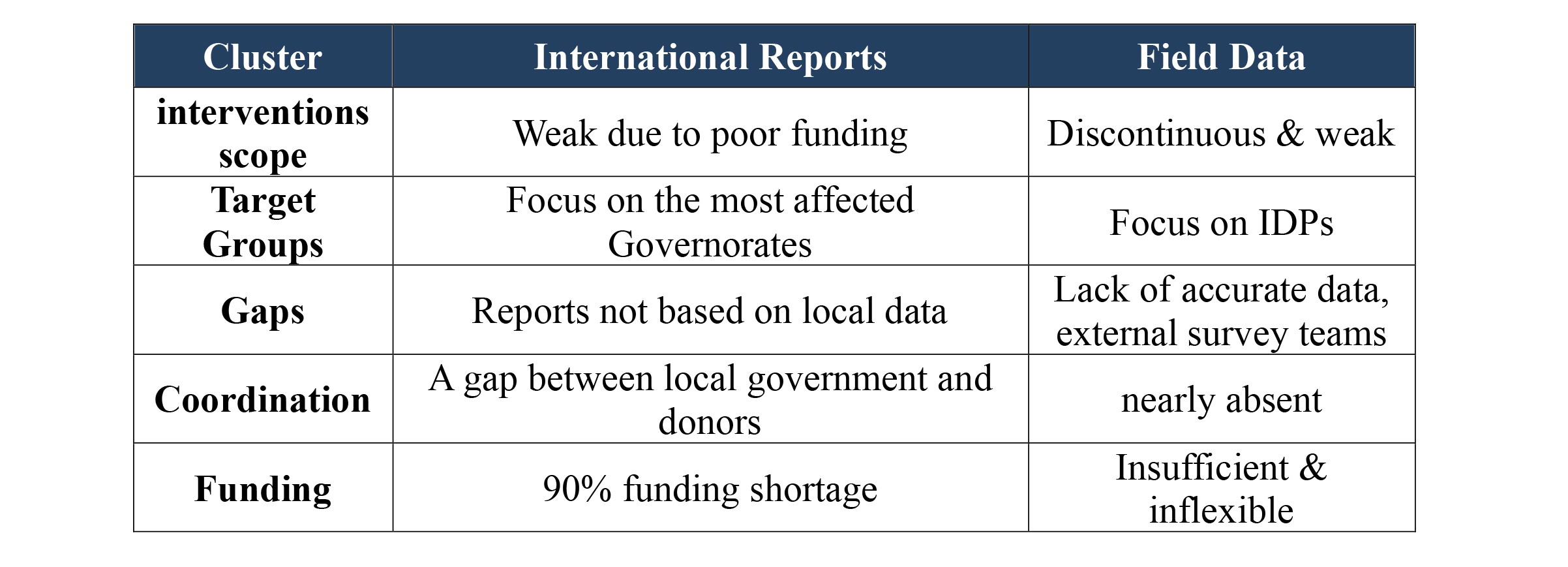
9.5 Comparative Analysis: Field data vs. international reports
9.6 Recommendations regarding Al-Mahra Governorate:
Al-Mahra Gov. is a living example of a governorate that has been “humanitarianly forgotten,” even though it is not located in a direct conflict zone. It suffers from weak interventions, infrastructure, a huge funding gap, repeated marginalization in response plans, and the impact of natural disasters.
Recommendations
- Establishing a permanent humanitarian coordination room under the supervision of local authorities and international organizations.
- Dedicated and flexible funding for emergency interventions, particularly after natural disasters.
- Diversity of interventions to include education, water, and sustainable livelihoods rather than relief only.
- Hiring local survey teams to ensure fairness of targeting and data quality.
- Involving civil society in planning, implementation, and monitoring to prevent exclusion or politicization.
10- Shabwa Gov.: Full Analysis of Humantarian Interventions (2020-2025)
10.1 Background & General Context:
Shabwah Governorate is located in southeastern Yemen and has a lot of natural resources like oil and gas, but this wealth hasn’t been reflected in the governorate’s development or humanitarian situation. It faces complex challenges involving security, political, and economic factors, which have led many international organizations to classify it as a “high-risk area.” This has had a negative impact on the scope and diversity of humanitarian interventions in the region between 2020 and 2025.
The geographical nature of Shabwah, which includes mountainous, desert, and coastal areas, has created differences in access to services. Districts such as Al-Rawda and Ataq are among the areas that have witnessed rapid demographic changes as a result of displacement, lack of development, and periodic security deterioration.
10.2 Research Methodology:
- Quantitative Tools: A field questionner has distributed to samples of residents in Al-Rawda and Ataq Districts to observe the reality of services and needs.
- Qualitative Tools: questioneers, in-depth interviews with local activists, and review of local reports.
- Cross-Sectional Analysis: Review international reports such as OCHA, UNICEF, and risk analysis platforms to understand the relationship between security classification and declining interventions.
10.3 Main findings of the field questioners:
First – Food Relief Sector:
- Most families do not receive food aid, or they do not know who is responsible for providing it.
- When aid is received, it is irregular or insufficient to meet basic needs.
Second: Education:
- Schools are partially available, but face serious challenges:
- Lack of teachers due to low salaries and lack of incentives.
- Weak infrastructure, power cut-offs, and water shortages in some schools.
- Absence of psychological and educational support from organizations.
Third: Health:
- Absence of nearby health centers in a number of areas, or their existence with limited capabilities.
- Medicines are in very short supply, and most people have to buy them at high prices.
- According to participants, there is no tangible health assistance from any humanitarian organization.
Forth: Water:
- The main source of water is purchased or seasonal water barriers, which exert household budgets.
- There are no projects to improve access to water, either through pipelines or wells.
- Water quality is weak, which affects public health.
Fivth: Protection:
- The sense of security is unstable, especially among women.
- Worrying indicators of protection have spread, such as:
- Child Marriage.
- Family Abuse.
- Child Labor.
- There are no psychological support services or effective protection centers.
Sixth – Population Priorities and Needs:
- Improving the education system in terms of staff and content.
- Providing integrated health services in each district.
- Economic support for families through small business.
- Improving infrastructure, including electricity, water, and roads.
- Reconsider the security classification that prevents Shabwa Gov. from receiving international support.
10.4 Results of Qualitative Interviews:
First – The nature of humanitarian interventions:
- Describing interventions as “semi-absent”.
- The main reason, according to the local activist: The Ministry of Planning has classified Shabwa as an unsafe governorate, which has led many authorities to hesitate to work therein.
Second – Challenges & Restrictions:
- Some international organizations, such as UNICEF, have left.
- Lack of coordination plan at the governorate level.
- Ambiguity surrounding the actual causes of the funding gap and the absence of alternative plans from the authorities.
Third – Recommendations from local activists:
- Reviewing the security classification of Shabwa Gov. based on realistic standards.
- Reactivating projects that are suspended due to withdrawal or poor coordination.
- Empowering local partners to implement development and humanitarian interventions.
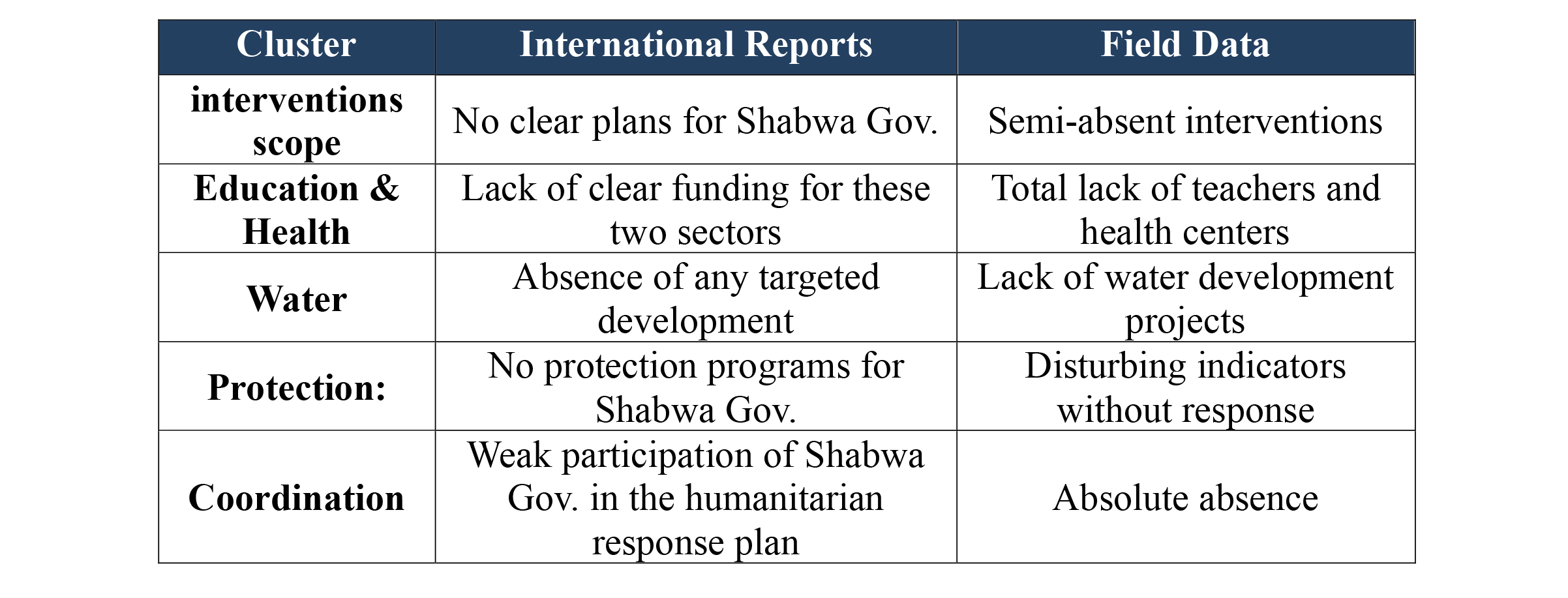
10.5 Cross-checking field findings with international reports:
10.6 Recommendations for Shabwa Gov.:
Shabwah Gov. is suffering from complex humanitarian marginalization, where security and political obstacles interact with a lack of accurate data and institutional coordination. The classification of Shabwa as a ‘high-risk’ governorate has contributed to reducing the field presence of international organizations, despite the high humanitarian need. This reflects the impact of political factors on geographical justice in the response. Even though there’s a lot of humanitarian need, the response is still below what’s needed, and international organizations aren’t paying enough attention, either because of a lack of info or fear of the working environment.
- Requesting the Ministry of Planning and International Cooperation to review the security classification of Shabwa based on recent field reports.
- Establishing a field observation unit specializing in collecting and analyzing humanitarian needs data in eastern districts.
- Enabling eligible local organizations to implement projects with international support.
- Restarting suspended health, education, and water projects.
- Integrating representatives from Shabwa Gov. into the humanitarian response plan drafting process.
- Enhancing local coordination through the formation of humanitarian committees or joint planning councils.
11- Hadhramout Gov.:
Full Analysis of Humanitarian Interventions (2020-2025)
11.1 Background and development & humanitarian context:
Hadhramout Governorate, located in southeastern Yemen, is one of the largest governorates and the most geographically and demographically diverse. It goes from the Arabian Sea coast to the depths of the eastern desert, and its administrative divisions include important urban areas such as Mukalla, Al-Shehr, Seiyun, Tarim, and Al-Qaten. This geographical extension has made it a governorate with multiple territorial identities, as the needs and challenges of the population differ between the coast, the valley, and the remote deserts.
Although Hadhramout enjoys relative security compared to other governorates, it has not received a humanitarian response commensurate with its size, population, and needs. Instead, it has often suffered from gradual marginalization in humanitarian funding policies. Interventions have been limited to seasonal programs that don’t address the accumulated crises in health, education, water, protection, and livelihood sectors.
Climate disasters (such as floods and rising temperatures), constant power cut-offs, and unbalanced population growth are all factors that have made Hadramaut in need of an advanced humanitarian approach based on justice, geographical distribution, and long-term planning.
11.2 Field Analysis Methodology:
A methodology combining quantitative and qualitative tools:
- In-depth interviews with community activists.
- Field questionnaires are conducted in districts such as Mukalla, Al-Shehr, Al-Ghail, Seiyun, Tarim, and Al-Qaten to cover part of the valley and part of the coast.
- Connecting field findings to the broader context of Hadhramout and identifying humanitarian response gaps based on local community input.
- In-depth analysis of indicators of institutional weakness, environmental challenges, and poor coordination between local and international activists.
11.3 Main findings of the field survey and qualitative analysis:
5.1 The nature of Humanitarian Interventions:
- Participants described interventions as limited, irregular, inconsistent, and mostly short-term relief efforts, such as: food baskets distribution
- Interventions have been concentrated in urban centers, while villages and remote areas have been left out of the targeting scopes.
- Participants from the local community agreed that most interventions are not based on actual needs studies and that the mechanisms for selecting beneficiaries are unfair or non-transparent.
Education Sector:
- Education is one of the sectors that is relatively available in Wadi Hadhramout regions, but its quality faces significant challenges:
- Critical shortage of textbooks and educational supplies.
- The absence of electricity in most schools, or depending on insufficient alternative sources, makes education difficult, especially in the summer.
- Lack of psychological support or motivational programs provided by organizations for students in primary and secondary schools.
- Lack of training and qualification programs for teachers, which affects the level of achievement.
Health Sector:
- There are health centers, but with poorly equipped in most districts.
- Large hospitals are serving a population beyond their capacity, especially since patients from neighboring areas are also coming to them.
- The most significant challenges observed by participants:
- Lack of medicines, or irregular availability.
- Weak infrastructure in emergency departments.
- Lack of preventive programs, especially for mother and child health.
- There has been no tangible health assistance from international organizations for at least two years.
Water & Sanitation:
- The public pipline is depended upon, but it:
- Suffers from weak pumping and frequent interruptions.
- There are no projects to improve water quality or treat liquid waste.
- Residents have pointed out a major problem related to sanitation, as sewage spreads in some residential neighborhoods, causing skin diseases and environmental pollution.
- There are no current projects to improve or expand the sewage network to cover populated areas.
Protection & Social Services:
- The population faces a range of social risks, including:
- Family abuse among poor families.
- Child marriage in rural areas.
- Child labor, especially in markets and workshops.
- The spread of drug addiction among young people, without any precaution or treatment programs.
- There are no community protection centers, nor any effective psychological or legal support activities for affected groups
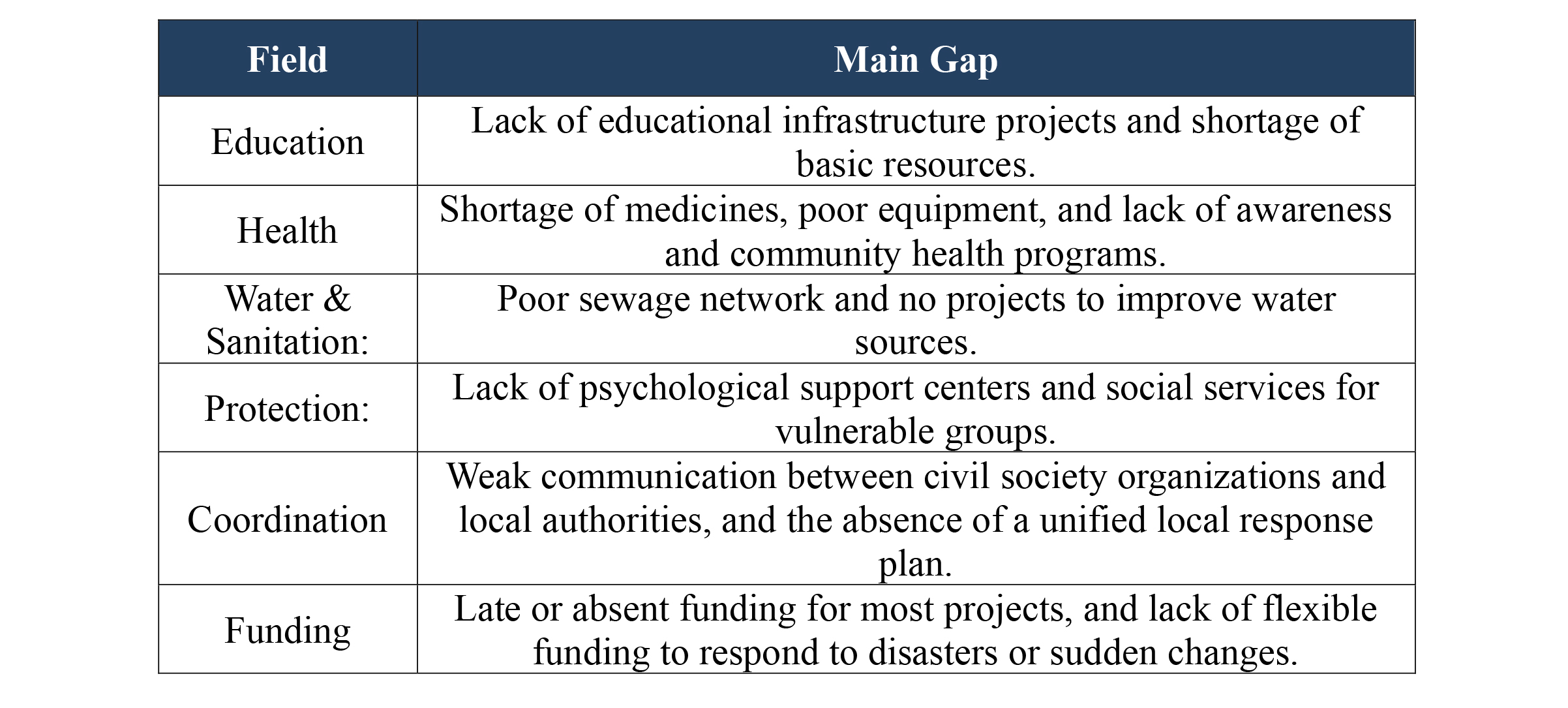
11.4 Major gaps in the humanitarian response in Hadhramout:
11.5 Most urgent needs according to the local community:
- Installing Solar energy systems for schools and health centers to ensure continuity of services.
- Improving sewage networks and establishing special treatment plants in main cities.
- Supporting health centers with medicines and equipment, and operating emergency departments 24/7
- Implementing community protection programs including psychological support, awareness, and empowerment of women and children.
- Supporting job opportunities for young people through livelihood development programs, especially in rural areas.
- Establishing modern and comprehensive databases of beneficiaries to ensure fairness and avoid duplication.
11.6 Systematic recommendations to improve response in Hadhramout:
- Establishing a mutual coordinating council between local authorities and NGOs to unify efforts.
- Signing clear memos of understanding with government authorities makes humanitarian work easier and gets rid of bureaucratic obstacles.
- Activating the role of the local community in planning and implementation, especially young people and women.
- Launching integrated development programs including education, health, water, and protection.
- Using technology and open data to track response and aid distribution.
- Establishing meaningful partnerships with international organizations to sustain and expand interventions.
Hadhramout – despite its relative stability and strategic location – has not received its fair share of humanitarian interventions; there is a huge gap between actual needs and the level of response. The lack of coordination, insufficient funding, and weak community participation have further deepened this gap.
If donors and implemented authorities want to make a real impact in Hadramaut, they need to rethink their approach to planning and implementation, expand local partnerships, and focus on sustainability rather than just relief.
Comparative analysis between the three Governorates (Al-Mahra, Shabwa, and Hadhramout):
This analysis aims to highlight the differences and similarities in the scope and nature of humanitarian interventions between the three governorates, identify similarities and differences in field restrictions, response gaps, and the behavior of local and international activists in planning and implementation.
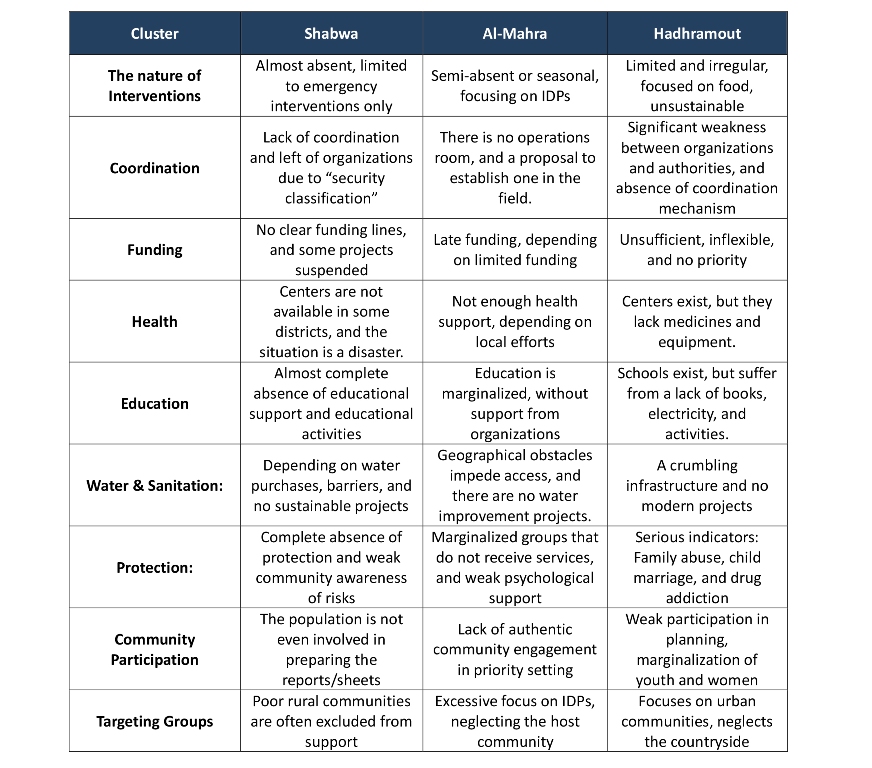
This table shows the fundamental differences in humanitarian response between the Governorates: of Hadhramout, Al-Mahra, and Shabwa. While Hadhramout appears to be more present in some interventions, it suffers from a gap in quality and sustainability. As for Al-Mahra, it shows a case of geographic marginalization despite relative stability, with seasonal interventions that don’t take into account actual needs. Shabwah represents the greatest challenge, as its security classification has led to a near-total absence of response, deepening the crises in education, health, and water. The comparison shows that all governorates have in common weak funding, lack of coordination, and limited community participation, which requires a comprehensive review of priorities and humanitarian response planning in these areas.
The most significant gaps common to all three Governorates are:
- Funding Gap
- Weak or delay in funding are common, with no financial flexibility to adapt to emergency needs, such as disasters or sudden displacement.
- Coordination Gap:
- The absence of effective coordination mechanisms between active organizations and local authorities, and the weakness of joint initiatives, leading to duplication, overlap, or even a lack of intervention in some areas.
- Equity Gap in Targeting:
- Repeated targeting of the same groups or areas due to donors’ use of outdated data or lists, leading to the marginalization of the poorest or geographically isolated groups.
- Data Gap:
- Using survey teams from outside the governorate leads to inaccurate data that doesn’t reflect reality, which affects intervention and funding plans.
- Gap in sustainability of interventions:
- Most interventions focus on relief, while medium- and long-term development projects are absent, particularly in education, health, livelihoods sectors, and community empowerment.
- Community Protection Gap:
- Complete absence of psychological and social protection programs, especially in Shabwah and Hadramaut, with an increase in cases of child marriage, family abuse, and child labor.
Political and security factors and their impact on equity in the distribution of interventions:
The study results showed that political and security factors have played a decisive role in shaping the map of humanitarian interventions in the eastern governorates, not only in terms of funding levels, but also in the nature and geographical scope of the response. In Shabwa Gov., for example, its classification as a “high security risk” area by some donors led to the pullout of a number of international organizations and the suspending of ongoing projects, despite the continuing needs of the population and the collapse of basic services. Local political divisions have also contributed to weakened coordination between authorities and organizations, and the absence of a unified vision for response.
In Al-Mahra, geopolitical considerations and geographical distance have led to its marginalization in national response plans, despite its relative stability compared to governorates directly affected by the conflict. In contrast, some areas in Hadhramout have benefited from relative security, but distribution has remained concentrated in urban centers, without fair access to rural or desert areas.
The absence of impartial technical criteria in determining humanitarian intervention priorities, in favor of security and political considerations, has undermined the principle of geographical equity in aid distribution. Instead of directing interventions based on actual need, some governorates are automatically excluded due to outdated classifications or inhumane considerations. Therefore, adopting a response model based on accurate data and clear indicators of need ensures that support reaches the most vulnerable groups and restores geographical balance between governorates, especially those suffering from double marginalization, such as Al-Mahra and Shabwa.
12- General recommendations for improving the humanitarian response in Al Mahra, Shabwah, and Hadhramout:
- Establishing humanitarian coordination units in Governorates:
- Establish permanent humanitarian operations rooms at the governorate level, including representatives from local authorities, international organizations, and civil society, responsible for coordinating plans and supervising equitable distribution.
- Adopting an integrated response approach:
- Go beyond emergency relief to build integrated development interventions that include (education, health, water, protection, and employment opportunities).
3 Flexible, multi-year funding:
- Call for the allocation of permanent emergency funding for eastern governorates, with the ability to adapt plans according to changes on the ground and climate disasters.
- Updating Databases & Survey Teams:
- Depending on trained local survey teams, regularly updating beneficiary databases, and unifying them across organizations to avoid duplication.
- Strengthening partnerships with communities:
- Empowering young people and women in the planning, implementation, and follow-up stages through community councils or local committees.
6 Supporting the institutional capacity of local organizations:
- Training and qualifying civil society organizations to be effective partners in the response, rather than mere project implementers.
7 Upgrading neglected governorates:
- Collaborating with the Ministry of Planning and international organizations to reassess the security situation in Shabwa and ensure that Al Mahra and Hadhramout are among the priorities for humanitarian funding.
- Expanding the concept of social protection:
- Integrating community protection programs into response plans, including psychological support, community awareness, and anti-violence measures.
- Using technology in observation and evaluation:
- Applying digital tools to observe needs, evaluate projects, and track impact to ensure transparency and efficiency.
- Investing international reports:
- Using international reports and analyses to put pressure on donors and raise the priority of these governorates in national plans and future funding.
11 Moving to sustainable projects:
- Shifting from seasonal relief models to sustainable development programs that include education, health, and livelihoods through support for community-based productive projects and real local empowerment.
- Community Participation:
- Involve local communities in all stages of the response, from planning to evaluation, including the forming of community humanitarian committees at the districts level.
This study sheds the light on the complex humanitarian situation in Yemen’s three eastern governorates (Hadhramout, Al-Mahra, and Shabwa). Although they have different geographic and demographic characteristics, they all share the same struggles with marginalization, lack of funding, poor coordination, and low actual response to needs.
There is still an opportunity to correct the path through participative approaches that place local communities at the heart of decision-making, based on up-to-date data, sustainable financing, and clear integration between interventions.
The study suggests strengthening integration between humanitarian and development work, especially in governorates that are stable in terms of security, such as Hadhramout.
Developing a successful humanitarian response model in these governorates requires not only financial support, but also coordination, political commitment, and community involvement to restore trust among all partners and place human dignity at the center of any plan or intervention.
Due to ongoing political and environmental changes in the governorates of study, the paper recommends periodic updating of field data to ensure the accuracy of estimates and their compatibility with changing realities, especially before using them in planning or directing practical interventions.
Based on the results of this study, and the gaps and challenges it revealed in humanitarian interventions in Al-Mahra, Shabwa, and Hadhramout Governorates, the study suggests a number of research directions and future studies that would deepen understanding and develop the humanitarian response in the Yemeni context, especially in areas not sufficiently covered by international plans:
- Analyze the impact of security classification on the scope and quality of humanitarian interventions in “low priority” governorates in order to provide more equitable recommendations to international donors.
- Evaluate the effectiveness of humanitarian coordination rooms (if any) at the local level and suggest more integrated and flexible alternative models.
- Design comparative studies between the eastern and western governorates of Yemen to measure differences in funding and outcomes, and identify factors influencing the geographic equity gap.
- Propose flexible funding models based on indicators of immediate need rather than political or security classifications of regions.
- Establish an up-to-date database, available to researchers and donors, covering development and humanitarian gaps in eastern regions, in partnership with NGOs
- Conduct specialized studies to understand the dynamics of marginalized groups in the eastern governorates, such as African migrants and women in rural areas, and their needs.
- Moving from emergency response interventions to empowerment interventions.
- OCHA Office (2023). Humanitarian Response Plans of Yemen 2023 https://reliefweb.int
- UNICEF (2022). Report on the situation of children in Yemen.
- Sana’a Center for Strategic Studies (2021). Yemen at a crossroads: Humanitarian Action Map.
- King Salman Humanitarian Aid & Relief Center. (2020–2024). Reports on humanitarian support projects in Yemen.
- World Food Programme (WFP) (2022). Food Security Analysis in Yemen – National Report.
- The World Bank. (2021). Analysis of poverty and inequality in Yemen.
- Ministry of Planning and International Cooperation – Yemen. (2020–2023). Annual reports on Governorate needs.
- Field interviews and researcher observations in the governorates of: Al-Mahra – Shabwa – Hadhramout (2024–2025).
- Questionnaires– direct collect and analysis of data within the current study. (2024–2025).