

Executive Summary:
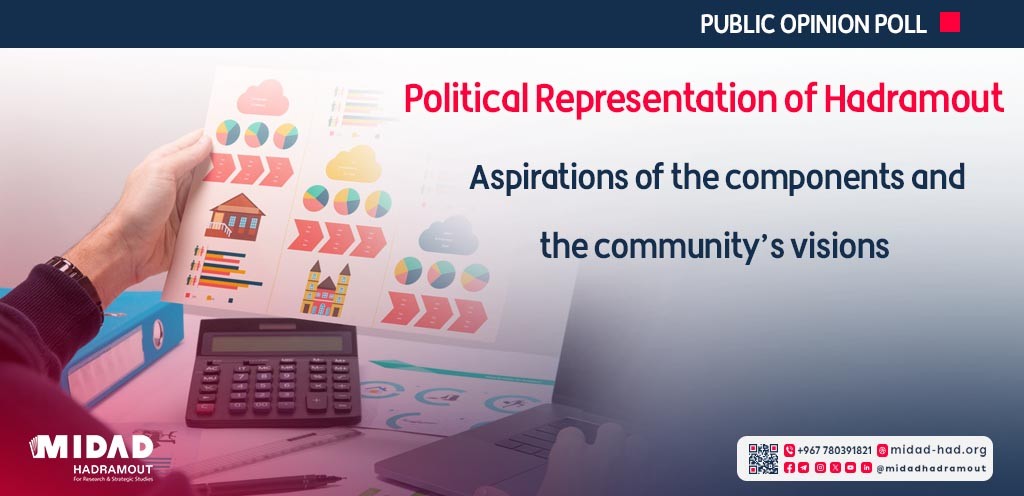
In light of the accelerated political and social changes taking place in Hadhramout governorate and the increasing presence of political and social components as actors on the local scene, MIDAD Hadhramout For Research & Strategic Studies conducted a field study and analysis aimed at understanding the nature of the roles of these components, the degree of their influence in shaping public policy, and their approach to current national and local challenges. The study based on various research tools, including a large-scale field and electronic survey, as well as Focus Group Discussions (FGDs) with leaders, representatives, and members of the most influential groups in the governorate.
The survey results showed that a large percentage of respondents (estimated at 44.7%) believe that these components are weak in defending the issues and rights of Hadhramout, and the most important reason for this is the multiplicity of these components and the distraction of their voice. 82.1% of respondents believe that the multiplicity of these components leads to the division of Hadhramout’s voice, reflecting a gap between the symbolic presence of these bodies and their actual institutional influence.
Meanwhile, respondents have been divided on the impact of these components on local and central political decision-making in Hadhramout, with 41% of respondents believing that these components have no impact on such decisions.
Overall, the data extracted from the study indicates that the political and social components in Hadhramout have a significant social support base and a historical record of local representation. However, they continue to operate within traditional frameworks that are mostly based on customs and personal relationships, and they lack effective institutional structures and strategic action plans. Furthermore, weak coordination between the different components and the absence of real partnerships with civil society organizations and youth and women’s groups are among the most significant obstacles to these components playing a transformative role in the political process.
The study recommends moving away from division and individual representation to building alliances and shared visions based on the public interest, openness towards society, and the development of their capacity for dialogue and influence, enabling them to contribute effectively to building a unified vision that meets the aspirations of society in Hadhramout and supports the political transition towards a sustainable and inclusive decentralized model.
To download the report click here
Political Representation of Hadramout Aspirations of the components and
the community’s visions