

Introduction
The experience of presidential councils in Yemen is a recurring political phenomenon that reflects the nature of the transitional phases that the country has undergone following major political changes or the collapse of regimes. Since the 1960s, a pattern or form of collective rule has emerged as a tool for managing the balance between different tribal, military, and political forces.
In northern Yemen, the Revolutionary Command Council was announced following the revolution of September 26, 1962, as a collective framework for leading the state after the overthrow of the Imam’s regime. Then, in 1967, the Republican Council was established, headed by Judge Al-Eryani. The Republican Council faced major challenges, including divisions within the military establishment and differences between conservative and radical republican forces. and radical forces. These contradictions led to political instability, forcing the elites to redistribute centers of power between the military establishment and tribal sheikhs, so that the experiment gradually shifted toward military rule represented by the president.
In southern Yemen, the experience of councils began after the removal of President Qahtan al-Shaabi in 1969 through the “Presidential Council of the People’s Democratic Republic of Yemen” to expand the participation of the National Front leadership cadres in the highest office of the state. However, this form of government was unable to overcome the ideological divisions within the unified political organization of the National Front in 1975. The country witnessed armed conflicts in 1978, which reached their peak in the events of 1986, claiming the lives of thousands of leaders. This experience showed that collective rule in a conflicted political environment requires institutions that balance interests and manage disputes through institutional methods, which did not actually happen.
After unity in 1990, the Constitution of the Republic of Yemen stated that a five-member Presidential Council should be formed, representing the governments of the north and south in an attempt to establish a participatory system. Although the council was temporarily successful in managing the balance of power, escalating political, administrative, and military disputes between the two sides of the union led to the collapse of this system during the 1994 war, and the country returned to a single-presidential system.
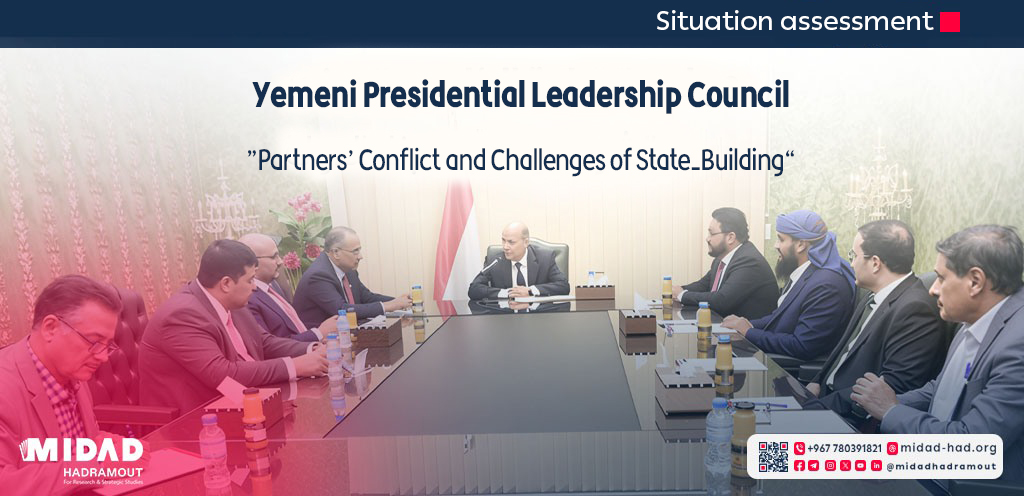
The current Presidential Leadership Council came into being in the context of a complex internal war and multiple political, military, and regional power centers. Although it returned to the idea of collective leadership, it was formed in the shadow of divisions deeper than those Yemen had witnessed in previous experiences, with direct interference from regional actors (Saudi Arabia and the United Arab Emirates), which made it a tool for managing power balances rather than an institution for good governance.
1. Concept of Conflict:
Conflict is defined as a state of negative interaction between parties with conflicting goals, limited resources, or differing perceptions of power and legitimacy. In the Yemeni context, the conflict within the Presidential Leadership Council takes on complex dimensions; it is not limited to political disagreement, but extends to contradictions in military loyalties and regional affiliations, which has turned the Council into an arena for competing for influence rather than a governing institution. United Nations reports confirm that the lack of coordination between the council’s components has caused security and military decisions to be stalled, which has had a negative impact on the stability of the liberated governorates.
2. Political Partnership:
Political partnership is a tool for sharing power among multiple actors to guarantee stability and reduce the chances of political violence. However, the success of partnership depends on clear rules for power sharing and mechanisms for conflict resolution. In Yemen, these rules are absent due to weak institutions and a lack of mutual trust, with political and military actors exercising their powers in parallel to the state.
3. Power Sharing:
The theory of power sharing proposes a framework for managing societies with political differences by distributing positions in a way that prevents exclusion and enhances legitimacy. However, this theory can sometimes become a mechanism for sustaining division if it is not supported by effective institutional building. This clearly applies to the Yemeni case, Power-sharing arrangements within the Leadership Council have led to the consolidation of political and military quotas without the development of governing institutions capable of managing diversity. For example, there is no clear constitutional mechanism defining the relationship between the Council’s president and its members, which has made the decision-making process subject to political conflicts.
Forming the Presidential Leadership Council (comparison between stated goals and actual practices)
In the declaration of the transfer of power from President Abd Rabbuh Mansur Hadi to the Presidential Leadership Council in April 2022 , specific and clear objectives were presented: unifying the political and military line, managing a transitional phase towards a settlement, and restoring state institutions and central decision-making. However, a review of developments over the past years reveals a significant gap between these objectives and the Council’s actual practices, resulting from internal and regional dynamics, institutional weakness, and military, economic, and humanitarian challenges. In the following sections, we break down this gap according to a number of key topics: legitimacy and representation, military unity and operational command, the political process and peace negotiations, resource management and economic conditions, and institutional strength and ability to act decisively.
1. Legitimacy & Representation:
The declared goal was to broaden the base of participation and strengthen the legitimacy of the government by including influential forces in its leadership structure, but the actual practice reflected several things:
While President Hadi’s transfer of power to the Presidential Leadership Council received regional support and international support, with the United Nations and an international group welcoming the transfer of power, criticism continued on the ground, pointing out that the council was established through a “superior” mechanism and under regional pressure without broad internal consensus and without clear and announced regulations governing the council’s working mechanisms, the powers of its members, and their duties. This has limited its popular legitimacy, and the council is still searching for a mechanism to resolve this controversy.
Intense competition between the Council’s components, particularly between representatives of lists that are trying to consolidate the influence of traditional power centers, which has created a climate of institutional rivalry rather than building national consensus. As stated in the report of the United Nations Committee of Experts , which noted that the fragmentation of the Council’s internal cohesion poses a threat to its continuity if conflicts between its components continue.
While the symbolic transition succeeded in giving the council international and transitional cover, but it failed to create broad internal legitimacy or a popular base that could be translated into actual governing power. However, the transition was largely symbolic, and its form was the result of regional and local bargaining rather than broad socio-political consensus.
2. Unifying Military Efforts and Command of Operations:
Unifying the military under a single command capable of confronting the Houthis and restoring state institutions was one of the most significant declared objectives, but this goal has not been achieved in practice.
Various military forces gathered under the umbrella of the Council in accordance with agreements, and new formations were established with external support. All these forces remained under varying local and regional loyalties, and challenges have emerged in unifying the armed forces and the actual chain of command.
Over the past few years, there’s been a bunch of local clashes between factions that are supposedly allies, or repeated calls for military forces to take control of areas considered liberated from the Houthi group by force, reflecting a lack of agreement and understanding among the military formations under the Leadership Council and an escalation in cases of violence recorded in conflict databases and United Nations reports, reflecting a lack of genuine unity in military decision-making on the ground.
The Council has managed to coordinate politics and military stuff at the official level, but it hasn’t been able to set up one effective military command to control the field units and stop local conflicts or regional interference.
3. The Political Track and Peace Negotiations:
The stated goal was to manage a transitional phase leading to a comprehensive settlement of the war, but actual practice revealed a lack of unified goals and vision.
The announcement of the council coincided with a temporary truce in April 2022 and the opening of a political window, but real negotiations with the Houthis remain blocked. There were expectations that the council would act as a single negotiating body, but internal differences and regional pressure prevented the formation of clear and unified negotiating lines. On the other hand, the council failed to present a political roadmap approved by all components, giving the impression that it is more concerned with managing local balances than working on peace initiatives.
UN reports monitoring the peace process confirmed that international mediation efforts did not benefit from the presence of a unified and strong government party in the negotiations, as the negotiating government’s position remained divided.
In terms of the peace process, the Council represented a missed opportunity to develop a unified negotiating position; however, the institutional framework of the Council did not translate into strategic negotiating power.
4. Resource Management and Economic Status:
Restoring state institutions, managing economic issues, and financial rescue were the council’s most significant objectives in the face of continuing service collapse and the humanitarian crisis; however, the management of the humanitarian and economic crisis did not meet expectations.
At the economic level, central state institutions (customs, the central bank, and taxes) remained fragmented or divided among local authorities and interests, which obstructed the council’s ability to manage financial and economic policies in an effective manner.
International donations were not properly directed toward economic intervention to alleviate the suffering of citizens. This financial weakness limited the council’s ability to provide services or take steps to strengthen its legitimacy. Political differences were also reflected in the distribution of resources, which were used as a tool for internal negotiation between different networks of influence rather than being distributed according to reconstruction priorities and service networks. The practical result was the continuation of the humanitarian and economic crisis.
The Council has failed to achieve any meaningful economic or humanitarian breakthrough since its establishment, whether due to weak institutional tools, internal competition for resources, or a lack of sufficient international support.
5. State institutions and decision-making capacity:
Reactivating state institutions was one of the declared goals of establishing the Council, in order to bring the country out of a war to a state of institutions. However, the situation has got worse due to the Council’s false partnership, which reinforces the division of state institutions according to quotas.
The absence of internal decision-making mechanisms and clear regulations governing the council’s work has sometimes led to institutional paralysis, with many executive decisions held hostage to internal agreements or regional partnerships.
Calls were made to establish advisory bodies or executive committees to accompany the council, but most of them remained formalities or issued official statements with limited powers from the council president, emphasizing the importance of consensus and institutional work, but implementation remained stalled.
The ongoing multiplicity of status quo authorities and power sharing has led to weak accountability and governance.
The Council has faced structural constraints in terms of governance and building effective institutions in the absence of a clear institutional agenda and accountability mechanisms, which has made it difficult to translate declared objectives into sustainable governance processes.
Why did the gap occur?
An analysis of the reasons that led to the gap between goals and practices reveals an accumulation of multiple and interrelated factors:
1) The composition and legitimacy of the council: the council was formed in a context of fierce competition and regional pressure, resulting in its formal legitimacy.
2) Conflicting regional agendas and varying local loyalties have made it difficult to reach a single central decision.
3) The absence of guaranteeing institutions, without stable supervisory and executive institutions, turned political agreements into short-term “deals” rather than structural transformations.
4) The ongoing reality of the conflict, the escalation of the Houthi group’s capabilities, and the expansion of their maritime and land attacks have doubled the burden on the Council and made managing the war a practical priority over state-building.
5) Economic weakness, limited international support, a deficit in international funding, and the failure of some donors to commit to the required support have weakened the Council’s ability to achieve tangible economic outcomes.
Comparing the declared objectives of the Presidential Leadership Council (establishing legitimacy, unifying military efforts, managing the transition phase, and restoring the state) with its practices reveals a structural gap between ambition and capability. This gap can be explained by the structure of the council, conflicting loyalties, weak institutional mechanisms, and pressures on the ground and humanitarian pressures. Accordingly, it is necessary to examine the structure and components of the Council closely to understand how internal balances translate into decision-making mechanisms or transform the Council into a framework for conflict between partners.
Structure and Components of The Presidential Leadership Council:
The council was established as part of a regional understanding (between Saudi Arabia and the UAE), and its formation was therefore more a reflection of the interests of the guarantors than the result of deep internal consensus. We discuss its structure through three interrelated analytical points:
a) Legal text and distribution of powers.
b) Individual profiles of members and their political-field networks.
c) Dynamics of regional loyalties and practical implications for decision-making.
A. Legal text and distribution of powers (formal framework vs. practice):
The authorization stated that the council formed in April 2022 by presidential resolution would transfer President Abd Rabbuh Mansur Hadi’s powers to the council, with actual authority concentrated in the position of council president, who would have broad executive powers (appointing governors, commanding senior military affairs, and signing sovereign decisions). In other words, the wording was “collective-formal” with a practical concentration of prominent executive powers in the hands of the Council’s president. This legal balance created institutional problems , the most important of which was: where does the president’s authority come from when facing objections from members with armed forces within the council?
The practical result was that formal powers clashed with the reality of multiple decision-making centers in the field; the authorization did not translate into unified executive power on the ground.
B. Council Members:
The following list is brief, with each item including background, network of connections, and geographic sphere of influence:
1) Rashad Muhammad Al-Alimi (Council President): A security and administrative character close to former Sharia circles, he was chosen as a consensual leader linked to Saudi, regional, and Western diplomatic channels. Al-Alimi’s efforts to establish institutional ties were evident in official statements and speeches he delivered before international bodies.
2) Aidrous Qassem Al-Zubaidi (President of the Southern Transitional Council): His influence is based in the south, his loyalties lie with the south, and he receives support from the UAE. Al-Zubaidi’s discourse and his political and practical programs have exerted pressure on issues such as the administration of Aden (the temporary capital) and the southern governorates .
3) Tariq Saleh (leader of the National Resistance): An extension of the former Republican Guard, he is an active military force on the western coast, established on logistical and field bases supported by regional partners. His military practices and media statements have demonstrated the extent of his independence in field decision-making.
4) Faraj Al-Bahsani (former governor of Hadhramout): He has local influence in Hadhramout, coordinating with tribal characters, especially in the Hadhramout coast and oil extraction areas. His role is linked to resources, port protection, and local administration. His attitudes reflect representative demands and regional interests.
5) Abdulrahman Al-Mahrami (commander of Al-Amaliqa Brigades): A military field commander with influence among the Salafi movement and support from the UAE, he plays a role in creating military and administrative balance in some tense situations within the southern Governorates, particularly Aden.
6) Sultan Al-Arada (Governor of Marib): A powerful tribal and political base in Marib; his defense of the governorate’s resources, which are considered a direct line of contact with the Houthis, has made him a key player in security and economic issues in the region.
7) Dr. Abdullah Al-Alimi (Office Manager of President Hadi): An administrative person with negotiating influence within the Council.
8) Othman Majali: A tribal and parliamentary character with particular tribal influence in Sa’ada, he has practical skills and is known for his early activity in confronting the Houthis.
C. Dynamics of Regional & International Loyalties, and Practical Implications for Decision-Making:
The Saudi side tends to support consensus leaders or regional leaders with relations to northern tribes and the center, while supporting elite alliances focused on border stability and protecting oil and gas lines. Saudi Arabia is considered the council’s biggest sponsor and aims to create a unified political framework that can negotiate with the Houthis.
The Emirati side relies on military and security forces in Aden, the western coast, and Hadhramout, focusing on consolidating its influence through military forces on the ground (southern forces, national resistance, and Al-Amaliqa Brigades), in strategic coastal areas, with a particular focus on Hadhramout. This support is reflected in the ability of these forces to maintain an independent field command structure.
The international community considers the Council to be a transitional tool, but is concerned about its internal lack of cohesion and duality of decision-making.
The clash between the three sides within the council has produced a “balance equation” that prevents complete collapse, but it restricts executive effectiveness (the council remains in place thanks to external balance, but it is unable to make unified, decisive decisions), and it also failed to impose a unified negotiating position against the Houthis, while regional sides exploited alternative direct or bilateral negotiation channels with the Houthis to secure their interests, This has weakened the Council as the unified representative of legitimacy.
The Nature of The Conflict Between Partners in The Presidential Leadership Council
In order to understand the nature of the conflict between the partners of the Presidential Leadership Council, it is necessary to link the phenomenon to the literature on conflict prolongation and power sharing. The literature confirms that power-sharing formulas in fragile contexts tend to produce temporary balances based on rules of influence rather than permanent institutions, which leads to a freeze in the conflict rather than its resolution if institutional guarantees are absent. This framework helps answer the question: Why does the council, in conditions of regional and local division, become an arena of competition rather than an effective platform for governance?
Political Dimension: Contradictory Internal and Regional Agendas
1. Nature of Contradictions:
The Council includes components with different political agendas:
A federal agenda (seeking to implement the outcomes of the comprehensive national dialogue).
A central agenda (seeking to rebuild central institutions).
A southern project (seeking to restore the pre-1990 state in the southern part of the country).
A self-rule orientation (seeking to protect oil resources and ports).
This contrast is not just a difference in priorities, but is accompanied by opposing regional support networks. Saudi Arabia tends to support the side that shows an ability to ensure border stability and open channels of negotiation, while the UAE supports traditional centers of influence that seek to impose a local political and economic reality. The result is that the Council is composed according to a matrix of regional balances rather than being the product of deep internal consensus, which appeared at the moment of the Council’s establishment and in its subsequent performance.
2. Practical Political Implications:
Paralysis of consensus: The need for “unanimity, or semi-consensus” on major issues led to slow decision-making and paralysis.
Weak legitimacy: The prevalence of external appointment/authorization limited the Council’s internal acceptance and weakened its ability to mobilize a national base.
Fragmented negotiating frameworks: The absence of a unified negotiating position in front of the other party (the Houthi group) left the Council without the advantage of unified negotiation.
The military dimension: dual leadership and lack of unity in decision-making
1. Duality:
The council includes representatives from independent military bases, each of which maintains its own command structure, supply chain, and field requirements. Rather than contributing to a unified effort, this military diversity has resulted in multiple field decision-making centers that sometimes act according to their own agendas.
2. Military and strategic consequences:
Failure of integration projects: Attempts to integrate the groups into the Ministries of Defense and Interior have been met with resistance and local power struggles.
Weak ability to activate central combat resources: The Council has been unable to establish a unified national military command capable of making integrated strategic decisions against an organized adversary (the Houthi group).
Taking advantage of the leadership gap: The other side (the Houthi group) used this state of disunity to strengthen its positions and impose new field equations. Reports also documented an increase in the Houthis’ capabilities and an expansion in the scope of their operations during the same period, which doubled the burden on the Council and its limited powers.
Economic And Administrative Dimension: Conflicting Agendas On Resources And Governance
1. A Struggle Over Resources and Management:
Local resources have become tools of pressure and informal sources of funding for various council components. Local actors seek to retain a share in order to refinance their forces or political projects.
The struggle over resource management dedicates the logic of “the economy as a tool of power” instead of a shared resource for reconstruction and public administration. The result has been exacerbated financial problems and the absence of unified policies for managing the currency and services crisis.
2. Weak governance and management:
Duality of structures: The existence of conflicting executive bodies (recognized government institutions, local authorities, and parallel forces) has led to institutional conflicts and a failure to deliver services.
Corruption and mismanagement charges: Administrative obstacles and mutual accusations of resource appropriation or diversion for personal agendas have weakened the confidence of international and local partners and made the flow of funds for economic reform or service delivery less effective.
Interconnection of the Three Dimensions
The political, military, and economic dimensions are interconnected; political competition is driven by the acquisition of economic resources and seats on the ground; an independent military presence secures political bargaining power, and weak economic management affects the legitimacy of the council. This overlap means that addressing any one dimension in isolation from the others will fail; integrating military forces without political agreement on the distribution of powers and resources will remain fragile, and vice versa. This conclusion is consistent with concerns about power sharing, which warn that arrangements will fail if they are not accompanied by institutional action and sustainable guarantees. Based on the results of the analysis, we can conclude the following:
1) The problem of military fragmentation cannot be resolved without a clear political agreement on the participation of all legitimate parties in power, the redistribution of resources, and acceptable guarantees of integration for the groups.
2) Reforming resource management must be accompanied by a transparent accountability plan that ensures a part of the revenues is transferred to civil services and integrated into a central budget with regional and international guarantees.
3) The role of the regional guarantor must shift to a role of “facilitator and guarantor” instead of being a competing party that feeds the conflict.
The consequences of the conflict between partners on the battle to restore the state, peace negotiations, and the security and economic situation in the liberated governorates
The internal conflict between the components of the Presidential Leadership Council has had direct consequences on the course of the war and peace, as well as on security and economic management in areas under legitimate authority. This chapter provides a descriptive and analytical analysis of these consequences through three interrelated topics (the battle to restore the country, peace negotiations, and the security and economic situation in the liberated governorates).
First: The Battle to Restore the Country
Military stalemate on the ground:
Despite regional support, the council was unable to direct the various forces into a unified front against the Houthis. The southern and eastern forces were more concerned to preserve their areas of influence than to engage in northern fronts, as the clashes within the areas of legitimacy were between allied groups, not against the Houthis.
Absence of Central Leadership:
The absence of a unified command structure weakened the ability to plan strategic operations, allowing the Houthis to maintain their positions and consolidate their control over the north and center.
Political consequence:
These dynamics undermined the discourse of “restoring the state” and kept the Council on the defensive, weakening its ability to convince both inside and outside the country that it was a valid framework for managing a unified national struggle.
Second: Peace Negotiations
Lack of a unified negotiating position:
Each member of the council had its own agenda: the Transitional Council focused on the southern issue, while the Islah Party and a part of the General People’s Congress focused on a federal Yemen (the outcome of the comprehensive national dialogue), and Tariq Saleh focused on reintegrating the Saleh family group. This contrast prevented the formulation of a common vision for peace.
Impact of regional centers:
At one-point, Saudi Arabia pushed for a truce and bilateral understandings with the Houthis outside the council, which reduced the council’s negotiating power. Meanwhile, the UAE encouraged its allies to focus on securing their interests in the south and on the western coast.
These regional policies increased the Council’s isolation in the negotiation process, weakened its legitimacy in the eyes of its internal audience, and reinforced the image that it was more of a symbolic entity than a key player.
Third: The security and economic situation in the liberated governorates
1. Security Situation:
Aden as an example: The temporary capital witnessed a series of repeated clashes between forces related to components within the council, creating a state of “parallel security” and weakening the authority of the Ministry of Interior.
Hadhramout and Al-Mahra: The power in these areas has remained divided between the two sides of the Arab coalition and regional countries through local agents, making security decisions subject to external balances rather than local institutions.
2. Economic situation:
Oil and gas:
The disruption of oil exports from Hadhramout and Shabwah since the Houthi attacks on ports in late 2022 has revealed the weakness of economic management, as the council has failed to develop an alternative plan to compensate for the loss.
Currency and services:
The Central Bank in Aden was unable to control exchange rates due to divisions among its components and the absence of a unified monetary policy. The exchange rate reached more than 1,200 riyals per dollar in 2023, which was reflected in a 40% increase in basic goods prices, according to reports by the World Food Programme.
Duality of revenues:
Each component has aimed to keep a portion of local resources (customs, oil, and ports) instead of transferring them to the central treasury, which has exacerbated the public sector salary crisis and led to widespread protests, particularly in Aden and Hadhramout.
Summary of Implications
At the military level: The fragmentation of leadership prevented any strategic progress in “restoring the state.”
At the negotiating level: The Council became more of a “theater of disputes” than a unified negotiating platform, allowing regional and international parties to exclude it.
At the security and economic level: The policies of competing factions deepened institutional divisions and weakened legitimacy in the eyes of the public.
This situation shows that the continuation of the Council in its current form will make any peace process or economic reform weak and subject to collapse in the absence of radical reform of the Council’s structure or its restructuring with regional and international support.
Future Scenarios for The Presidential Leadership Council
The following scenarios are based on a structural diagnosis of conflicts of loyalties within (politic, military, and economy) and on recognized developments on the ground and in the economy during the period 2022–2024 (decline in the exchange rate and inflation, decline in oil export capacity, and continued violence recorded in conflict databases). The analysis links these data to regional agendas (Saudi Arabia and the UAE) and the policies of local actors.
Limited External Support for Relative Cohesion
The Council continues to exist as a formal institution but operates with limited capacity because of regional support (Saudi Arabia and the UAE) focused on maintaining its international legitimacy, with temporary agreements allowing for limited military and political coordination.
Scenario Motives:
Continued financial and political support from Saudi Arabia and the UAE to avoid a greater power gap (regional security motives).
Local trade-offs that provide incentives to keep groups leaders within the framework of administrative positions and shares of local revenues.
Regional truces/periods of calm that allow for a calming of the fronts on a temporary basis.
Field Indications:
The formation of the council itself was driven by regional dynamics and the sponsorship of the coalition, making it viable as long as its sponsors remain willing to maintain it.
Impacts:
Political impact: Formal institutional legitimacy with weak popular advocacy.
Military impact: Continued dual command structure but with limited operational coordination (conditional operating agreements).
Economic impact: Continued fragmented resource management; external support reduces some pressures but does not resolve structural exchange rate and inflation crises.
This scenario remains mid-to-high probability over 12–24 months if Riyadh and Abu Dhabi remain committed to balanced policies, but the probability decreases if field or economic pressures intensify.
Gradual Erosion & Collapse of Effectiveness
The council’s cohesion gradually breaks down to the point where it becomes a formal framework with no real executive power; escalating disputes lead to the breakdown of its internal alliances and the intensification of bilateral regional understandings outside the council’s framework.
Scenario Motives:
Increasing competition between components supported by the UAE and Saudi Arabia leads to open internal conflicts.
The worsening economic crisis (collapse of the exchange rate, inability to pay salaries) undermines stability.
Regional mediation fails to provide convincing guarantees for the start of integration measures.
Field Indicators:
Weak council cohesion and continued heated competition, with indications that some members are acting outside the council to serve their local agendas.
Reports of continued violence and lack of unification of arms, indicators that support the erosion scenario.
Impacts:
Politically: Loss of internal political legitimacy and expansion of local-regional alternatives to legitimacy (alternative regional-local formulations).
Military: Increase in military formations supported by the Arab coalition in areas of legitimacy, and the possibility of renewed clashes between groups loyal to each side, weakening the ability to confront the Houthis.
Economically: Worsening collapse of services, increasing risks of humanitarian deterioration, and resorting to informal financing networks.
This scenario remains mid-to-high probability if economic pressures continue, external support declines, or regional patrons’ priorities change.
Reforming The Council
The Main Idea:
The joint central council example fails, but tension leads to a political settlement that results in the restructuring of power, either through a decentralized-federal agreement (in any form of federalism), or through a new institutional process (a temporary council with clear powers, or more formal regional delegations).
Scenario Motives:
Internal pressures (protests and regional demands) combined with regional pressures that accept an alternative form of centralization.
The Council’s failure to achieve a military and political breakthrough pushes the parties to accept that a more decentralized formula may be the realistic solution for stabilizing services and the economy.
Neutral mediation (Gulf, Arab, European, and UN) leads a negotiation process to re-define the powers.
Field indicators:
Calls from southern and eastern governorates indicate that the option of a two-region or federal formula, broad local governance powers, or self-rule are being put forward as realistic alternatives if the current council formula continues to fail.
Regional experiences such as federalism or confederalism may ease direct confrontation, but require accountability mechanisms and guarantees for revenue sharing.
Impacts:
Politically: It may improve local authorities in governorates or regions (if implemented with clear guarantees), but it may pave the way for actual political division if it does not include national guarantees.
Military: Requires the integration of forces into the structures of the Ministries of Interior and Defense, with the risk of continuing parallel loyalties if not treated with a new national system and timetables.
Economically: The possibility of managing local resources and governing them more efficiently locally with international guarantees of transparency and accountability, timelines, and performance indicators, but with the risk of losing a unified economy if mechanisms for settling resource revenues are not included.
This scenario remains mid-to-high probability over 2–4 years if local and regional pressures increase, or if a regional-international guarantor is available to ensure a clear separation of powers and resources.
Replacing The Council with A New Legitimate Structure
The accumulation of failures will result in a regional-international initiative to restructure legitimacy through a new structure, form a transitional authority under broad regional and international auspices, or conduct preliminary elections governed by international security controls.
Scenario Motivators:
International stress from the ongoing failure, increased humanitarian and political costs (changing priorities of the conflict’s sponsors).
An escalation on the ground or a geopolitical event (a major attack, loss of key revenue sources) that pushes the international community to force a new solution.
Strong local forces demanding the replacement of a leadership that has failed to deliver services and security.
Field indicators:
Growing pressure in the international arena (global reports, changing positions of key sponsors) may lead to initiatives similar to the strong mediation intervention that originally established the Council.
Impacts:
It may create an opportunity for genuine institutional reforms, provided that a transitional “roadmap” is prepared that suggests criteria and preconditions for any replacement, if the measure is accompanied by international support and early coordination with donors to secure a financial and humanitarian package that prevents a security gap.
On the other hand, it may create a hostile gap if a new structure is imposed without internal consensus or sufficient security guarantees.
This scenario remains a short-term (one to two years) low to medium probability, rising if guarantors lose patience or the regional-international landscape changes suddenly.
The near future of the Presidential Leadership Council will be determined by how regional and international guarantors respond to three related realities:
(1) Increasing economic pressures.
(2) Duality of command on the ground and lack of unified leadership.
(3) Fragile internal legitimacy.
The above scenarios offer alternative paths from “externally supported relative cohesion” to “erosion and collapse,” or “decentralized reconfiguration” and even “institutional replacement.” Each scenario requires decision-makers to choose a combination of motivations, guarantees, and carefully designed economic programs to prevent the worst outcomes and enable viable alternatives.
Yemeni Presidential Leadership Council
“Partners’ Conflict and Challenges of State-Building”