

( Economic Researcher )
Submitted By:
Mohammad Hedaijan
Analytical Reading.
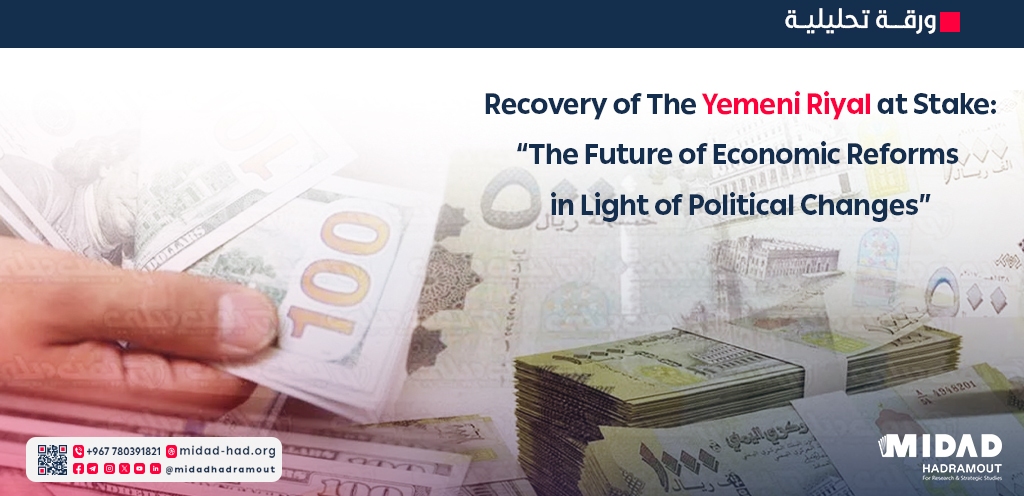
Over the past decade, the Yemeni people have experienced economic crises and currency fluctuations that have brought hunger and poverty upon them, but what happened recently was different. the Yemeni riyal witnessed a sudden rise of nearly 44% in one week in 2025, with the exchange rate dropping from 2,900 riyals to around 1,600 riyals, according to Al Jazeera Net[1]. This “technical” improvement raised legitimate questions about the sustainability of these measures and whether they resulted from a well-thought-out plan or were merely a temporary bubble.
Despite initial hopes, these economic reforms quickly got mixed up with the complicated political and military situation. While the central bank was getting its stuff together, the Transitional Council forces launched a big attack to take control of Hadhramout and Al-Mahra governorates. The situation did not stop there, but developments accelerated, reflecting the complexity of the situation with direct Saudi intervention that included bombing the port, along with demands for the UAE to leave Yemeni territory. The legitimate government forces, the National Shield and Emergency Forces, took control of all the southern governorates.
In light of this analytical reading, we aim to deconstruct this complex scene, starting with a review of the package of measures taken by the Central Bank, followed by an examination of the real motives behind them, and concluding with an analysis of the political and military variables in the eastern governorates, and how these dramatic shifts have affected the path of economic reforms and drawn new scenarios for the future.
Cash Reserve: What measures have already been taken?
To achieve this improvement, the Central Bank in Aden, in coordination with the Presidential Leadership Council, has taken a package of coordinated measures:
- Intensive Monetary Policies
The Central Bank has taken measures to withdraw excess liquidity from the local currency using auctions, absorbing approximately SAR 2.94 trillion from the market. At the same time, it raised yields on local currency deposits to 15% and local debt securities to approximately 18%, according to the Central Bank, making it more attractive to keep Yemeni riyals[2].
- Regulation of Import Financing
Through the “National Committee for the Regulation and Financing of Imports” (Prime Ministerial Decree No. 9 of 2025), the bank enforced strict controls on foreign currency consumption[3]. Traders could only obtain financing for confirmed import documents and a specific list of essential goods, which reduced random demand for dollars and controlled currency smuggling.
- Banking Supervision & Compliance
The bank launched a comprehensive monitoring campaign, under which it closed nearly 70 non-compliant banking establishments since July 2025[4]. This move was necessary, as the war resulted in the emergence of a large number of currency exchange shops that did not comply with the Central Bank’s standards. The aim of this supervision was to prevent currency manipulation by speculators (who use strategies such as spreading rumors) and to shut down establishments that cooperate with the Houthi militias in money laundry and smuggling. These measures, along with the requirement for everyone to comply with transparency standards and international regulations, played a role in restoring control, in addition to the introduction of digitization and electronic payments to control the market more effectively.
- Leadership Council Resolutions (Customs Dollar, Revenue Supply)
The monetary resolutions came with political backing through Leadership Council Resolution No. 11 of 2025[5], which obliged all units and governorates to transfer public revenues to the Central Bank account. Most one, was to “liberalize the customs dollar,” which aimed to restore lost revenues to the state treasury, despite the potential risk of raising import costs.
Behind the scenes: Revealing the real motives
These measures are not random, but rather driven by a complex network of interrelated motives. Since the political scene was divided in 2015, economic conflict has become apparent, starting with the printing of new currency by the legitimate government and its prevention by the Houthis. The recent measures were part of an attempt to “strangle” the Houthis’ economy by preventing currency smuggling into their areas, which indicates a political decision to implement meaningful economic reforms.
It appears that this approach is not isolated, but rather enjoys strong regional backing, specifically from the Kingdom of Saudi Arabia. This momentum was evident in the intensive meetings between the Yemeni leadership and the Saudi Ambassador, which translated into direct support for the general budget in the amount of 1.380 billion riyals, according to data from the Saudi Program for Development and Reconstruction of Yemen, as well as the launch of a package of projects and development initiatives worth 1.9 billion riyals[6] covering all key sectors. These figures clearly indicate a qualitative shift in the regional position towards a transition from relief to strengthening state institutions.
This support differs from previous support, as the Presidential Council intervened in the past to stop similar measures taken by the governor of the Central Bank (Al-Ma’baqi) , indicating that the current support is a political green light to economically strangle the Houthis as a means of pressure. The social motive cannot be overlooked either, since the political leadership was under pressure from massive popular discontent over the deterioration of living conditions, and these measures were necessary to absorb some of this anger.
Economically, the situation was at its worst. With inflation reaching 30% in 2024 and a sharp contraction in gross domestic product of 27% over ten years, according to the World Bank[7], and with the government’s inability to pay salaries for about four months, according to Al-Araby Al-Jadeed[8], urgent action had to be taken. The measures aimed to address the severe balance of payments deficit resulting from the suspension of oil exports (the primary source of hard currency) since early 2022, after the Houthis struck oil export ports in Hadhramout and Shabwah in eastern Yemen, and to attempt to regain control of the black market money supply.
The “international reality” is considered the most prominent driver. With the Red Sea front inflamed after “Operation Al-Aqsa Flood”, the US administration decided to reclassify the Houthis as a terrorist organization. This designation requires the freezing of accounts and, more importantly, puts enormous pressure on the legitimate government to tighten control over banks and financial institutions. These measures came in direct response to this pressure to cut off money laundering mechanisms, as reports revealed that the group was sending funds through accounts in legitimate banks under the cover of “importing goods,” when in fact it was “financing” the group. Some traders also requested foreign currency financing from the Bank of Aden (for imports), then secretly sold it in Houthi areas to profit from the exchange rate difference, which is considered indirect currency smuggling. Therefore, the new measures (such as the Import Regulation Committee and banking supervision) are directly aimed at drying up these sources, as confirmed by the report of the International Expert Committee.
The international community’s support for reforms is evident in practical actions that go beyond simple statements. The US Treasury’s support was clearly demonstrated during its extraordinary meeting with Yemeni banks in Riyadh, sending a message of reassurance and protection to the legitimate banking sector. In parallel, this international cover has been reinforced through a series of intensive and ongoing meetings with major financial institutions, specifically the International Monetary Fund and the World Bank, reflecting an international consensus among donor and regulatory institutions on the need to ensure the success of monetary reforms in Aden.
Events in Hadhramout & Al-Mahra Governorates
How did politics bring down the technical considerations?
The rapid events in Hadhramout and Al-Mahra governorates acted as an “existential test” for economic reforms. Initially, the Transitional Council’s control of the two governorates and its taking control of Petromasila company represented a decisive strike against the reform efforts and a challenge to the contents of Resolution No. 11 of 2025. This decision was the keystone of the economic reform plan, as it clearly stated that all public revenues and oil sales should be deposited in the Central Bank’s accounts and that any illegal collections should be prohibited. In actual fact, the loss of control over these resources meant the “clinical death” of state authority and completely paralyzed the Central Bank’s ability to intervene in the exchange market, which threatened to disrupt salary payments and exacerbate the government deficit to disastrous levels. However, the situation was turned upside down at the last minute when Saudi Arabia’s direct intervention, along with the UAE’s announcement that it was leaving Yemen and dissolving the Transitional Council, became a strategic turning point. This dramatic change provided, for the first time, solid ground for enforcing the rule of law and ensuring that sovereign revenues flowed back into the public treasury, giving economic reforms the lifeline they needed.
In the context of strengthening the state structure, the political leadership has taken a strategic step by forming a supreme military committee under President Rashad Al-Alimi to unify all forces under a unified command. according to the Yemeni News Agency (Saba)[9], this was accompanied by an explicit warning from the political leadership that any illegal tax collection would be severely punished. This radical shift in policy is not only aimed at improving security, but also has a crucial economic dimension. Ending the “military points economy” will reduce transportation costs, which have driven up commodity prices for citizens. It will also close the channels of corruption that have been swallowing revenues, redirecting cash flow toward official channels and giving the central bank real power to manage the money supply and contain inflation.
It is a matter of basic logic that whoever controls the land and institutions controls their revenues. Therefore, the de facto authority imposed by the former Transitional Council presented a structural challenge to the flow of public resources, in addition to the refusal or previous delay of a number of liberated governorates to transfer their revenues to the Central Bank. Field reports indicated that the transfer of revenues had stalled due to a dispute over powers[10]. However, the problem was not limited to the political side only, but was exacerbated by the fragility of the administrative system, the conflict of interests, and the weakness of government oversight mechanisms, which allowed resources to be wasted. Therefore, the recent military shift and the end of duality were not just security measures, but rather a necessary condition for rebuilding a unified financial administration. This will serve as a real lever for strengthening the public treasury, closing the deficit, giving the central bank the necessary power to prevent speculation, close down illegal facilities, and restore the real value of the Yemeni riyal.
Economic success remains subject to the extent of political stability and the success of negotiations between southern components and the people of the eastern governorates to arrange the post-transitional situation. This path has been reinforced by the call of the President of the Leadership Council, Rashad Al-Alimi, and the Kingdom’s response to sponsor the dialogue in the Saudi Foreign Ministry’s statement to hold a comprehensive dialogue conference with the political factions and shape the political future. This scenario is complicated by the relationship with the Houthi group and the indirect role of the UAE, as any setback in the comprehensive political settlement could generate instability that would undermine the government’s financial reforms, especially the formation of the “Supreme Military Committee” carries clear implications for the possibility of renewed military conflict with the Houthis, which threatens to drain the already depleted public budget and move the battle to the economic square in a more intense and violent manner.
The Wall of Reality: Analyzing the Upcoming Challenges
Despite its initial success, these measures face a wall of deep structural and political challenges. The main challenge is the division of banking policy; the existence of two central banks and two monetary authorities creates chaos and conflicting directives, preventing any monetary policy from being fully effective at the national level. In addition, there is the structural imbalance of the economy. The problem is not only a monetary one; the Yemeni economy depends on oil as its main source of income (70% of the budget was previously funded by oil), and this source has stopped. What is worse is that public spending is “current expenditure” (salaries) rather than “capital expenditure” (projects). Current expenditures made up 80% of the total during the period 2010-2014, compared to only 13% for investment[11]. This means that the current measures are just “painkillers” for a crisis that requires comprehensive economic reconstruction.
The fundamental challenge remains institutional fragility resulting from political and field disturbance, as no financial reforms can take root in an environment where the state does not have a power monopoly. Therefore, transforming current gains into a sustainable reality necessarily requires the imposition of strict political and military stability that subjects all institutions to the rule of law, enabling them to extend their influence and collect resources without dispute. Economic reform cannot develop in an environment of insecurity.
Fundamentally, the “confidence crisis” remains an obstacle to a recovery in the financial cycle. The commercial sector and foreign investors continue to view the banking sector with suspicion, afraid that the current improvement is just a “temporary fix” that depends on foreign deposits rather than sustainable resources. These fears are exacerbated by the uncertain political horizon, as capital links its stability to the success of the Riyadh dialogues in producing a comprehensive political settlement that would prevent any potential military setback.
The serious challenges presented by the suspension of oil exports and the difficulty of raising funds for the central bank in the temporary capital of Aden make it necessary to adopt decisive, multidimensional solutions. With regard to the oil issue, the solution is closely linked to the political and military tracks. It can either be achieved through the activation of UN and international mediation based on the proposals of the International Crisis Group, which call for neutralizing sovereign institutions and pooling their revenues in a financial center under international guarantee, so that the proceeds can be used to cover agreed-upon public expenditures such as employee salaries[12], or through a military solution by strengthening efforts to liberate Sana’a, which is an option that remains subject to the availability of political will and military capability.
In terms of internal financial resources, the solution lies in leaving behind traditional methods and moving toward comprehensive electronic digitization by linking tax revenues and ports to unified systems that are controlled and supervised directly by the Central Bank in Aden, in parallel with the activation of regulatory laws and their strict enforcement to ensure compliance by all revenue sources.
The Future of Economic Reforms, Between Conditional Recovery and Fragile Stability
In light of the complexity of the new political situation and developments on the ground, combined with monetary measures, the future of the Yemeni economy is divided into three main scenarios:
This scenario assumes a qualitative shift in the form of a significant improvement in the value of the riyal and a decline in inflation, supported by progress in digitization, financial inclusion, and revenue maximize. However, this “ideal” path remains subject to conditions that are currently impossible to meet, most significantly: finding immediate alternatives to resume oil exports, imposing strict central control over sovereign resources, reaching a comprehensive political settlement, and achieving long-term military stability that ends the state of fragmentation.
Current indicators suggest that the economy is heading toward a “middle ground” characterized by relative currency stability (without significant improvement) and a “moderate” government capacity to collect revenues enough to cover essential expenditures such as salaries. However, this stability will remain tempered by a limited rise in prices as a result of “imported inflation” following the liberation of the customs dollar, and continued “anxious anticipation” among investors and traders due to ongoing security instability and the absence of a final political solution.
This scenario warns of a dramatic setback leading to a new collapse in the exchange rate, accompanied by a wave of severe inflation that will hit the prices of goods and services. The drivers of this scenario are not limited to the possibility of the failure of current monetary measures, but are closely linked to military risks, specifically the possibility of renewed war with the Houthis or the spread of security disturbances resulting from recent changes in the power structure in the southern and eastern regions.
People in Yemen have been observing economic plans in the hope of improving their lives. The recent measures, with their complex motivations, are a step in the right direction. However, they remain “monetary tools” that attempt to solve a crisis with political and military roots. The structural challenges, particularly political and military division, are too great to be solved by currency auctions. Real success will only be achieved through a unified political will that imposes state authority, unifies its institutions, and restarts the wheel of economic development.
[1] Continued high prices prevent Yemenis from enjoying the benefits of currency appreciation.
[2] The Central Bank of Yemen’s measures: solutions, economic impact, and ways to persevere
[3] Prime Minister’s resolution on establishing an import regulation committee.
[4] Central Bank closes down companies and currency exchange facilities in violation of regulations.
[5] Leadership Council Resolution No. 11 to apply the reform plan.
[6] The Prime Minister meets with the Saudi ambassador.
[7] Concluding Statement by World Bank Experts
[8] Yemen employees unpaid for fourth month
[9] Presidential decree establishing the Supreme Military and Security Committee.
[10] Revenue dispute deepens crisis in Presidential Council amid economic collapse
[11] Restructuring Public Finance in Yemen – Sana’a Center for Strategic Studies
[12] The economic conflict in Yemen.
Recovery of The Yemeni Riyal at Stake:
“The Future of Economic Reforms in Light of Political Changes”