

The new government is being shaped in an extremely complex political, security, and economic context, in which the effects of armed conflict overlap with institutional division, the decline in the state’s ability to provide basic services, weak trust between society and the authorities, and high public expectations of government performance. In an environment where there are multiple centers of power and decision-making, and where living pressures are rising, the government is facing a double test: establishing its effective presence within areas of legitimacy, and improving conditions for stability by restoring the presence of state institutions, raising the efficiency of resource management, and reducing administrative and financial imbalances.
The government seeks to strengthen its presence in areas under its control, improve service delivery, and restore the effectiveness of institutions[1]. However, the scale and complexity of the challenges may obstruct these goals unless they are managed according to clear priorities and realistic executive options based on an accurate assessment of the balance of power and available resources.
This report aims to analyze the most significant challenges facing the government in the areas under its control, explore possible scenarios, and provide practical, actionable recommendations that will enhance opportunities for stability and gradually restore the effectiveness of the government.
Challenges and Considerations:
The new government in Yemen faces a difficult internal environment characterized by a series of political, security, economic, and institutional crises, restricting its ability to take strategic action and forcing it to make decisions based on responding to events rather than on medium- or long-term planning.
Politically, the contrasting priorities of the parties sharing power and the absence of a coherent decision-making center impose a pattern of “balancing acts” rather than strategic policymaking, weakening executive consistency and limiting the effectiveness of the government.
Regarding security, the multiplicity of armed actors and overlapping command centers continue to undermine the government’s monopoly on force, making local stability dependent on informal power arrangements that can change whenever there’s a conflict of interest.
Economically, the government is operating within a very tight financial space, with oil exports suspended since early 2022 due to the targeting of export ports in Hadhramout and Shabwah, as well as disruptions in revenue transfers to the Central Bank, increased reliance on cash flows and foreign grants, and continuing exchange rate volatility and declining purchasing power. This reduces the margin for economic intervention and puts pressure on the regular payment of salaries and the financing of basic services.
In the social and service dimension, the chronic deterioration of the service infrastructure, and the high cost of living create an explosive environment for protest, especially in major cities such as the temporary capital, Aden, when any additional shock occurs (power cuts, delayed salaries, or rising goods prices).
On an institutional level, weak administrative capacities, lack of transparency and governance, and fragmented supervisory authorities are limiting the ability to implement rapid structural reforms, restore the regularity of government institutions, and improve the efficiency of public spending.
These considerations indicate that the greatest challenge lies not in the size of each crisis individually, but rather in the cycle of mutual influence between them: the decline in revenues exacerbates the deficit in services and salaries, which fuels protests and puts pressure on local security, while weak political coordination and multiple decision-making centers slow down solutions and turn them into partial, short-term fixes.
Accordingly, the central challenge for the government is to prevent a slide into instability and build a minimum level of operational capacity for the government, rather than its ability to achieve broad reform breakthroughs in a short period of time.
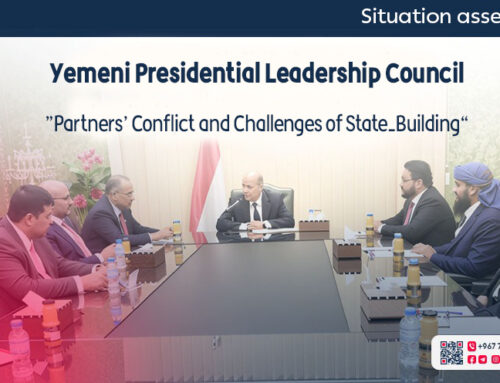
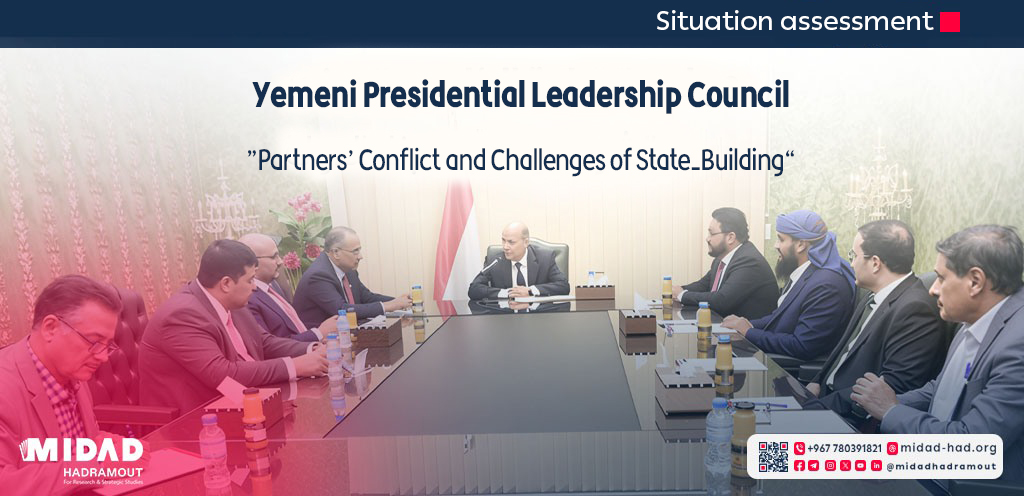
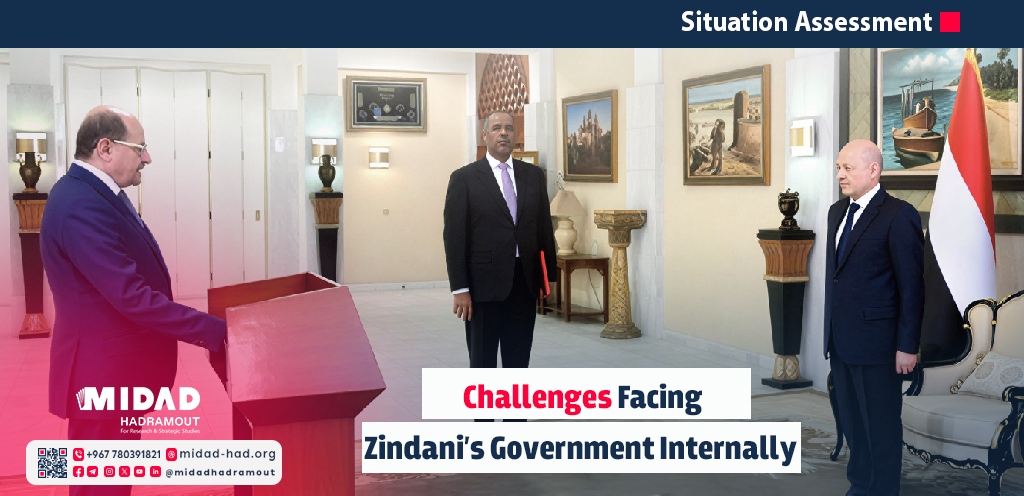
The formation of the new Yemeni government, under the leadership of the Presidential Leadership Council and Prime Minister Shaye Al-Zandani, is a turning point in the administration of the legitimate areas, especially in light of the political changes that took place at the beginning of 2026. This government faces a complex legacy of internal conflicts, economic decline, and a humanitarian crisis that has been continuing since 2015. According to many reports issued by research centers, its success depends on unifying security and military forces, reforming government institutions and bringing them into order, and addressing regional tensions between Saudi Arabia and UAE. This analysis suggests three possible scenarios for internal challenges, focusing on security, economic, and political aspects.
The following scenarios are based on a central idea: that the government’s course in the near term will be determined not only by the quality of its announced policies, but also by its ability to activate implementation tools within an environment characterized by multiple actors, fragmented resources, and high political decision-making costs. Therefore, the variables governing the scenarios can be summarized as follows: the degree of security discipline, unity of leadership, the government’s ability to restore a minimum level of financial stability (salaries, revenues, exchange rates), the level of consensus within the decision-making center, the limits of regional support, and its implications for internal arrangements.
On this basis, this analysis outlines three possible scenarios for the course of internal challenges, focusing on security, economic, and political considerations, as well as the opportunities and risks that may arise in the coming period.
This scenario assumes that the government succeeds in expanding its executive presence within the liberated governorates and turning the political transition that took place in early 2026 into an opportunity to reorganize the decision-making center and reduce institutional fragmentation. This path is based on the central assumption that the political environment will become less polarized than in previous periods, allowing the Presidential Leadership Council and the government to move from managing balances to pursuing institutional reforms that strengthen administrative capacities and adopt the principles of transparency, governance, and activate oversight authorities and bodies in order to implement rapid institutional reforms and restore the regular functioning of government institutions.
At the institutional level, this scenario relies on implementing a package of practical measures with rapid impact, including: reorganizing revenue-generating and service-providing institutions, improving financial management efficiency, activating governance and oversight tools, and reducing uncontrolled spending.
The Supreme Military Committee, which was formed under the supervision of Saudi Arabia-led coalition, is the main tool for making this happen. It’ll work on bringing together armed groups under one national structure. The success of this process will reduce polarization and secure defensive and internal lines, which will end the situation of multiple security decision-making centers.
Economically, the government is adopting a strategy of “securing sovereign resources” by improving the efficiency of public revenue collection and directing its proceeds to cover operating expenses, regularize salary payments, rationalize public spending, and mobilize external support. This approach is supported by a Saudi financing package estimated at 1.9 billion SAR[2] allocated to the energy and infrastructure sectors, strengthening the performance of the central bank, and maintaining monetary and financial stability. This contributes to creating relative stability in the national currency and encouraging investment in vital sectors to create job opportunities that alleviate the humanitarian crisis for 19.5 million Yemenis and reduce the rates of forced displacement caused by internal military operations.
Despite promising opportunities, this path faces extremely complex geopolitical challenges, most significantly the ongoing Houthi threat and the possibility of attacks on vital infrastructure (airports, export ports, oil and gas companies) that would undermine the government’s success story, regional tensions, and concerns about the role of local parties that UAE has built up over a decade, which may act as pockets of resistance against full unification, especially after the cancellation of the joint defense agreement.
The success of this scenario depends on the effectiveness of the dialogue called for by Dr. Rashad Al-Alimi on January 10, 2026. The success of the preparatory sessions in Riyadh will transform this dialogue into a unifying political umbrella, giving the “Zindani” government the necessary cover to move from the stage of “establishing its presence” to the stage of “imposing sustainable stability.”
The current political scene is characterized by the continuing fragility of the decision-making center as the central problem, as the government limits its activity to managing daily crises (protests, fuel, electricity, salaries) instead of building a gradual reform program and moving to a stage of comprehensive institutional reforms. Despite attempts to present the latest government formation headed by Dr. Shai’a Al-Zindani as technocratic, the expanded government structure[3] (35 ministers) practically reflects the continuation of party and regional power-sharing and attempts to satisfy traditional centers of influence in the north and south. The reproduction of regional power-sharing formulas in appointments, in light of limited economic resources, not only leads to administrative inefficiency, but also expands the circles of decision-making paralysis and reproduces competition over powers and revenues, repeating the failures of previous political experiments.
In terms of security, political challenges coincide with popular pressure on the ground, varying between spontaneous protests and those driven by affected forces that have lost their privileges after political changes. These parties are empowered by local organizational and financial networks, as well as their ability to exert influence within certain armed groups or security departments. The fact that these parties possess armed militias built up over years of conflict makes breaking them up or integrating them into government institutions an existential challenge, which reinforces the pattern of multiple armed actors. which is common in post-conflict environments that are content with preventing total collapse without the ability to rebuild.
Economically, the government faces a difficult situation with the public as a result of its failure to present a realistic program to address pressing livelihood issues, particularly salaries, services, and the exchange rate. Government reforms have relied on begging diplomacy to obtain foreign grants, a strategy that lacks sustainability and collapses as soon as regional support stops. On the other hand, parallel war economies, speculation networks, and smuggling continue to disrupt monetary and commodity stability, and are invested in manipulating currency prices and oil derivatives, which undermines reform efforts and turns any service improvements into temporary gains that quickly disappear with the first crisis.
A scenario that assumes the failure of the political system to contain internal contradictions, leading to complete functional paralysis of the government as a result of conflicting agendas among its constituent parts and a lack of unity in political, military, and security decision-making. This contrast disrupts government meetings and transforms ministries into systems managed by unilateral decisions made by the forces controlling the ground. In this case, the government loses its status as a unifying entity and becomes a protocol front with no ability to make unified sovereign decisions. The temporary capital and vital regions may witness conflicts over political legitimacy and administrative influence.
In the same context, regional disputes affect the government’s course of action, as these disputes are reflected on the ground through parallel security and political arrangements in strategic areas, which increases the potential for conflict.
Furthermore, the failure of efforts to unify the security and military authorities due to resistance from former armed groups, particularly in Aden and southern regions, will lead to violent protests, increasing the risk of renewed internal conflict, especially with the widespread presence of unregulated weapons after the events of January 2026. It will also increase human rights violations, such as arbitrary arrests and restrictions on the movement of the government and citizens.
Economically, in light of the government’s weak position, the security and military units affiliated with the factions have emerged as a substitute for government institutions. This situation will lead to an increase in illegal tax collection and the multiplicity of customs centers between governorates, which will tighten commercial activity and increase the cost of living. Furthermore, the government’s inability to resume oil exports will delay salary payments and exacerbate the humanitarian crisis, with the number of people in need of assistance rising by 1.3 million compared to 2024.
All of the above will contribute to transforming the government into an authority incapable of providing services or protecting citizens, which will open the door to emergency international intervention or impose “administrative guardianship” by direct donors to manage humanitarian and service issues outside the official government structure.
Expected Scenario:
Current indicators show that the Yemeni scene is shifting toward a scenario of stability through security integration and institutional reform, driven by two structural changes: the disintegration of parallel entities and the merging of their political branches into the structure of the legitimate government, and moving from a “grant economy” to a “resource economy” by regaining control over the country’s most important resources (oil and ports).
The “dialogue planned to be held in Riyadh” represents a mechanism for absorbing regional tensions and turning them into an institutional political partnership, which reduces the chances of “political obstruction” and gives Al- Zandani’s government broader authority to act internationally.
The Supreme Military Council is expected to successfully implement the process (of dismantling and reintegration)[4] gradually, taking advantage of the political openness left behind by the dissolution of the Transitional Council. Unifying security decisions will necessarily lead to a reduction in illegal tax collection, which will have a positive impact on the cost of basic goods.
External financial support for development projects is the cornerstone of the success of the first scenario and prevents the country from sliding into the second scenario (fragile decision-making) and the third scenario (administrative disintegration). Regular payment of salaries[5] will restore the government’s “functional legitimacy,” which will pull the rug out from under the forces that invest in popular protests.
Despite the risks of “fragility” represented by Houthi threats and deep networks of interests, avoiding total collapse has become a top regional and international priority. Therefore, the government’s ability to take advantage of “Hadrami moment” and the disintegration of its political opponents will make 2026 a year for stabilizing the foundations of the government, with the challenges of administrative corruption as a secondary obstacle that can be contained within the likely trajectory.
Recommendations for dealing with the expected scenario:
Governance of sovereign resources, strict supervision of oil and port revenues, and targeting Saudi support towards “sustainable development” projects to strengthen the government’s legitimacy through achievement.
Institutionalizing security integration, quickly transforming the “Supreme Military Committee” into a permanent authority to manage the structural integration process; this will ensure that armed factions are contained within a unified national ideology that prevents the recurrence of internal conflict.
Securing the internal front and investing in outcomes from the upcoming dialogue in Riyadh to build a broad political base that supports technocratic approaches, while adopting a strategic communication plan for transparency in decision-making and reducing the trust gap with the public.
[1] [1] President Dr. Rashad Al Alimi | Facebook
[2] Saudi development aid reaches 1.9 billion… – Saudi Program for the Development and Reconstruction of Yemen | Facebook
[3] Presidential resolution to form the government and appoint… – Presidency of the Yemeni Council of Ministers | Facebook
[4] Minister of Interior heads meeting of committee… – Presidency of the Yemeni Council of Ministers
[5] Under the instructions of the leadership -… – Saudi Program for the Development and Reconstruction of Yemen | Facebook
Midad center