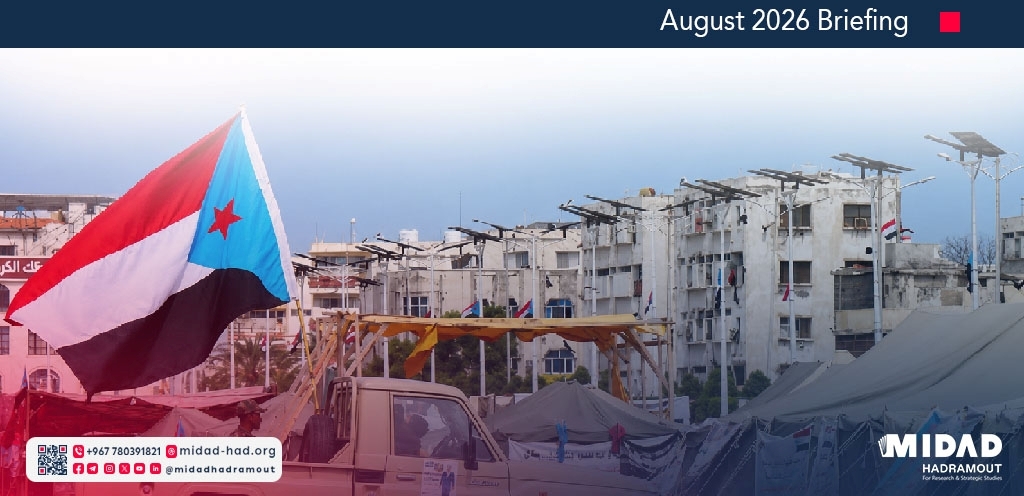


Since the end of the military transitional council’s campaign in the eastern governorates, and its departure from the area by force of arms during the operation to take control of the military camps—led by Hadhramout Governor Salim Al-Khanbashi—the political situation in Hadhramout has been relatively stable. The local authority attempted to consolidate its power, reorganize its affairs in the governorate, restore stability, and take advantage of recent developments, including the announcement of dissolving the Transitional Council. In particular, the Council had significant influence over certain government departments.
These political developments have resulted in changes in government and military positions, particularly in the First and Second Military Regions, including changes in the leadership of the National Shield Forces. Al-Khanbashi also issued several resolutions to replace certain officials in the administration of some local government departments.
Hadhramout has maintained a relatively good relationship with the “central government” and Presidential Leadership Council, as the appointment of Salem Al-Khanbashi as governor of the governorate to the Presidential Leadership Council opened the door to greater rights for Hadhramout. However, this high ceiling soon faced obstacles, particularly with the gradual deterioration of the electricity supply.
However, the apparent agreement between the governorate on the one hand, and the Leadership Council and the government on the other, soon came to an end when Governor Al-Khanbashi threatened to halt oil exports to the temporary capital, Aden, and to suspend financial transfers to the Central Bank, given that the governorate was not receiving its financial share of exported oil. “When the government exported oil, it used to give us 20% and Shabwah 20%,” Al-Khanbashi said.
The main problem with the governor’s recent statements is that they prove that there is no radical solution to the relationship between Hadhramout and the government. After Amr Bin Habrish had previously heightened tensions in the relationship, Al-Khanbashi has now heightened them once again; It is clear that, despite the passage of time, the relationship remains in a state of tension and constant threat. On the other hand, Al-Khanbashi’s recent statements once again open the door to ongoing disagreements with the central government; his threat to halt oil exports to the temporary capital, Aden, paves the way for further conflict, even if it is economic in nature, rather than political or military, as was the case with the dissolved Southern Transitional Council (STC) in the past.
If Al-Khanbashi’s threats are carried out, they will not only affect the relationship between the government and Hadhramout Governorate, but their impact will extend primarily to Aden; A disruption in oil supplies from Hadhramout would cause Aden to face a power generation deficit, leading to widespread blackouts, especially as the summer season will begin in a few months. This would bring back the difficult times Aden has experienced before, as the city was plunged into near-total darkness during previous periods in the recent past.
It is also worth noting that, although the governor is a member of the Presidential Leadership Council, he threatened to cut off oil supplies acting as governor of the governorate, not as a member of the Presidential Leadership Council. This raises further questions about the role of the Presidential Leadership Council in this tense relationship between the governorate and the government. Does the governor’s individual action indicate that the Leadership Council is unable to resolve this dispute internally without making public threats? Or could Al-Khanbashi’s recent declarations be just political statements meant to shift the blame for the failure to resolve the electricity crisis onto the government?
Both scenarios are possible; however, the statements made by Salem Al-Khanbashi—as a member of the Presidential Leadership Council, which holds authority superior to that of the government—and his threat to cut off oil supplies are clear evidence of a lack of coordination, and perhaps even conflict, within the legitimate government itself. Past events have shown that such threats and the use of oil as a means of pressure only lead to a further deterioration in basic services for citizens.
Meanwhile, another resolution that caused a lot of controversy recently was when Governor Al-Khanbashi ordered to fire hundreds of soldiers from “Barishid Brigade” who belong to Radfan, Yafaa, and Al-Dhale’a—members associated with the dissolved STC. Local authorities are defending these resolutions as steps to “Hadhramization” of security and military forces. Al-Khanbashi also called for issuing a presidential resolution to establish Barshid Brigade, in addition to resolving the conditions of members of Second Military Region and completing the reorganization of the First Military Region, in order to contribute to strengthening security and military stability in the governorate.
This move is seen as an escalation against STC and an attempt to break up its forces. The significance of such decisions would lie in whether they lead to a complete restructuring, not only in Hadhramout but in all other southern regions controlled by the legitimate government.
The latest measure, which clearly confirms the governor’s attempt to eliminate the remaining presence of the dissolved STC—and particularly its leader, Aidrous Al-Zubaidi—was a restriction on displaying Al-Zubaidi’s photos, since he is wanted by the authorities in the governorate. The governor also threatened to shut down the Transitional Council’s offices if its members remained uncooperative. and if they continue to escalate the situation.
All these measures indicate that Hadhramout is in a state of political tension—at once against the Transitional Council and the attempt to eliminate its remaining members through escalation, and at another time against the government over oil revenues. This creates many challenges for local authorities in terms of strengthening internal security on the one hand, and resolving the issue of power outages on the other.
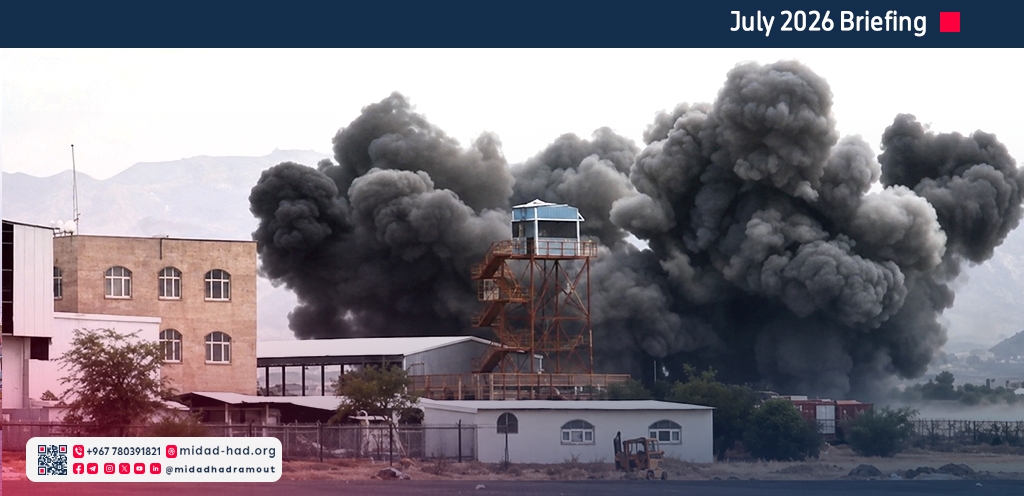
While in other parts of Yemen, the most significant political development was the Houthi militia’s announcement that it was joining Iran’s war against Israel, carrying out several military operations in the process. There were numerous reactions condemning the Houthi militia’s involvement in a regional war, particularly since the militia is unable to prevent the U.S.-Israeli coalition from bombing Yemeni territory, as has occurred in the past; several economic and civilian facilities, including ports, were bombed.
As for the dissolved STC, it continued to refuse to close its headquarters and attempted to gather and protest in front of the closed buildings, along with some of its remaining members, while rejecting any attempt at reconciliation with Saudi Arabia or any political effort to find a solution. It continued its efforts to mobilize its supporters to demonstrate complete rejection of Saudi Arabia’s actions against its forces in Hadhramout and the other eastern governorates. The dissolved Transitional Council accused local authorities of silencing people and preventing freedom of expression due to the ongoing closure of its offices, which prompted a response in a statement from the local authority in Aden affirming the freedom of expression guaranteed to all, while warning against attempts to bring chaos to the governorate.
Top News:
March 1
- The Presidential Leadership Council warns the Houthi militia and rejects the use of Yemeni territory as a launching platform for cross-border attacks.
- A broad group of “Transitional” leaders from Aden supports the decision to dissolve the council.
- The Houthi militia organizes mass demonstrations in Sana’a and the governorates in support of Iran.
March 3:
- Members of the dissolved Transitional Council hold a meeting in front of the council’s headquarters in Aden.
January 6:
- The Public Prosecutor’s Office in Shabwah issues a warrant to forcibly arrest the head of the dissolved Transitional Council in the governorate.
March 7:
- Houthi Militia: Ongoing delays in prisoner exchange despite recent agreements.
- Al-Khanbashi stresses that those manipulating the gas issue in Hadhramout must be held accountable.
March 10:
- One day after it opened, the dissolved Transitional Council complains about the closure of the General Secretariat headquarters in Al-Laham.
- Red Cross: Various Yemeni parties have demonstrated commitment to implementing the prisoner exchange agreement.
March 11:
- Yemeni Minister of the Interior: The current phase presents an opportunity to unify military and security decision-making.
March 16:
- Al-Zindani calls on the United Nations to increase its response to the growing needs in Yemen.
March 17:
- The UN envoy condemns the Houthi attack in Hajjah and calls the responsible parties to account.
- The coalition of political parties condemns the Houthi militia’s targeting of civilians in Hajjah Governorate.
March 20:
- Grundberg calls on the Houthis to release detained UN staff members.
March 21:
- The Presidential Council issues resolutions appointing a commander-in-chief and a chief of staff for National Shield Forces.
March 23:
- Sana’a: The Houthi militia conducts an armed protest in preparation for a round of conflict with Israel.
March 27:
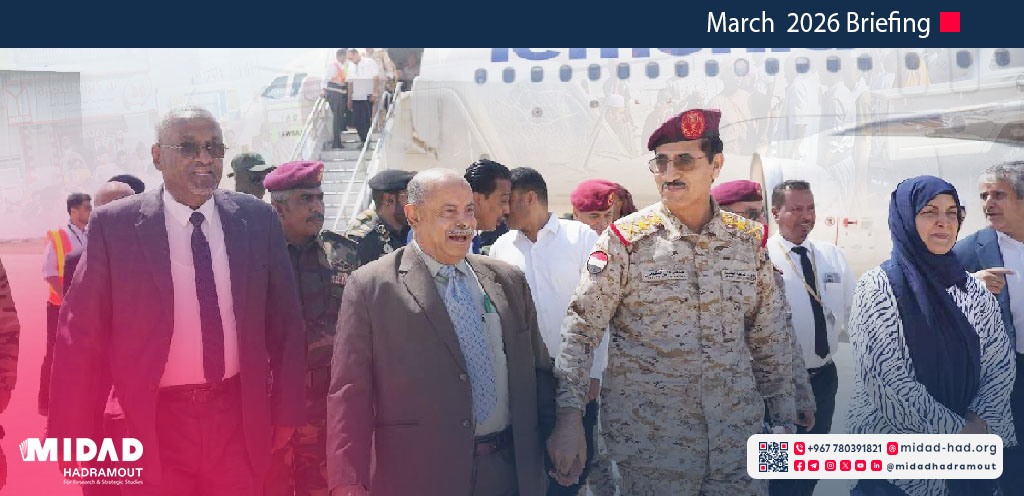
- Government officials, including the Minister of Defense, arrive in Mukalla to discuss a number of issues.
- The Houthi militia threatens direct military intervention if the Red Sea is used to launch an attack on Iran.
March 28:
- Al-Zindani discusses with the U.S. ambassador supporting the government’s efforts to rebuild state institutions.
March 29:
- Hadhramout National Council supports Al-Khanbashi’s statements regarding oil and revenues.
March 30:
- Al-Khanbashi issues a general order against carrying weapons inside Hadhramout.
March 31:
- The United Nations Mission to support Al Hudaydah Agreement concludes its work and hands over its duties to the Grundberg Office.
- The governor of Abyan issues strict directives prohibiting the blocking of roads and public routes.
Last March began with an important step: the government’s approval of the draft budget for fiscal year 2026. This marks a step forward in the economic recovery process after many years of financial and economic mismanagement and a lack of clarity regarding the country’s annual budget, which led to overspending and numerous economic problems.
The importance of this step is that it may be a solution to the problem of salary cuts and delays, which directly affects citizens’ economic situation. On the other hand, this step also strengthens the confidence of other countries, international organizations, and investors in the country; economic transparency is always a key factor in promoting investment and attracting international projects, which was followed by the signing of a financial support agreement with Saudi Arabia for 1.3 billion Saudi Riyals to cover the Yemeni government’s budget deficit by paying salaries.
The government also remains at constant conflict with powerful forces and economic instability in an attempt to collect all revenues and deposit them to the central bank—a problem that has troubled the government for many years and, in turn, leads to the government’s ongoing loss of billions.
However, this feeling of celebration soon faded quickly with the worsening of the economic crisis in areas under the control of the legitimate government, which are suffering from a lack of liquidity in the local currency. This has made it difficult for citizens to exchange their foreign currency for local currency. This was particularly difficult for many families who rely on remittances from relatives living abroad in various areas under the legitimate government’s control.
Meanwhile, several areas under the control of the legitimate government have been facing a domestic gas crisis, with a severe shortage in the local market and a resulting increase in prices. The effects of this crisis can be seen in Hadhramout, Shabwah, Aden, and others. This has caused the Ministry of Industry and Trade to issue a statement prohibiting any increase in gas prices and to increase field monitoring.
The most significant economic event in March was the low-pressure weather system that struck many parts of the country, resulting in extensive property damage and loss of life. Food and Agriculture Organization (FAO) warned that flooding threatened more than 4,000 hectares of farmland and millions of head of livestock in Yemen. This has put further pressure on poor economic situation in Yemen.
Furthermore, security measures taken by the Houthi militia against staff of UN agencies have led to a reduction in economic support provided to many organizations that previously received UN aid, which in turn is exacerbating the economic crisis, particularly in areas under Houthi control.
Various areas of legitimate government-controlled regions also witnessed the distribution of a large amount of food and in-kind aid provided by many donors, primarily the Kingdom of Saudi Arabia, on the occasion of Eid Al-Fitr. However, this aid remains insufficient compared to the significant needs of a large segment of the population, making Yemen one of the world’s most critical hunger hotspots, according to international organizations.
Top News:
March 2:
- Al-Zindani: The focus is on strengthening economic stability and increasing public revenues.
- Minister of Industry and Trade discusses strategic wheat and flour supplies to ensure market stability.
March 3:
- To increase financial resources, Yemeni government approves a package of reforms in the customs and tax sectors.
March 4:
- Al-Alaimi directs to strengthen economic emergency plans in case of escalation in the region.
March 5:
- In Shabwah, the gas and oil crisis is compounding the suffering of the people.
March 9:
- Yemen and China are discussing a 50-megawatt solar power project in Hadhramout.
March 11:
- China grants Yemen 1 million Yuan and exempts its exports from customs duties.
March 12:
- Japan provides $5.3 million to support humanitarian projects in Yemen.
March 16:
- European Union: Ready to increase support for Yemen in the area of public financial administration.
March 17:
- The arrival of fuel restores power to Al-Mahra after power cuts.
March 25:
- The United Nations states that closing Strait of Hormuz threatens food security in Yemen and several other countries.
March 27:
- Research paper: 80% of Yemeni children are in need of urgent humanitarian aid.
March 28:
- 17 people killed in flash floods, with extensive property damage.
March 29:
- The Central Bank issues resolutions to strengthen the payments infrastructure.
March 31:
- Yemen and the World Bank are discussing expanding support for development, the economy, and public services.
March is one of the most challenging months from a social perspective; heavy rains and flash floods in many parts of the country have caused significant economic and human losses. These human and economic losses highlight the deteriorating condition of Yemen’s infrastructure. Indeed, losses following each low-pressure weather system have become a general occurrence, rather than an isolated incident or a one-time event. These conditions have also been compounded by recurring problems with essential services, such as electricity and gas, across large areas of the country, which has further complicated the overall social situation.
Despite attempts by the government and local authorities in various regions to multiply their efforts to limit the damage caused by flash floods and heavy rains, the limited resources and poor infrastructure in rural and mountainous areas throughout the country have undermined the effectiveness of the government’s intervention efforts.
As for health care, the situation appears even worse. The United Nations has warned that 453 health facilities in Yemen are threatened with closure due to a lack of funding, which will make it even more difficult for many citizens to access health care, especially since Yemen is suffering from a combination of several complex diseases that are widespread across various regions, including cholera, measles, poliomyelitis, and dengue fever; therefore, the loss of any health facility would lead to even greater and more widespread problems
Despite all the efforts by the government and the United Nations, as well as the support provided by the international community—such as Europe and Japan—last month, the widespread hunger crisis in Yemen is still ongoing. March was a difficult month, but this time because of the floods.
In Hajjah Gov., the situation was even worse; the governorate has witnessed a tragic humanitarian crime, where 13 civilians were killed and others wounded in a missile strike by the Houthi militia on a house in Hajjah. This is a new crime added to the never-ending crimes committed by the Houthi group.
Top News:
March 2:
- A human rights organization confirms that the Houthi militia has been illegally detaining 74 civilians for months in Dhamar.
March 9:
- 100s of dead fish and shrimp found on Mukalla’s beaches.
March 13:
- UN female reporter calls for the release of lawyer Abdulmajeed Sabra from Houthi militia prisons, and the U.S. Center calls for the group to be held accountable.
March 15:
- Thirteen people were killed and two were injured in a missile attack by the Houthi militia that targeted a house north of Hajjah Gov.
March 17:
- Doctors Without Borders confirms that they treated about 37,000 cases of watery diarrhea in Yemen in 2025.
March 22:
- Flash floods swept through the Wadi and desert of Hadramout, causing major road closures.
- Heavy rains in Abyan; flash floods refresh agricultural lands and promise a good harvest.
- The Minister of Electricity orders urgent intervention to address the effects of the rains in Aden and other governorates.
March 23:
- The number of displaced persons has risen to 5.2 million across the country.
- A human rights official reveals that prisoners have been tortured and forcibly disappeared for years in secret prisons in southern and eastern Yemen.
March 26:
- In Sana’a, the Houthi militia kidnapped a local mediator and took him to an unknown location.
March 27:
- Flash floods cut off major roads in Shabwah, eastern Yemen.
- In Marib, a massive protest condemns Iranian attacks on Saudi Arabia and other Gulf countries.
March 28:
- 1,370 displaced families were affected by the rains and storms in Al-Jawf Gov.
March 30:
- 20 people died in Taiz Gov. due to flash floods, which also destroyed homes, cut off roads, and caused widespread property damage.
- A massive demonstration took place in Taiz to condemn Iranian attacks on Saudi Arabia and other Arab countries.
March 31:
- The International Organization for Migration confirms that access to water, healthcare, and shelter in Marib Gov. remains a challenge.
From a security perspective, Hadhramout has seen two important developments in March. The first was the local authority’s decision to forbid the carrying of weapons, a significant step toward normalizing civilian life in the city, particularly with the increase in random shootings at certain events and weddings. Security forces have begun to implement this decision and are seizing any weapons that violate it.
As for the other, more significant development: decision to dismiss hundreds of members of Barshid Brigade, which is considered part of the dissolved STC, a step that paves the way for “Hadhramization” of security forces in the governorate. However, this raises further questions about the fate of Hadhramout Protection Forces, which are loyal to Tribes Confederacy, especially since the government is seeking to restructure the forces in all areas under the legitimate government’s control, including Hadhramout. This move raises the question: Is the dismissal of members of Barashid Brigade because they come from outside the governorate, or because they are primarily affiliated with the dissolved STC? Especially since this brigade played a role on the side of the Transitional Council in its recent military offensive against Hadhramout. There is no doubt that the dismissal of these members will weaken any remaining military influence of the Transitional Council in Hadhramout.
Hadhramout has also seen several security operations that have led to the seizure of weapons, explosives, and stolen vehicles. These operations are crucial in the effort to dry up the sources of the arms trade in the governorate, especially following the looting of weapons stores in the recent period after STC’s withdrawal from the governorate. This situation poses a ticking time bomb that could explode at any moment, especially if these weapons end up in the hands of extremist or terrorist elements.
As for the restructuring problem, the government and the Presidential Leadership Council have been trying to solve it for some time, and this applies to all governorates. Nevertheless, a definitive solution to the problem still seems like a distant dream. Recently, Abyan has witnessed a period of tension due to the refusal of forces loyal to the dissolved Transitional Council to prevent the Giants’ Forces from entering the governorate. This may indicate the continuation of this state of rebellion and tension in various regions, despite differences in intensity from one governorate to another.
Meanwhile, irregular fighting continued between the National Army and Houthi militias on several fronts, most significantly in the south of Al-Hodeidah, Taiz, and Sa’ada. Although these sporadic clashes are not a new event and have been repeated frequently in recent times, it is notable this time that the attacks have become more violent, the number of attackers has increased, and the military tactics employed have become more complex. This, in turn, has resulted in casualties on both sides. Although the Houthi militia has so far failed to make any gains on the ground, it continues to attempt unsuccessfully thus far to achieve any significant breakthrough on any front.
The latest turn of events this month was the Houthi militia’s decision to enter the fight against Israel, which has shifted the nature of the military situation and could have significant implications for the military situation in Yemen. Although Israel has announced that it is defending itself against all Houthi attacks, including ballistic missiles and drones, it remains unclear how Israel might respond to these attacks. But what is certain, at least for now, is that it is unlikely we will see a major ground military campaign against the Houthi militia led by the legitimate government in the near future. The only exception would be if the Houthis were to go to war with Saudi Arabia again—a scenario for which there is currently no evidence, though it cannot be ruled out.
It can be said that there is a general sense of anticipation regarding the military situation in Yemen, accompanied by a state of mobilization and preparation on all sides; the Houthi militia continues to issue threats, while the leaders of the legitimate government consistently emphasize the importance of the battle to restore the country and the importance of preparing for it. Nevertheless, there are no real movements on the ground suggesting a return to the intensity of fighting seen in the period before the 2022 ceasefire.
Top News:
March 1:
- A meeting was held in Aden, attended by Minister of Interior, as part of efforts to restructure the security forces.
March 2:
- A U.S. surveillance aircraft crashed in Abyan Governorate.
March 3:
- Washington urges its citizens to leave 14 countries, including Yemen.
- Security tensions continue in Abyan after Transitional Forces blocked Al-Amaliqa Forces from entering.
March 8:
- Hadhramout security forces announced the arrest of a person in possession of explosive devices and weapons in Mukalla.
- In Amran Gov., there were deaths and injuries in clashes between Houthi militias and tribal fighters.
March 10:
- The National Army reports that Houthi militia members were killed in clashes in Sa’ada.
- A Houthi militia commander was killed by government forces west of Taiz.
March 11:
- Shabwah Security Committee confirms its commitment to conducting a transparent investigation into the events in Ataq District.
March 13:
- During two months, the International Organization for Migration (IOM) has recorded the arrival of more than 40,000 African migrants in Yemen.
March 14:
- The largest drug shipment since the beginning of this year was seized off the coast of Lahj.
March 15:
- Seizure of weapons looted from Al-Rayyan Airport camp in Hadhramout.
March 16:
- National Shield Forces recover a stolen military vehicle in Shibam, Hadhramout.
March 17:
- An unsuccessful attempt to detonate bombs on the road connecting the coast and Wadi Hadhramout.
March 19:
- The National Army announces that it has shot down a drone belonging to the Houthi militia in Taiz.
March 25:
- Flooding and heavy rains left one dead and 30 wounded among Yemeni army forces at Al-Wadea Port.
- Iranian military manufacturing materials heading to the Houthi militia were seized at Bab al-Mandab.
March 26:
- Yemen Government: Supply lines between Tehran and the Houthi militia remain open and have not been affected.
March 30:
- Minister of Defense holds meetings with the leadership of the First Military Region in Seiyun.
- Taiz Police arrest the second suspect in the assassination of the director of Cleanliness Fund.
Your Content Goes Here