

Last April, the political situation was unstable in various regions—from Hadhramout and the western coast to Shabwah, through Aden, and all the way to Al-Jawf, which is under the control of the Houthi militia—all of which witnessed rapid political developments. This is a clear example of the political tension currently existing in various parts of the country.
The areas under the legitimate government’s control remain politically polarized between Southern Transitional Council (STC) on one side and the legitimate government on the other. Although STC has been dissolved, its power remains influential in various regions. Hadhramout was at the forefront of these regions.
After supporters of STC attacked a demonstration in support of Saudi Arabia in Mukalla earlier this month—an incident that included attacks on the Kingdom’s political symbols and flag—the local authority in Mukalla, headed by Al-Khanbashi, responded by opening an investigation and promising to hold those involved accountable.
STC wasn’t satisfied with these developments; it called for a demonstration on April 4 to emphasize its demands for the restoration of the “Southern” state. The demonstration degenerated into bloody violence, leaving three people dead and four injured. All sides accused each other: STC accused the local authority of opening fire on peaceful protesters, while the local authority accused elements of sabotage; The local authority reported that it had observed armed individuals in civilian clothing who opened fire on security and military forces while they were performing their duties, stressing that such acts will be met with nothing but firm action in accordance with the law
This bloody incident, which resulted in a number of casualties, has opened the door to greater fears of widespread violence and chaos in Hadhramout, especially since STC continues to ignore all calls from local authorities to de-escalate the situation and prevent the governorate from descending into chaos.
Political forces in Hadhramout have also commented on these rapidly unfolding events; Tribal Confederacy has warned of attempts to drag Hadhramout into chaos, and the Yemeni presidency ordered an investigation into the circumstances of the events and compensation for the victims. These events also indicated that the local authorities have so far been unable to deal effectively with the STC’s activities. They have neither allowed the Council to practice its political activities with complete freedom, nor have they been able to put an end to its influence.
However, on the positive side, negotiations succeeded in defusing tensions between the local authorities in Hadhramout and STC through an agreement to reopen the STC’s offices, release detainees, and de-escalate media attacks. This agreement was reached with Saudi approval. Negotiations were conducted by Hadhramout Reconciliation Committee.
Although this mediation is important for maintaining calm in the governorate, it also reflects the local authority’s confusion and failure in dealing with STC. After deciding to close the STC’s offices last March, the local authorities were forced to reopen them to calm the situation in the governorate. This raises a number of questions about the strategy the local authorities are relying on to deal with the STC’s actions and the extent of its effectiveness.
In Shabwah Gov., however, conditions were more positive for the security and military forces; the local authorities in Shabwah gathered a large security force, turning the governorate into “something resembling a military barracks,” as described in a statement by STC in the governorate. This prevented the demonstration planned for April 7 in solidarity with Hadhramout from taking place, and the resulting casualties.
It is worth noting that Shabwah Governorate had previously experienced a state of chaos earlier this year, due to STC mobilizing its supporters and attempting to attack the governorate’s administrative building in Shabwah. This clearly reveals the spread of chaos across the southern and eastern governorates, along with a clear instability in the local authorities’ ability to deal with the STC’s actions.
Another political development in Shabwah that sparked widespread controversy was the blocking of the opening of Shabwah National Council headquarters, due to the failure to sign Shabwah Comprehensive Conference document; some considered the blocking to be a form of suppression of political freedom and political abuse against freedom of expression. The authorities, however, believe that Shabwah National Council would increase political division in the governorate.
Regardless of the validity of the local authority’s claim that the establishment of Shabwah National Council will lead to further division, this justification could be opened up to prevent any form of political dissent if it were to be generalized and widely applied in the governorate in future, or in other governorates. The local authority has not provided any concrete evidence to support this claim, which makes it seem more like a general excuse to deny Shabwah National Council its right to freedom of expression and political participation. The continued posting of photos of the head of STC (Aidrous Al-Zubaidi) and separatist flags has also drawn some attention in the governorate, as is the case in the other southern governorates, where the decision to dissolve the council continues to reverberate
The Political Office of the Revolutionary Movement Council, which operates under the umbrella of STC, also approved dismissing Mr. Fadi Baoum from the council’s presidency and revoking his previous decisions, in response to organizational violations and attempts to undermine the Southern National Charter. The resolution included the appointment of new leaders for STC, most significantly Ali Bin Shihna as chairman, in a proactive move by STC following attempts by Baoum and Al-Saqqaf to reactivate the “Revolutionary Movement” component independently and disconnect from STC.
These decisions open the door to a fragmentation of the dissolved STC and the resulting emergence of new political entities, each claiming to represent the southern cause. This could flood the political arena in the southern regions with new entities, as a result of the disagreement within the former STC’s structure; indeed, it is evident that there is widespread disagreement regarding how to deal with the new political developments. Some parties continue to support Aidrous Al-Zubaidi and refuse to reconcile with Saudi Arabia, while others support a positive approach toward Saudi Arabia and the upcoming South-South Dialogue Conference.
agreement aims to contain the escalating tribal tensions that followed the killing of a young man, Burhan Taha, by gunfire from these forces; residents are demanding the full arrest of those involved, the removal of the district security chief, and an end to raid operations to ensure stability in the region.
These events in Taiz indicate a state of tension prevailing in most areas under the government’s control. The southern and eastern regions are suffering from a conflict between the Presidential Council, local authorities in the governorates, and STC, while Taiz and some areas of the western coast are experiencing instability due to tribal disputes with Tariq Saleh’s forces. These tensions extend beyond their narrow regional impact, placing a burden on the state as it works to consolidate stability, move forward with development, and prepare for the battle to restore Sana’a from the Houthi militia.
In areas controlled by the Houthi militia, Al-Jawf Governorate has witnessed the most significant escalation; the Houthi militia’s arrest of the tribal sheikh Hamad Al-Hazmi has sparked tension and tribal anger in the region. This led to a tribal mobilization called for by the “Dahm” tribes, which was joined by several other tribes. Tribal mediation led by Sheikh Naji al-Shaif succeeded in releasing Sheikh Hamad Al-Hazmi from the militias’ custody one week after his arrest in Sana’a. This release comes in fulfillment of the written guarantees provided to the “Dahm” tribes in exchange for ending their “blockades” and armed protests in Al-Yatma region; Al-Hazmi appeared at his home in Sana’a, expressing his gratitude to the tribal crowds who stood in solidarity with him and forced the militias to yield to the tribal demands.
Although this is not the first time a tribal sheikh has been arrested in areas controlled by the Houthi militia, the reaction of the tribes of Al-Jawf and their support for the Dahm tribe were particularly noteworthy; indeed, the growing number of instances of tribal resistance to the militia’s arrests may be the beginning of more significant political developments. Furthermore, the deteriorating economic conditions in areas under Houthi militia control may contribute to the rise in opposition to the group; after all, economic decline always plays a role in intensifying discontent with the ruling authority, regardless of other circumstances
Despite the general sense of optimism that prevailed after the resolution of the issue involving tribal leader Sheikh Al-Hazmi, the killing of Sheikh Nasser al-Salahi by Houthi militia gunmen at a security checkpoint in Bart Al-Anan District, Al-Jawf Gov., as a result of an argument over his participation in the tribal gathering in support of Sheikh Al-Hazmi, has restored tensions in the governorate. The incident has led to renewed tensions, with Zou Mohammed tribe gathering to demand the killers be handed over, among accusations by human rights groups that the militias are pursuing a policy of direct assassinations to intimidate tribal leaders and undermine the cohesion of their communities. It remains unclear what developments may arise as a result of this incident, but it is obvious that Al-Jawf governorate will witness a state of clear tension between the tribes and the Houthi militia.
As for foreign policy, the UN Special Envoy for Yemen’s briefing to the Security Council was the most significant event. On April 14, Grundberg briefed the Council on the latest developments in Yemen; his remarks focused primarily on the deteriorating humanitarian and economic conditions caused by the war. The envoy also emphasized the danger of the Houthis involving Yemen in a broader regional war, especially with the outbreak of the Iranian-American conflict, which could further worsen the already bad economic conditions.
The briefing also included a discussion of the in-depth negotiations between the legitimate government and the Houthis regarding the release of prisoners; although progress has been made, no clear outcome has been achieved so far. As for the positive developments highlighted by the UN envoy, these included the approval of the 2026 budget for the first time since 2013. Also, the conclusion of Article IV consultations between the government and the International Monetary Fund, the first in eleven years. Despite the UN envoy’s persistent efforts, a final resolution to the Yemeni crisis does not appear to be close, especially given the accelerating regional developments, which in turn may impact the Yemeni situation.
UN Special Envoy Hans Grundberg has held a series of technical meetings in Jordan that included representatives from Riyadh and Sana’a as part of the Military Coordination Committee. The aim was to discuss ways to de-escalate tensions and enhance security in Yemen and the region. The meetings focused on continuing dialogue and maintaining the ceasefire, with the parties committing to hold future expanded meetings involving the three delegations (the legitimate Yemeni government, Riyadh, and the Houthis) to ensure the stability of the military process.
The Saudi presence has caused much speculation among observers; indeed, it raises questions about the legitimate government’s ability to make decisions independent of Saudi desires and the Saudi’s will regarding the form and manner of ending the war. This could empty the negotiations between the legitimate government and the Houthis of their meaningful content, reducing them to mere formalities for implementing any potential agreement between Saudi Arabia and the Houthi militia.
Top News:
April 1:
- A demonstration by the dissolved Transitional Council calling for the reopening of its headquarters in Aden.
April 2:
- A government-UN meeting in Aden to strengthen cooperation in the areas of population and development.
April 6:
- Houthi group: We will not attack America or Saudi Arabia from Yemen unless they escalate the conflict; the decision to target Israel is a one-sided one.
April 7:
- Resistance Council: Al-Waziyah is facing systematic aggression and a violent invasion by Tariq Saleh’s forces.
- Tariq Saleh orders an investigation committee after casualties in Al-Waziyah, Taiz.
April 8:
- Houthi leader; Ali Al-Emad: We are part of the center of Resistance, and our actions are guided by a unified vision.
- The general manager of Hadhramout Coast Oil Company was fired and another person was appointed to replace him.
April 11:
- Following armed clashes in Loder, Abyan Gov., local authorities, community leaders, and tribal sheikhs issued a warning against attempts to undermine security and stability.
April 15:</p>
- The governor of Aden (Abdurrahman Sheikh) issued resolutions appointing new directors to five executive offices, including Education, Media, Tourism, Culture, and Youth and Sports. This batch of changes is the most extensive since his appointment last January.
April 22:
- Tariq Saleh’s forces began withdrawing from Al-Waziyah, west of Taiz, as part of an agreement with the tribes.
- The Transitional Council called for a demonstration on May 4 to celebrate the ninth anniversary of the council’s establishment and to authorize Council President Aidrous Al-Zubaidi.
April 25:
- The former head of the Political Office of the Southern Revolutionary Movement (Fadi Baoum) threatens STC with exposing corruption cases and taking over lands in Aden.
The economic situation has seen a general decline, similar to the general deterioration experienced by various governorates, amid the ongoing crises affecting them all. The news that salaries had been paid to both military and civilian personnel was a bright spot amid these crises and mounting economic pressures.
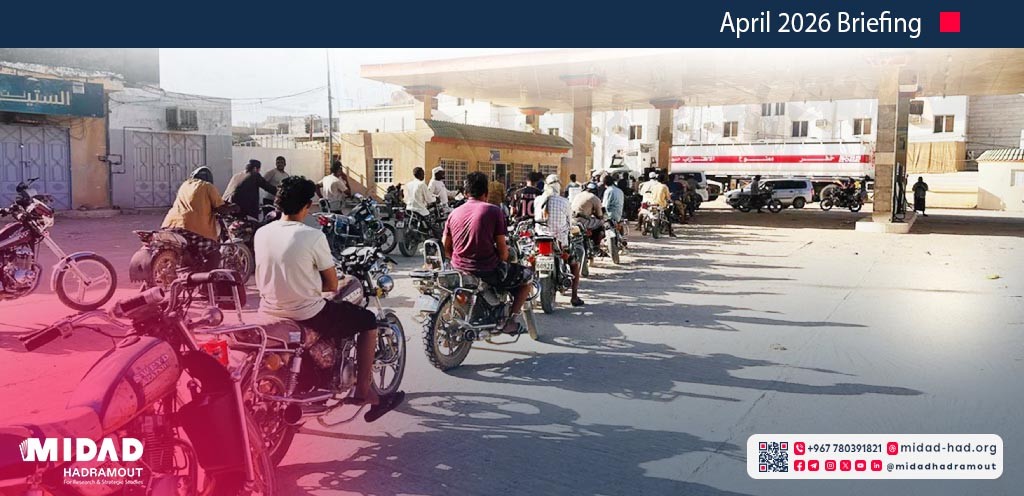
From Hadramout as a starting point, the districts of Wadi and Sahra Hadhramout have experienced a severe shortage of petroleum products, which in turn has brought daily life to a standstill and led to long lines at gas stations. This crisis resulted from a decline in oil supplies, which in turn led to a revival of the black market for petroleum products.
The gradual deterioration of electricity service in Hadhramout Governorate has also raised concerns about what the situation will be like in the summertime, especially as temperatures continue to rise. This led the local authority, represented by Salim Al-Khanbashi, to discuss the matter with Electricity Minister Adnan Al-Kaf. The meeting focused on urgent power generation needs to meet summer demand, fuel supply issues, and maintenance plans to improve grid efficiency. The two sides also reviewed strategic projects, including the installation of two 100-megawatt power plants each in Sahel and Wadi Hadhramout, to improve service stability.
Despite the importance of these promises and the huge impact that the installation of two power plants could have, these promises remain widely met with suspicion. Successive local authorities in Hadhramout have repeatedly promised to build power plants and end the electricity crisis, but none of these promises have been fulfilled.
In Al-Mahra, however, there was a complete power failure due to a tribal conflict in Hadhramout. This has placed civilians in Al-Mahra in a critical situation. In Shabwah, meanwhile, tens of fuel tankers have also been detained. This, in turn, has exacerbated the fuel crisis.
On the monetary side, areas under the government’s control are experiencing a severe cash flow crisis described as the worst ever. This crisis is attributed to difficult economic conditions caused by the suspension of oil exports due to the war. Additionally, some local authorities in Marib, Hadhramout, Al-Mahra, and Taiz have refused to transfer their revenues to the Central Bank in Aden, leading to the accumulation of trillions of Riyals outside the banking system at currency exchange companies.
This crisis is having a direct impact on the government’s ability to pay employees’ salaries and supply fuel to power plants in some governorates. It is also affecting the overall business situation across all governorates. This, in turn, will lead to an economic downturn and exacerbate the difficult economic situation faced by the general public.
As for the flash floods, they have caused real economic disasters: the death count in Taiz has risen to twenty-four, thirty-one thousand families have been affected, and losses exceed fifteen million dollars. The poor weather conditions also threaten more than 400,000 hectares of farmland, which in turn will cause significant damage to the agricultural sector, on which a large portion of the population in various governorates depends.
As for the International Monetary Fund’s report, issued at the conclusion of the 2025 Article IV consultations, confirmed that the Yemeni economy remains under severe strain due to institutional fragmentation and conflicting fiscal and monetary policies, which have led to the erosion of public revenues, a worsening fiscal deficit, and inflationary pressures.
The report explained that the disruption of productive sectors and the country’s excessive reliance on foreign aid have deepened the humanitarian crisis, emphasizing that any future recovery remains conditional on the implementation of comprehensive structural reforms. Although the Central Bank has been attempting to implement these reforms for some time, it appears that they have yet to be reflected in a real improvement in economic conditions in areas under the control of the legitimate government.
Top News:
April 2:
- The United Nations provides emergency aid to about 12,000 people affected by floods in Yemen, with European support.
- Kuwait supports the distribution of 400 food baskets to flood victims in Mokha.
April 6:
- United Nations: Humanitarian operations in northern Yemen have collapsed as a result of violations by the Houthi militia.
April 8:
- Al-Mahra approves a $647 million development plan and prepares to launch it officially.
April 13:
- The government approves a draft resolution to establish Al-Dhale Hospital Authority.
- Yemeni-French talks to strengthen cooperation in the electricity sector and support energy reforms.
April 16:
- Yemeni Oil Minister inspects the Aden refinery and confirms efforts to restart operations.
April 19:
-
-
- 2 million dollars were allocated to establish the foundations for three water projects in Marib, funded by Saudi Arabia.
- The UN warned that 18 million Yemenis are at risk of severe hunger.
<
-
/ul>
r=”ltr”>April 20:
- Ministry of Transport announces arrangements for resuming transit operations to Port of Aden.
ir=”ltr”>
- April 22:
- The Presidential Council emphasizes the closure of any accounts outside the Central Bank.
- Aden: A shortfall of nearly 60 percent in electricity supply due to fuel shortages.
April 24:
- The gas crisis in Marib has worsened for the fifth consecutive day amid calls for urgent solutions.
April 28:
- A presidential initiative has led to the reopening of Nashtun port in Al-Mahra after it had been shut down.
The social situation across all governorates has deteriorated sharply. It is mainly reflected in two aspects: the health and humanitarian aspects. In terms of health, various governorates have seen a large number of cases of various diseases; Wadi Hadhramout’s health authorities alone reported five deaths from measles and more than a thousand cases. Many other governorates have also suffered from the same disease, bringing the total number of cases in the first three months of this year to 5,600, with 21 deaths.
In light of this rapid spread, the Ministry of Health has warned of a return of measles and diphtheria and has called for urgent support for vaccination campaigns. World Health Organization reports that 64% of Yemen’s population is now at risk of infection with malaria. This means that millions of citizens are at risk of catching the disease, which exceeds the capacity of hospitals in areas under the government’s control, indicating that tragic conditions may arise if serious and urgent action is not taken. This is why Yemen tops the global rankings in terms of the number of cases of cholera, measles, malaria, and dengue fever.
On the humanitarian aspect, weather conditions played an exacerbating role; floods in Taiz led to the deaths and injuries of forty-three people and the displacement of twelve thousand families, while more than two thousand displaced families in Marib were affected by the rains and storms, amid UN warnings of massive floods and impending disasters.
On the human rights side, the International Organization for Migration has documented the displacement of more than 5,000 people since the beginning of this year. Reports also indicate that 3.2 million children are out of school, with some 200,000 child casualties documented during the years of the ceasefire. This also comes in conjunction with human rights violations committed by various political and military groups, particularly in Houthi-controlled areas, where there has been a significant escalation in human rights violations against both journalists and civilians.
The killing of Abdurrahman Al-Alimi inside the Security Belt Forces’ detention facilities in Aden has caused widespread anger after his body was returned to his family bearing signs of violent torture. The incident began on the second day of Eid Al-Fitr when contact was lost with Abdurrahman, a father of five, and it was later discovered that he had been detained in Sector 8 in Sheikh Othman District before being transferred to Al-Soulban Camp prison.
Meanwhile, the victim’s family rejected the security authorities’ explanation that he had committed suicide by hanging, saying that the body shows clear evidence of a homicide. The family has sent an urgent complaint to judicial and security authorities and the attorney general, demanding an immediate and transparent investigation. In addition to the regretful human rights implications highlighted by this case, it also presents a challenge for the security forces to demonstrate their commitment to ensuring justice for the oppressed and holding members of the security forces responsible for their actions.
In Hadhramout, the governor, Salim Al-Khanbashi, has pledged to bring justice to the victims of the terrorist attack that targeted Al-Ziar Masjed in Yabath District in 2022, confirming that the crime will not go unpunished. During his meeting with the victims’ families in Mukalla, Al-Khanbashi insisted that the authorities are committed to completing the legal proceedings to bring those involved to justice and compensate the families. He considered this a priority for establishing security and stability. This step comes four years after the incident, in response to the families’ constant demands that the criminals be brought to justice. It reopens one of the most sensitive humanitarian cases that Hadhramout has witnessed in recent years; this crime touched the hearts and emotions of people from all groups of Hadhramout society.
Top News:
April 7:
- The Journalists’ Union condemns the detention of Amjad al-Rami in Hadramaut without legal justification.
April 12:
- Following an extensive search operation, it is announced that two brothers who were fishermen have died in Shabwah.
April 13:
- Human rights report: 2,421 grave violations in Yemen in 2025, the Houthis at the top of the list.
April 15:
- UN agencies: Flooding in Yemen worsens, with warnings of a massive disaster and predictions of heavier rains.
April 16:
- Eight deaths and hundreds of measles cases in Taiz, along with a health warning urging immediate vaccination of children.
April 18:
- A human rights organization records about 2,000 child victims in Yemen during the years of the truce.
April 21:
- The Minister of Health discusses the spread of measles as cases rise.
April 23:
- Amnesty International calls on the Houthis to release the lawyer Abdulmajeed Sabra.
The security and military situation has seen developments in various regions of the country, which can be summarized under several main headings: The first is the reintegration of the security forces under the legitimate government, particularly following the dissolution of the Transitional Council and the emergence of military formations that have demonstrated their capacity for military victory, particularly Hadhramout Protection Forces belonging to Hadhramout Tribal Confederacy.
Hadhramout Protection Forces, led by Sheikh Amr Bin Habrish, announced the initiation of administrative procedures to integrate its members into the security forces under the command of the Ministries of Defense and Interior. This is in implementation of the decisions of the President of the Presidential Leadership Council, with the support of the Saudi-led Arab Coalition. The statement emphasized that this step aims to unify the military and security agencies in Sahl and Wadi Hadhramout and enhance their efficiency, while renewing the commitment to operate under the umbrella of the state and its legitimacy, to promote stability and national unity.
This step is crucial for consolidating security stability in the governorate, and it is also an important step toward achieving the goal of full Hadhramautization of all security forces in the governorate. Although the statement did not clarify whether Hadhramout Protection Forces will join the Second or First Military Region, or whether they will be integrated as a separate military formation under the Ministry of Defense, it is certain that this decision can be considered an achievement for these forces, which played a major role alongside the state against STC’s forces during the operation to take over the military camps.
Also in Seiyun, an initiative was started to integrate Hadhrami Elite forces into the security agencies operating in Wadi and Desert Hadhramout, in line with efforts to strengthen stability in the governorate. Local authorities and Ministry of Interior officials emphasized the importance of this step in unifying security efforts and enhancing the professional competence of personnel under the state’s umbrella, with a focus on intensifying security deployments and securing vital sites to ensure public peace in Wadi and Desert of Hadhramout.
Although both Hadhramout Protection Forces and Hadhrami Elite Forces are composed of Hadhrami men, the difference lies in the nature of their support and their political affiliations. While Hadhramout Protection Forces have raised Hadhramout’s flag from the beginning, Hadhramout Elite Forces were part of the forces affiliated with the Transitional Council; they received direct support from the UAE and have raised the flags of the Southern State for many years.
The goal should not be integration for integration’s sake, but rather integration to safeguard national principles, which are an integral part of the state’s entity and its constitution. Military events, particularly STC’s entry into Hadhramout, have demonstrated that some military commanders in the Second Military Region ignored or failed to fulfill their roles in repelling the forces of the dissolved STC, which called for division.
The first step in dealing with Hadhrami Elite Forces must be to restructure their leadership and remove those commanders who may have dual loyalties or who are against the national project. This should be accompanied by a gradual process of changing the military values held by soldiers and officers, so that they are dedicated to protect the unity, the republic, and the constitution—and no other political agenda.
In the same context, government sources have revealed that the first phase of the restructuring and consolidation of military and security units under the command of Ministries of Defense and the Interior is almost complete, under the direct supervision of the Saudi-led coalition. This phase, which began in the eastern military regions, focused on building a unified database using fingerprinting technology, which resulted in the uncovering and removal of tens of thousands of fake and duplicate names. In addition to its military significance, this achievement is also important from an economic standpoint; it protects the country from widespread corruption and the waste of huge amounts of money that could otherwise be used to improve economic conditions and invested in more beneficial projects
While the military integration process has been successful in Hadhramout, various media sources have reported on a document issued by the so-called “Joint Operations Committee of the Southern Forces” regarding the establishment of three new combat centers belonging to STC outside the framework of the Ministry of Defense. The newly established centers cover a wide geographical area extending from Abyan and Shabwah to Bab Al-Mandab and Al-Dhale’, with command bases and leaders for each center. This move reflects the Council’s continued efforts to strengthen its independent military formations outside the structure of the official armed forces. This clearly indicates that the escalation led by STC on the political side, which we have previously discussed, is also accompanied by an escalation on the military side. Furthermore, the fate of the military equipment withdrawn by STC after its departure from Aden following its defeat in the battle to take over the military camps remains unclear. This could allow it to arm any new forces it forms, especially in light of the lack of Emirati military support since the UAE’s withdrawal from Yemen.
The second center is the military state of alert declared by the legitimate government, backed by Saudi Arabia, in an attempt to contain any political or military escalation by STC. It does not appear that the military integration process in the Aden, Al-Dhale’, and Yafaa regions will proceed as smoothly as it did in Hadhramout. Saudi reinforcements, along with those loyal to the legitimate government, have arrived in Aden and Shabwah in an attempt to prevent any escalation of tensions resulting from STC’s actions.
The government, backed by Saudi Arabia, is attempting to normalize the situation and strengthen security and stability without engaging in open confrontation with STC. It is worth noting that many of STC’s security and military leaders still hold official security or military positions, even if some have been replaced. This gives STC significant influence in certain sectors and areas in Aden, Al-Dhale’, Lahj, and Yafaa.
Hadhramout also has witnessed a state of security chaos due to demonstrations by STC, which resulted in several deaths and injuries, in a situation of mutual accusations between the local authorities and STC about who was responsible for the casualties.
The third trend that can be observed in the security and military sector in April is the breakdown in security affecting various areas under the control of the legitimate government. Aden has seen the assassination of Dr. Abdurrahman Al-Shaer, chairman of the board of directors of Al-Nourus Private Schools and a leader in Islah Party. This incident, which has been widely condemned, has raised fears that the shadow of assassinations may return to Aden, a city that has suffered a tragic history of such attacks, which have targeted religious, social, and political figures.
Although the security forces performed with a high level of professionalism, Aden Security Administration announced that it had detained four key suspects in the assassination of education leader Abdurrahman Al-Shaer and seized the car and weapon used in the crime. Initial investigations have revealed that a large cell was behind the operation and had been planning to target religious leaders and Imams. The arrests were carried out as part of a large-scale security operation covering the governorates of Aden and Abyan, amid promises by security officials to pursue the remaining suspects and break up the cell’s networks. However, this operation highlights the security challenges suffered by areas under the control of the legitimate government. Especially since this operation coincided with broader chaos: a lieutenant colonel was killed, and five soldiers from the National Shield Forces were wounded as a result of an armed ambush targeting their military vehicle in Al-Abar, in Wadi Hadhramout. Sources identified the victim as Lieutenant Colonel Faraj Al-Aghbari, who died from his injuries at the hospital. The suspects remain unknown in light of the repeated assassinations and ambushes occurring in the area extending toward Al-Wadiah port and the border of Marib Governorate.
Hadhramout is still suffering from the consequences of the chaos that took place following the withdrawal of forces from the dissolved Transitional Council from the governorate. Security forces in coastal Hadhramout announced that they had seized a quantity of heavy weapons, including ammunition and mortar shells, in Fawwa area west of Mukalla city. Security officials in the governorate confirmed that the operation was carried out after intensive investigations, and emphasized that they would continue to pursue smugglers of stolen weapons and respond to any attempts to destabilize the region, while transferring the suspects and the seized items to the relevant legal authorities. Meanwhile, Mukalla police in Hadhramout Governorate announced the seizure of a box containing twenty explosive devices that had been in the possession of a 33-year-old man. The Security Media Center of the Ministry of the Interior confirmed that the suspect had been detained, the seized items had been secured, and the necessary legal procedures had been initiated to pursue the case. These repeated incidents involving the discovery of heavy weapons or explosive devices demonstrate that security forces in Hadhramout still have a great deal of work ahead of them to try to eliminate the looted weapons that remain hidden or are being smuggled into the governorate.
The security instability was also evident in Shabwah, where Al-Waziyah District witnessed armed clashes between armed men belonging to Sheikh Ahmed Salem Haider Al-Mashouli and forces from the “National Resistance.” These clashes escalated and eventually led to the withdrawal of Tariq Afash’s forces from the district.
In Abyan, Commander of Brigade 103, Brigadier General Abdulqadir Ali Al-Ja’ari, and six other members of the National Security Forces (formerly the Security Belt) were killed in a security incident in Abyan Governorate. Local authorities have not announced any further details. Meanwhile, Loder city has witnessed armed clashes between tribal armed groups and a former commander of the forces of what was known as the Security Belt, named Saddam Gharama, against the backdrop of previous disputes between the two sides. This led to decisive intervention by the local authorities in Abyan, as stated by the governor, who promised to put an end to any chaos in the governorate.
Also in Abyan Governorate, police announced the completion of a five-day security campaign that resulted in the arrest of twenty-five smugglers and the dismantling of illegal migrant camps along the coastline. These actions came in response to public anger after the revelation of brutal abuses suffered by migrants. At least one soldier from the security forces was also wounded.
Hussein Abdurrahman Al-Maysari, head of STC in Modya district, also survived an assassination attempt by unidentified gunmen on a motorcycle just before Friday prayers in Abyan governorate. The attack left Al-Maysari with serious injuries to his neck and back, and he was subsequently transferred to intensive care in critical condition, while the attackers fled the scene without any official comment from security authorities.
Although Abyan has suffered from multiple security disturbances this month, security efforts have also been evident; a joint security campaign was carried out in Abyan Governorate to remove illegal checkpoints in Al-Mahfad District. The campaign resulted in the arrest of three suspects and the seizures of unofficial tax collection receipts that had been imposed on trucks on the international road. These operations were carried out in accordance with the governor of Abyan’s order to stop all illegal payments. The security force also came under fire from an armed ambush on its way back, resulting in one soldier being wounded. Despite the importance of these operations, it is clear in this context that the security campaign against unofficial fees will not be easy, given that these disruptions are mainly linked to influential figures and those who benefit economically from large sums of money.
The situation in Al-Dhale’a was no better; the governorate witnessed an escalation in security tensions, as armed men attacked a security checkpoint in the Al-Azraq district. This was in response to security measures taken against wanted individuals. This attack came one day after armed groups led by Raafat Ali Khalid broke into the governorate building in Al-Dhale’a in protests against Governor Major General Ahmed Al-Qabba’s orders to remove illegal collection points, resulting in injuries to the director of the governorate’s Culture Office.
Despite these escalating attacks, the local authority in the governorate has affirmed its commitment to show restraint in order to protect civilians and prevent the governorate from descending into chaos. It has emphasized that it will continue its efforts to enforce the rule of law and strengthen security and stability, and has warned that those involved in the incident will be held accountable.
The fourth point was the ongoing occasional clashes between government forces and Houthi forces. Al-Salo and the western front in Taiz have seen clashes that have resulted in casualties on both sides. The northern fronts of Al-Dhale’ also saw further clashes, in which both sides lost a number of soldiers. Although these ongoing attacks, despite their limited scale, have not led to any real change on the battlefronts nor resulted in any gains for either side, they are taking a toll on all parties involved. More importantly, they have led to continued instability, which negatively impacts the lives of civilians in these areas and deprives them of any opportunity for investment or development.
Top News:
April 2
- Conflicting reports regarding an airborne landing on Mayun, amid talk of a foiled airborne landing on the island of Mayun.
- The security director of Mukalla was fired, and a committee was formed to investigate recent events in Mukalla.
April 4:
- Hadhramout Local Authority: Armed men wearing civilian clothing opened fire on security and military forces.
April 6:
- The Second Military Region prevents the smuggling of a shipment of weapons into Shabwah.
April 8:
- Houthi militias launch a pursuit campaign in Dhamar after their slogans were erased.
- A large quantity of medium-caliber ammunition was seized in Aden.
April 9:
- Fourteen thousand mines, explosive devices, and munitions from wartime remnants were destroyed in Hadhramout.
April 12:
- British Navy: An incident occurred 54 sea miles southwest of Hodeidah.
April 14:
- Emergency forces seized more than fifty oil tankers that were headed for the black market.
April 18:
- Government forces shot down a Houthi militia drone in Al-Jawf.
April 20:
- Amr Al-Shimiri, an officer with Criminal Investigation Department, was assassinated in Taiz.
April 21:
- The Security Committee in Marib promised to take action against acts of sabotage and roadblocks.
April 29:
- An officer was killed in Dar Sa’ad District after being shot; gunmen transported his body to an unknown location.
April 30:
- Al-Alaimi replaces the commander of the 4th Military Region and appoints Brigadier General Hamdi Shukri as his substitute.
- A military arrest warrant is issued for Asil Bin Rashid, commander of the 4th Infantry Brigade in Shabwah, who is associated with STC.
Your Content Goes Here