

The political scene in May has not seen any major developments or events that could mark a turning point in the Yemeni crisis, whether in areas controlled by the legitimate government or in those controlled by the Houthi group; The developments that took place this month were a continuation of what happened in recent months, with no exceptional events to shift the political landscape. However, they brought three interrelated issues back into focus: the situation of prisoners and detainees, the relationship between the legitimate government and the Southern Transitional Council, and the future of Hadhramout in light of declining confidence in public services and economic promises.
- Prisoners’ agreement and limits of humanitarian relief:
In May, the announcement of a prisoner exchange agreement between the Yemeni government and the Houthi group, negotiated under UN auspices in Jordan, was the most significant political and humanitarian development. The agreement states that about 1,750 detainees from various parties, including 27 from the coalition forces, will be released following a protracted round of negotiations that lasted nearly 90 days.
Despite the humanitarian nature of the agreement and its limited potential to revive the process of building trust between the parties, its implementation remains subject to overcoming a number of political and humanitarian complications, primarily the case of the kidnapped politician Mohammad Qahtan. The Yemeni government has stressed the need to clarify his situation before proceeding with the deal, while his family continues to reject the unofficial reports regarding his death and holds the Houthi group responsible for his safety
The agreement was significant in that it served as a practical test of the ability of the parties, as well as regional and international sponsors, to use humanitarian understandings as a stepping stone toward broader confidence-building. However, the risk of failure remains unless outstanding issues are addressed transparently—most significantly the case of Mohammed Qahtan—and unless steps are taken to ensure that humanitarian issues are not used as a tool for political pressure or negotiation.
- Ongoing tensions between the Yemeni government and the Southern Transitional Council:
The second political development is the ongoing tension between the Yemeni government and the dissolved Southern Transitional Council. This comes at a time when disputes continue over the future of political and military arrangements in the southern governorates, as well as the scope of partnership within the institutions of the internationally recognized government.
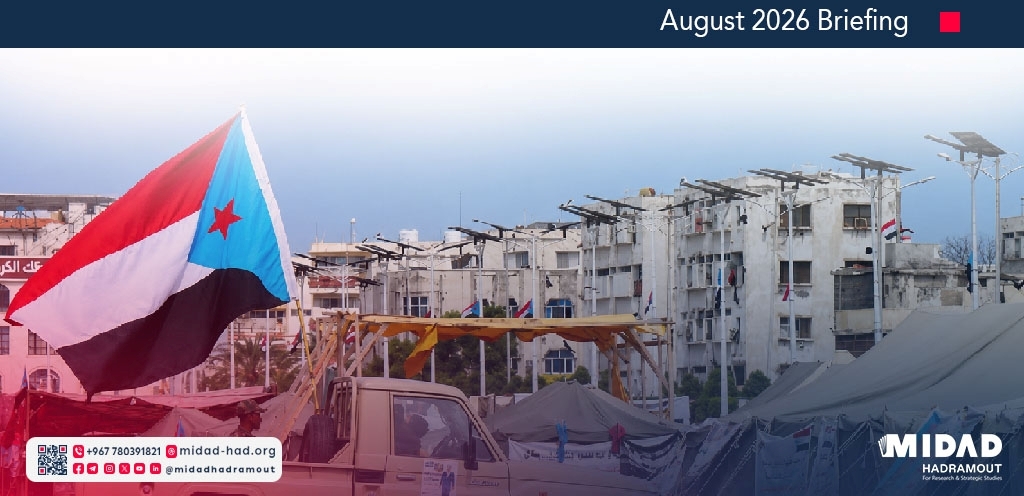
The temporary capital, Aden, has witnessed a massive demonstration by supporters of the Transitional Council on the anniversary of the Council’s founding, which clearly demonstrates the Council’s ability to mobilize support, regardless of whether that support is waning or not. A statement attributed to Al-Zubaidi was also published, in which he rejected the restructuring of the army and reaffirmed his commitment to separation. This suggests that this political tension will continue for some time.
The political statements issued by its leadership also reaffirmed its commitment to its political choices and its rejection of any arrangements that could be seen as a reduction in its military or political influence, including issues related to the restructuring of the armed forces, rapprochement with the government, or with Saudi Arabia outside of its stated conditions.
For decision-makers, the significance of this issue lies in its direct impact on the stability of the temporary capital, Aden, and on the government’s ability to implement unified security and administrative reforms, as well as its implications for the path toward any comprehensive political settlement in Yemen.
- The return of the debate over the future of Hadhramout and parallel local tensions:
As for the third political development, it was the announcement by Hadhramout Future Forum to publish a draft document on self-rule, which is a forward-looking political project rather than a short-term one. This step marks a return to the debate that heated up at the end of last year and the beginning of this year regarding the political future of Hadhramout, how realistic Hadhramout self-governance project is, and the limits of its ability to develop a unique model for managing its resources and local affairs.
The resumption of this debate coincides with a deterioration in public services, particularly electricity and fuel. Especially since these crises follow previous economic promises, the call for self-rule cannot be separated from the growing frustration with the performance of state institutions and local authorities, nor from the repeated demands to ensure Hadhramout’s fair share of resources, services, and political decision-making.
The recent sad security incidents in areas under the control of the legitimate government, particularly in Aden, have sparked political reactions from leaders of the legitimate government, especially the assassination of Wissam Qaid, the media coverage, and the public reaction to the rape of a child in Aden. However, these reactions do not constitute a significant political development.
At the same time, certain security and criminal incidents in areas controlled by the internationally recognized government—particularly in Aden, such as the assassination of Wissam Qaid—provoked widespread political and public reactions, but these reactions remained more indicative of a lack of trust between the public and security institutions than a political shift in itself.
In areas controlled by the Houthi group, however, the Houthis’ violation of the agreement to release Sheikh Hamad Al-Hazmi has sparked widespread outrage among Dahm tribes in Al-Jawf Governorate. The tribes are currently threatening to resume “breaches of agreements” and escalate tensions on the ground in response to the continued detention of the sheikh and the woman who sought refuge with him to escape abuses by Houthi leaders. This risks leading to further escalation between the Houthis and the tribes. However, past experience with the Houthis shows that they have consistently managed to resolve issues with the tribes in some way without their influence or authority being significantly affected.
All of these developments suggest that the Yemeni political landscape is shaped not only by formal negotiations, but also by mounting local pressures related to services, resources, justice, and trust in institutions. These are issues that are likely to increasingly influence the prospects for stability in the coming period.
Key indicators of political monitoring:
|
Date |
Event |
Political Implications |
|
May 2 |
The revolutionary movement in Hadhramout is holding a large-scale meeting in preparation for the Riyadh dialogue. |
The Southern Movement’s continued efforts reflect its attempt to reposition itself within any future political arrangements. |
|
May 4 |
The Chairman of the Presidential Leadership Council heads a mini-meeting of the government and stresses the need to bring to justice those responsible for the assassination of Wissam Qaid. |
it indicates an attempt to contain the repercussions of security incidents on the government’s image and the confidence of international partners. |
|
May 4 |
UN Special Envoy Hans Grundberg condemns the assassination of Wissam Qaid. |
This reflects the sensitivity of security incidents in Aden to the international community and the importance of supporting institutional stability. |
|
May 5 |
The Transitional Council is organizing demonstrations in Al-Mahra during a period of political tension. |
It indicates that the Council continues to expand its political presence outside Aden and to keep the issue of the south on the agenda. |
|
May 7 |
Al-Khanbashi discusses the launch of a coordinating council for political and social components. |
This reflects attempts to establish local coordination frameworks that are not intended to replace political parties, but which may influence the balance of political representation. |
|
May 10 |
Al-Alaimi confirms that recent assassinations are targeting international partners’ confidence in the Yemeni government. |
This official statement links internal security to the government’s ability to maintain international support. |
|
May 13 |
The Prime Minister affirms that terrorism and chaos will not succeed in undermining the state’s presence and its institutions. |
This reflects a government policy to strengthen the state’s authority in dealing with security and service challenges. |
|
May 17 |
The European Union welcomes the prisoner exchange agreement and hopes it will pave the way for a political settlement. |
It highlights international partners’ interest in using humanitarian issues as a means to build political trust. |
|
May 20 |
The government has announced that the prisoner exchange may begin in the middle of June. |
It puts the agreement to the test of implementation, especially in light of unresolved issues such as the case of Mohammad Qahtan. |
|
May 20 |
Political parties and civil society groups in Shabwah have rejected what they described as a one-sided vision of Shabwah Comprehensive Conference. |
It reflects the ongoing local competition over the legitimacy of political representation in the eastern governorates. |
|
May 24 |
The Deputy Chairman of the House of Representatives attacks the Presidential Council, accusing it of being controlled by foreign powers. |
It reveals the growing criticism from inside the legitimate government regarding the Presidential Leadership Council’s performance and its relationship with regional actors. |
|
May 25 |
The Transitional Council criticizes Al-Al-Aimi’s speech on Unity Day and accuses Riyadh of fabricating the will of southerners. |
It reinforces the ongoing political dispute between the Transitional Council and the government over the future of the Southern issue and a comprehensive settlement. |
The economic situation was one of the most deteriorating sectors in May, as several government resolutions negatively impacted citizens’ standard of living. Furthermore, the decline in service provision in many areas led to widespread public anger and discontent.
The 24.5% increase in fuel prices was one of the most significant decisions that sparked public concern in May, considering its direct impact on transportation costs, commodity prices, supply chains, and everyday services. This increase is particularly sensitive because fuel is involved in most economic activities, from internal transportation to food transport and the operation of essential services.
Furthermore, the government’s decision to adjust the customs dollar rate has sparked widespread debate. This, in turn, will lead to an increase in prices. The government defended this decision by stating that it applies only to luxury goods and not to basic necessities. However, these promises were not enough to calm the public, as the government’s statements were seen as nothing more than a way to appease the public.
These decisions coincided with a deterioration in essential services; Aden has seen a sharp breakdown in its electricity grid, which has led to the shutdown of water treatment plants in some areas, while Hadhramout has suffered from power outages and fuel shortages. As well, Taiz has been suffering from a domestic gas crisis, and demonstrations have been held to protest these conditions. These crises reveal that the economic problem is no longer limited to indicators such as revenues or exchange rates, but has become a part of citizens’ daily lives. Extended power outages, reduced fuel availability, and disruptions in gas supplies are all factors that are deepening public frustration and increasing pressure on local authorities and the central government, especially as summer begins and demand for electricity and water rises.
Furthermore, the government’s public statements to international bodies and UN agencies clearly indicate that the government continues to rely heavily on foreign aid. Moreover, international and Saudi support in the health, infrastructure, water, and agriculture sectors remains essential to alleviating the crisis, but it cannot serve as a substitute for institutional reforms in resource management, revenue collection, the fight against corruption, and improving the efficiency of public spending
Key indicators of economic monitoring:
|
Date |
Event |
Political Implications |
|
May 3 |
The opening of “Abu Halifa” Village for flood victims in Taiz, funded by Kuwait, which includes 80 housing units. |
This reflects the continued importance of external funding in addressing housing and humanitarian needs, particularly in areas affected by disasters and displacement. |
|
May 4 |
Presidential instructions to control fiscal revenues and ensure a conducive environment for relief efforts as part of the return to the economic recovery plan. |
It indicates an official recognition of the importance of revenue and the relief environment in supporting recovery, but it remains subject to clear implementation mechanisms. |
|
May 6 |
Water stations in Aden have shut down due to a power outage. |
It highlights the critical link between electricity and water, and shows that the energy crisis is quickly turning into a crisis of basic services. |
|
May 6 |
A severe power outage in Aden. |
It reflects the fragility of the electricity sector in the temporary capital and increases the chances of popular anger during the summer. |
|
May 6 |
A destructive attack on power transmission lines in Marib causes a loss of 1/3 of the electricity supply. |
It highlights the impact of security threats and destruction on the stability of critical services and infrastructure. |
|
May 8 |
The Import Regulation and Financing Committee approves measures to enhance efficiency and address challenges. |
It refers to efforts to regulate imports and alleviate imbalances amid pressure on the currency and markets. |
|
May 12 |
Discussions with the United Nations to enhance the project of rehabilitating the port of Aden and the transportation sector’s infrastructure. |
It reflects the importance of ports and transportation infrastructure in any path to economic recovery and the improvement of supply chains. |
|
May 12 |
Yemen and China sign a development cooperation agreement of 50 million yuan. |
It serves as an indicator of the ongoing search for development partnerships beyond the framework of traditional aid. |
|
May 13 |
A delegation from the government, the Netherlands, and FAO are inspecting agricultural and water projects in Hajer district, Hadhramout. |
It highlights the importance of the agriculture and water sectors in Hadhramout, particularly in light of the challenges of drought and food security. |
|
May 13 |
New British aid of $33 million for Yemen’s health sector. |
It confirms the continued reliance of essential service sectors, including health, on international funding. |
|
May 18 |
A government meeting approves a number of urgent measures to address the electricity situation in Aden and the liberated governorates. |
It reflects the fact that the electricity crisis has become an urgent government priority, without necessarily implying that sustainable solutions are in place. |
|
May 19 |
The Presidential Leadership Council defends the decisions to adjust the customs dollar rate, describing them as part of comprehensive reforms. |
It highlights an official effort to frame financial decisions as part of a reform process, in contrast to public concerns about their impact on prices. |
|
May 23 |
The World Bank reports that Yemen’s economy has contracted again amid growing pressure from the conflict in the region. |
It confirms the continued fragility of the overall economy and its impact on the local conflict and regional tensions. |
|
May 24 |
The UN has issued warnings about a severe heat wave and a drought crisis threatening Yemen’s agricultural sector. |
It highlights the interconnection between the climate crisis, food security, and rural livelihoods. |
|
May 27 |
The United Nations reports that half of Yemen’s population is unable to meet its food needs. |
It reflects the depth of the food security crisis and the decline in households’ purchasing power. |
|
May 28 |
Saudi Arabia announces it will provide $150 million in oil derivatives to Yemen to operate power plants. |
It provides vital support to alleviate the electricity crisis, but it reveals the sector’s continued reliance on emergency measures. |
|
May 30 |
Yemenia Airlines cancels Seiyun-Cairo flight due to a fuel shortage. |
It highlights how the fuel crisis has spread to the air transport sector and its impact on the movement of citizens, patients, and travelers. |
May was a shocking month for all segments of society, especially following the child rape case that has shaken the entire Yemeni society. In Houthi-controlled areas, however, the case of Saddam Hussein’s daughter received widespread attention; it dominated public discourse on politics throughout May, as Houthi authorities denied that she was related to the late Iraqi president Saddam Hussein.
As for the internal situation, public anger and discontent over the deteriorating economic conditions continue, particularly in Taiz, which has seen popular protests against the domestic gas crisis. As for the health sector, it continues to face significant pressures due to the spread of numerous diseases and epidemics, primarily malaria; the World Health Organization has confirmed that 64% of Yemen’s population is at risk of malaria. This poses a disaster for the already crumbling health system.
Key indicators of social monitoring:
|
Date |
Event |
Political Implications |
|
May 1 |
Heavy rains are exacerbating the suffering of displaced people in Hays, Al-Hodeidah. |
It reflects the fragility of the displaced population’s situation in the face of climate shocks and the weakness of camp infrastructure. |
|
May 2 |
Three deaths and more than 3,000 cases of cholera were reported in the first quarter of the year. |
It indicates the continuing risk of epidemics and the weakness of health and preventive responses. |
|
May 3 |
Marib Health Authority reports four deaths and 707 cases of measles since the beginning of the year. |
It highlights the reduction in health coverage and vaccinations, particularly in governorates hosting large numbers of displaced persons. |
|
May 5 |
A study reveals the spread of stomach bacteria among 18,000 patients and its link to an increase in stomach ulcers and stomach cancer. |
It highlights the growing chronic health problems related to food, water, and medical care. |
|
May 8 |
The Minister of Health discusses with the U.S. ambassador ways to save the health sector and support hospitals. |
It reflects the health sector’s continued reliance on external support to meet basic needs. |
|
May 9 |
The funeral of academic Abdulrahman Al-Shaer was conducted in Aden two weeks after his assassination. |
It highlights the social and symbolic impact of assassinations targeting civilian and academic figures. |
|
May 14 |
The International Organization for Migration counts more than 4.5 million children out of school in Yemen. |
It reveals the depth of the education crisis and its long-term repercussions on human capital and social stability. |
|
May 16 |
An internally displaced person dies of starvation in a camp in Hajjah. |
It reflects a critical level of food insecurity and instability within some displacement camps. |
|
May 18 |
The Houthi group issues death sentences against nineteen abductees and imprisons others on charges related to helping the enemy. |
This indicates that human rights risks persist and that judicial proceedings are being politicized in areas under Houthi control. |
|
May 19 |
A security force has been kidnapping an academic at Aden University and his son for a week. |
This reflects ongoing concerns regarding detention outside legal frameworks and the lack of safeguards for civilian protection. |
|
May 22 |
The government warns of growing health pressures and calls for continued international support. |
It highlights the fragility of the health sector and its reliance on external funding to combat epidemics and provide essential services. |
|
May 23 |
The International Organization for Migration has recorded the displacement of nearly 300 people over the past week across several governorates. |
It refers to the continuing internal displacement despite the decline in the intensity of widespread clashes. |
|
May 23 |
Protests in Aden demanding the release of those who have been kidnapped and forcibly disappeared. |
It reflects the growing demand for human rights and the ongoing crisis of trust between society and security institutions. |
|
May 28 |
A demonstration by citizens in Aden on the morning of Eid demanding access to water. |
It shows how basic services have become a focal point for direct social protest. |
Your Con
The security situation last May was the hardest part, because of recent events, especially in the temporary capital, Aden; Last May, the capital, Aden, witnessed the assassination of Abdulrahman Al-Shaer, a leader of Islah Party, and then, in May, the assassination of Wissam Qaid, the executive director of Social Fund for Development, which caused a double shock and wider concerns about the security situation in the temporary capital, Aden.
Three main trends became apparent in May: Growing concerns over the return of assassinations with political and institutional repercussions in Aden; ongoing challenges related to public trust in security agencies; and continued signs of weakness among military and security forces in a number of governorates, including Hadhramout, coastal areas, and fronts near Houthi-controlled territory.
- Assassinations in Aden and Their Impact on Trust and Stability:
The assassination of Wissam Qa’id, acting executive director of Social Fund for Development, was the most significant security development in May, particularly as it came shortly after the assassination of education and political leader Abdulrahman Al-Sha’ir in Aden in April. The sequence of events deepened fears of a return to assassinations targeting civilians or figures associated with institutional and development work.
These assassinations create pressure on the security and military sectors in several ways, the first of which is the pursuit and prosecution of those responsible for the assassinations—a process that can be extremely complex. The second is to reveal whether other parties seeking to destabilize the country are behind these operations, and to uncover the true motives behind these assassinations, especially since they have targeted exclusively civilian figures. The final one is to defeat any future operations before they take place, which requires the activation of surveillance and intelligence operations capable of detecting any suspicious movements before any assassination attempts occur. Although security authorities have succeeded in arresting those accused of carrying out Al-Sha’ir’s assassination and have begun their trial, the situation appears to be more complicated when it comes to the assassination of Qaid.
Security authorities in Taiz also announced the arrest of the main suspect in the assassination of International Committee of the Red Cross (ICRC) employee Hanna Lahoud after years of pursuit. However, the significance of these steps will depend on their ability to achieve transparent judicial outcomes and expose the networks or entities that may be behind these crimes, rather than merely prosecuting the direct performers.
Accordingly, the file of assassinations does not only represent a security challenge; it also constitutes a political and institutional test of the government’s ability to restore trust, protect the civil and humanitarian environment, and prevent security incidents from being exploited for internal political polarization.
- Fragility of trust between the public and security agencies:
One of the most shocking and controversial cases in May was the assault on a child in Aden. The case subsequently transcended its immediate criminal nature, becoming an indicator of the depth of the crisis of trust between citizens and security agencies, particularly in light of widespread public accusations of attempts to cover up the incident or delay proceedings.
Although security forces have pledged to conduct intensive investigations to find the truth and to do whatever is necessary to achieve justice—including suspending the security director of Al-Mamdara area—a sense of suspicion and mistrust prevails among the general public. This is widening the gap between the authorities on one side and the people on the other.
In Hadhramout, the death of Awad Al-Obthani—despite having been declared a suicide month ago—has sparked a new wave of demands from the public and the media to reopen the case and investigate the circumstances surrounding it. The continued discussion of the case suggests that institutional silence on sensitive issues may exacerbate public suspicion, even when conclusive evidence is lacking, making transparency and official communication essential for maintaining trust.
- Continuation of a state of no war and no peace:
On the military level, May has not seen any significant shift in the balance of power between the internationally recognized government and the Houthi group; however, occasional clashes have continued on a number of fronts, including Sa’ada, Hajjah, and Taiz. The use of drones also continued in the context of the conflict, with government forces announcing the shooting down of Houthi drones, while the Houthis claimed to have shot down an American drone.
In the maritime sector, the Yemeni Coast Guard’s announcement of the hijacking of an oil tanker off the coast of Shabwah highlighted the difficulty in tracking it down due to limited capabilities.
Meanwhile, in Hadhramout, security forces along the Hadhramout coast announced the shutdown of four illegal gold mining and processing operations in Al-Mukalla, seizing large quantities of equipment and raw materials used in the plundering of mineral resources. There was also a similar raid on another makeshift operation, following an intensive intelligence investigation that led to the arrest of a number of those involved and their referral to the legal authorities to complete the proceedings.
Key indicators of Security & Military monitoring:
|
Date |
Event |
Political Implications |
|
May 11 |
Security campaign in Lahj to remove illegal checkpoints. |
This refers to efforts to bring informal revenue sources under control and strengthen the state’s authority on the roads. |
|
May 11 |
An attempt to smuggle a shipment of ammunition and explosives in Al-Mukalla was defeated. |
It highlights the ongoing risks of arms and explosives smuggling in Hadhramout and the importance of preventive intelligence work. |
|
May 13 |
An international report indicates that the Houthis have obtained advanced missiles and technology across the Red Sea. |
It highlights the continued flow of the Houthis’ specialized military capabilities and its implications for Red Sea security. |
|
May 13 |
The Presidential Leadership Council has fired a commander in the Giants Forces accused of participating in the attack on Hadhramout. |
It reflects an attempt to address the security and political repercussions related to Hadhramout and the armed groups. |
|
May 14 |
Members loyal to the Transitional Council have blocked the main road in Lahj to demand payment of their salaries. |
This indicates the impact of delayed salaries on security and military discipline, as well as the possibility of this leading to instability on the ground. |
|
May 14 |
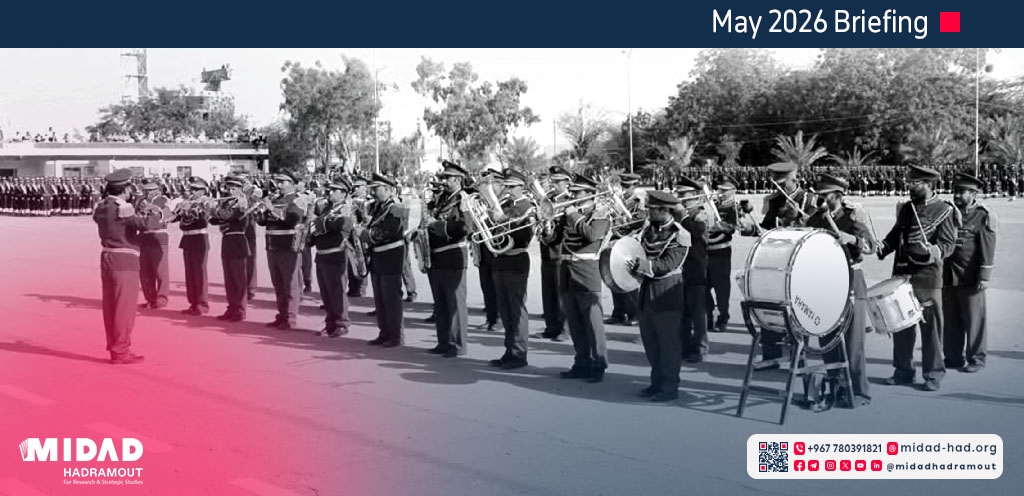
Al-Khanbashi orders an increase in military readiness during an army parade in the First Military Region in Hadhramout. |
It points to the continued sensitivity of the military situation in Wadi Hadhramout and the importance of being prepared to prevent any disruptions. |
|
May 17 |
A civilian and a child were injured in Houthi bombing targeting residential areas in Taiz and Hajjah. |
This reflects the continuing threat to civilians in the contact zones, despite the decline in the intensity of widespread clashes. |
|
May 19 |
The College of Aviation and Air Defense celebrates the graduation of its 34th Batch. |
It is an indication of ongoing efforts to build regular military capabilities. |
|
May 23 |
Seven Houthis were killed and others wounded in clashes in Al-Razamat region of Sa’ada. |
It confirms that the northern fronts remain areas of active military engagement. |
|
May 26 |
Two Houthi fighters were killed in clashes with government forces in Hajjah. |
It indicates that occasional clashes continue across the western and northern front lines. |
|
May 30 |
Aden’s Security Director Orders Action Against Those Who Attacked the Acting Chief of Al-Mamdara Police Station. |
This reflects the importance of discipline within the security institution and its connection to public trust in the security services. |
Your Content Goes Here