

Executive Summary:
June has seen a significant simultaneous escalation on two distinct fronts: a military confrontation between the Houthis and the government, particularly on the fronts in Al- Dhale’, and a tribal conflict in Al-Jawf centered on Al-Rayyan encampment. These developments are putting the Yemeni ceasefire through its first real test of sustainability since it was signed.
The Houthi group’s announcement of a popular mobilization, statements by the movement’s leader Abdul-Malik Al-Houthi regarding readiness for war, and the resumption of clashes in Al-Dhale’ and Lahj have been the clearest indicators of the truce’s erosion since its signing. However, the absence of any official Houthi announcement of a unilateral withdrawal from the truce suggests that this is a limited escalation in rhetoric and on the ground, rather than an actual decision to go to war.
As for the tribal uprising in Al-Rayyan, it is the most significant development; for it may mark the beginning of widespread tribal opposition to the Houthis, which could place them in another predicament no less serious than the threat posed by the legitimate government’s forces.
In the areas under the legitimate government’s control, however, the security situation continues to deteriorate; The assassination of Brigadier General Yahya Wahish in Hodeidah was announced; preliminary investigations suggest Houthi support for the perpetrators. Additionally, journalist Mohammad Aida was assassinated in Hadhramout, and the perpetrators have not yet been arrested despite prior reports of threats. These two incidents raise a common question regarding the ability of security agencies in areas under the legitimate government’s control to provide protection and deter threats, regardless of who was responsible in each individual case.
The Political Briefing:
The significance of the political developments that took place last June lies in four main aspects:
First: The Houthis’ escalation and the de-escalation process test
The Houthis’ escalation and their declaration of a popular mobilization represent one of the most significant developments of the month. This is considered the most prominent military escalation, which in turn is clearly reflected on the political side and has led to the collapse of the political truce. Although there have been no genuine attempts to violate the truce, nor has there been a clear official Houthi announcement unilaterally ending it, However, the resumption of clashes on some fronts and the intensification of mobilization rhetoric reflect the current tension and may further complicate any future efforts to resume the political process.
These indicators alone are not sufficient to conclude that a full-scale war is imminent, but they do increase the likelihood of a gradual escalation unless accompanied by effective political and military efforts to contain the tension.
Second: Tribal Tensions in Al-Rayyan Encampment in Al-Jawf Governorate
The tribal movement in Al-Rayyan encampment, led by tribal sheikh; Hamad Bin Fadgham, emerged as a local development with political and security implications and began to form a tribal coalition opposed to the Houthis. The region also witnessed an escalation after the tribes detained trucks belonging to tribes in Sa’ada. The Houthi group attempted to contain the crisis through two delegations from Sahar tribe—one sent to government-controlled areas and the other to Houthi-controlled areas—but the tribes insisted on rejecting any settlement until the woman claiming to be Saddam Hussein’s daughter was handed over to Al-Rayyan Site. This incident follows the Houthis’ 50-day detention of Sheikh Fadgham and their forcing him to renounce his beliefs—according to his statements after his release—which sparked widespread tribal outrage and criticism even within the group’s own ranks.
It is still too early to assess whether this tension will escalate into a military confrontation or a broader tribal movement against the Houthi group. However, the ongoing tribal mobilization and the lack of clarity regarding the position of the internationally recognized Yemeni government make this issue one worth monitoring, especially in light of the ability of official stances or political support to influence the tribes’ choices between de- escalation and escalation.
Third: Appointment of New Deputy Governors for Hadhramout Governorate
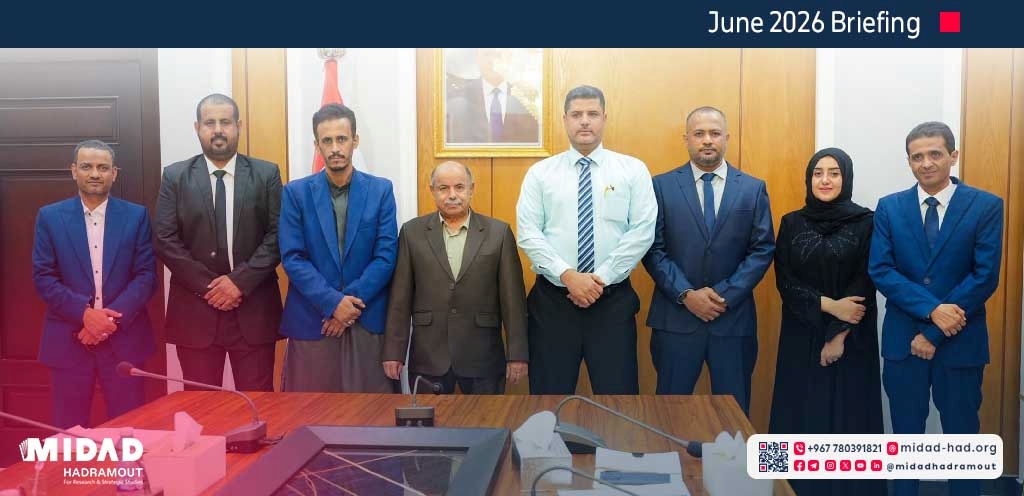
The President of the Presidential Council has issued a resolution appointing seven new deputy governors for Hadhramout Governorate in different sectors, including technical affairs, finance, energy, development, and women’s and youth affairs, with the aim of strengthening the performance of local authorities. During his meeting with the new deputy governors, Hadhramout Governor Salim Al-Khanbashi called for working as a unified team to improve services and address the governorate’s development challenges.
The significance of these appointments lies in the fact that they represent a serious effort by the new local authority—led by Governor Al-Khanbashi—to appoint young professionals to key positions; Therefore, this important step may mark a shift in the nature of the relationship between the local authority and young cadres toward greater empowerment for the latter, especially if these cadres succeed in their current positions. However, assessing its actual impact remains clearly linked to the powers of the deputy governors, the availability of resources, and their ability to translate administrative mandates into tangible improvements in local services and governance.
Fourth: The UN Track and the Limited Opportunities for Resuming the Political Process
In his briefing to the Security Council, the UN envoy noted that recent regional developments—most notably the U.S.-Iran agreement—present a new opportunity to revive the political process in Yemen, pointing out that the military repercussions of the regional conflict on Yemen have remained limited so far. He also spoke about the agreement reached by the Yemeni parties in April to release more than “1,600” detainees—the largest release in the history of the conflict—and reiterated the call for the release of “73” UN staff members being held by the Houthis.
This briefing reflects the UN’s continued focus on humanitarian issues—particularly detainees—as a potential gateway for confidence-building. However, this approach will have limited impact unless it is accompanied by practical steps to address broader political and security issues, as well as guarantees that allow UN organizations to operate safely and stably.
Nevertheless, the humanitarian crisis has also taken its toll: the UN Relief Coordinator confirmed that nearly 60% of Yemenis are now unable to meet their food needs, and that more than “18” million people are suffering from acute hunger and 2.2 million children under the age of five are malnourished. He called for the release of UN detainees, increased humanitarian funding, and support for a political settlement in Yemen. These indicators confirm that the humanitarian crisis cannot be separated from the political impasse, and that continued restrictions on humanitarian work and funding shortfalls may further exacerbate social and economic fragility in the coming period.
Key Indicators of Political Monitoring:
|
Date |
Event |
Political Implications |
|
June 7 |
The UN Security Council renews its condemnation of the Houthis’ detention of UN staff |
This condemnation indicates the continued strain in relations between UN agencies and the Houthi group, which in turn may affect the nature of the UN agencies’ work in Houthi-controlled areas |
|
June 7 |
Technical military talks on Yemen begin in Amman |
These talks have not had a major impact on the ground; the front lines have seen a significant escalation this month |
|
June 14 |
A spokesperson for the dissolved Transitional Council has attacked Saudi
Arabia over the reclosure of the Council’s headquarters in Aden |
The ongoing dispute and rift between the Transitional Council and Saudi Arabia, which in turn will also lead to continued instability in areas under the legitimate government’s control |
|
June 17 |
In Al-Mahra, sit-ins in Seihut and Al- Masila affirm the unity of the popular stance and reject the Coordinating Council |
Popular protests in Al-Mahra against the Saudi-led coalition continue, which may affect any future resolution reached regarding the south |
|
June 19 |
The Yemeni government tightens
controls on officials’ travel and approves regulations for foreign engagements |
This reflects the legitimate government’s serious effort to reduce unnecessary government spending and combat the waste of public funds |
|
June 16 |
The Yemeni government calls for the inclusion of Aidrous Al-Zubaidi and his aides on the international sanctions list |
This indicates an escalation in rhetoric and the dispute between the legitimate government and the Transitional Council; therefore, reaching a resolution to the differences between the two sides remains a distant prospect |
|
June 17 |
The Yemeni government appoints new leaders for the tax and customs authorities |
The appointments sparked some controversy, particularly in Hadhramout, as some viewed them as a form of exclusion against Hadhrami officials. However, this decision is part of the government’s effort to accelerate economic reforms |
|
June 20 |
The dissolved Transitional Council escalates tensions with Saudi Arabia and calls for demonstrations in Aden and Hadhramout |
The dissolved Transitional Council continues to mobilize, and tensions between the two sides continue to escalate |
|
June 24 |
Presidential resolution establishing the General Authority for War Wounded Affairs |
This may resolve one of the most complex problems facing the legitimate government, namely the wounded and their difficult circumstances |
|
June 29 |
The head of the European Union mission and the Dutch ambassador visit Marib Airport |
European Interest in Developments in Yemen and Evidence of the Importance of Development Projects Led by the Legitimate Government |
|
June 30 |
Houthi Foreign Ministry: We are committed to resolving issues with the United Nations through dialogue. |
This is a positive and progressive stance by the Houthi group, and there is no doubt that resolving the issues between the two sides will have a tangible impact on the lives of citizens in areas under the group’s control, especially if UN support— which was cut off recently—is restored |
|
June 30 |
A high-level meeting in Marib discusses the final arrangements for implementing the prisoner and detainee exchange deal |
There is a contradiction here: while the Houthis are escalating tensions in the media and on the battlefronts, negotiations on implementing the prisoner and detainee exchange agreement continue without hindrance |
The Economic Briefing:
The economic side remains the most closely tied to the daily lives of ordinary citizens; it is the primary factor that simultaneously provokes both their anger and their happiness. If economic conditions improve, this is a key factor in judging the success or failure of officials and the government. Economic conditions have varied between positive and negative. Although key services remain in a state of general decline—which in turn affects citizens, particularly in conflict-affected areas such as Hadhramout and Aden—there are other important positive indicators. We can summarize them as follows:
- The World Bank provided Yemen with “285” two hundred eighty-five million dollars in funding during 2026–2030; this assistance includes a new financing package for Yemen worth “285” two hundred eighty-five million dollars, distributed across the health, water, irrigation, and urban services sectors, as well as the modernization of public institutions to serve This funding is significant for two reasons: first, it demonstrates continued international support despite all the obstacles and constraints faced by donor organizations; and second, it focuses primarily on sustainability rather than temporary in-kind support.
- The Ministry of Finance announces pay raises for civilian and military personnel; The Ministry of Finance in Aden announced the implementation of a 20% pay raise for May 2026 salaries for government employees and retirees. This comes in addition to March salary increases for defense and interior ministry Despite the importance of these decisions, the general high cost of living diminishes their impact.
- Governor Al-Khanbashi confirms improvements in the electricity supply in Hadhramout and reveals plans to expand solar energy projects; these statements by Governor Al- Khanbashi are among the most important promises and have the greatest impact on citizens’ daily lives. This is especially true given that power outages remain frequent during the However, the implementation of solar energy projects may require political will from the Presidential Council due to the relatively large scale of the projects.
- The Ministry of Electricity announced an emergency plan to increase power generation in Aden and Hadhramout with Saudi support; Saudi Arabia provided $150 million to subsidize fuel for power plants. This decision comes amid an extremely hot summer with prolonged power However, this Saudi support—which is provided almost every summer—may solve the immediate problem of the current summer, but past years have demonstrated the government’s inability to find a long-term solution to the electricity crisis.
- Hadhramout Governor Salem Al-Khanbashi chaired the first meeting of a joint technical committee with “Aqua International” to develop short- and long-term plans for the electricity and water desalination sectors in the Water desalination projects will be of great importance in Hadhramout and throughout the governorate, as Yemen as a whole suffers from water scarcity. Several regions have been affected by this issue, particularly Taiz and Hajjah earlier this year and last year.
- The Yemeni Gas Company has approved new measures to improve domestic gas supply chains; these include alternative emergency routes and a new schedule for transporting gas from “Safer” in Marib to the governorates, along with financial penalties for those who fall behind Although these measures may resolve gas shortages in various governorates, including Aden, they may simultaneously face numerous challenges, most notably military and tribal roadblocks that transport convoys may encounter from time to time.
- The Saudi ambassador to Yemen announced that the Kingdom of Saudi Arabia has disbursed a new tranche to support the Yemeni government’s budget deficit, amounting to more than “224” (two hundred twenty-four) million Saudi riyals. This is an important step because it will have a direct impact on citizens’ daily Nevertheless, these steps still require genuine sustainability that leads to stability and an overall improvement in the payment of salaries.
While the positive economic indicators are varied, as we highlighted above, the negative indicators are numerous and significant. They can be summarized as follows:
- According to a government report, about “297” two hundred ninety-seven thousand households in Marib are in need of urgent assistance as the humanitarian crisis worsens. These reports underscore the difficult situation faced by families in Marib in particular, as the fighting has turned the area into a gathering place for many displaced people, who are suffering from difficult economic and humanitarian conditions. Despite all government, regional, and UN efforts to provide support to the displaced, these efforts still fall short of what is needed.
- According to UN agencies, the famine will worsen unless international support is increased; three UN agencies (FAO, World Food Program, and UNICEF) have issued an urgent appeal for increased humanitarian funding for Yemen, after figures revealed that nearly five million people in areas under the recognized government’s control are suffering from acute food insecurity, a number projected to rise to 5.4 million during the upcoming dry season. The agencies warned that declining funding would reduce food and health assistance, cautioning that millions of Yemenis could slip into hunger and lose their livelihoods without urgent
- As for displacement, the situation was no better; the United Nations High Commissioner for Refugees (UNHCR) stated that Yemen is experiencing one of the worst displacement crises in the world, noting that 2 million people remain internally displaced. The humanitarian crisis we discussed in Marib served as an example of the worsening displacement crisis in Yemen.
- While the current humanitarian and economic conditions are extremely difficult, the economic situation—in terms of rationalizing government spending and combating corruption—was no The Yemeni Network for Rights and Freedoms accused the dissolved Transitional Council of operating an illegal tax collection system generating more than 22.4 billion riyals per month. Most of these funds came from fees imposed on petroleum products, cement companies, and security checkpoints, and the network emphasized that these figures represent only the minimum of documented cases. Although these allegations are not official, they warrant official action at the highest levels to verify their validity and to determine the current status of these funds— whether they are still being deposited into the accounts of the dissolved Transitional Council or other accounts linked to it.
Key Indicators of Economic Monitoring:
|
Date |
Event |
Economic Implications |
|
June 10 |
Al-khanbashi discusses operations and future plans for the development of the Al-Ghuwizi Fish Factory in Mukalla |
An effort to increase revenue for the local authority, as the governor pledged in his recent interview on a media podcast regarding his strong commitment to developing economic projects that generate more revenue for the local authority |
|
June 11–12 |
Opening a water project in Lahj with Kuwaiti support, and a project to drill three water wells in Taiz with Saudi support |
This project enhances water security in Yemen, especially since Yemen has clearly suffered from water scarcity in recent years |
|
June 14 |
Signing of an agreement to train graduates in the oil sector in Hadhramout |
This opens the door further to include other sectors and larger numbers of graduates. It is a matter of utmost importance that will enhance the technical and practical capabilities of graduates, which will have a positive impact on the economy as a whole |
|
June 18 |
Import financing committee reveals financial irregularities at Yemeni border crossings |
This points to a situation of waste and corruption that continues to affect the economic situation and the general budget. On the other hand, it indicates that while the government’s efforts have made progress in terms of revenue, they remain incomplete to date |
|
June 20 |
Al-Arrada: Marib International Airport project has made significant progress, and many aspects of the work are nearing completion |
Marib Airport project is a promising initiative that will bring about a real change in people’s daily lives. It is part of the government’s efforts to expand the network of domestic airports in the Republic |
|
June 22 |
The 2026 Al-Balda Festival Committee in Hadhramout is discussing the plan for events and preparations to welcome visitors |
Al-Balda Festival is an important tourist destination and can generate significant revenue for the governorate. The local authority’s focus on this event is a positive step |
|
June 24 |
Yemeni presidential office announces formation of the supreme committee for tenders and auctions |
The legitimate government is attempting to restore the economic process to its optimal form, free from arbitrariness, nepotism, and corruption |
|
June 25 |
Yemeni government approves five-year allowance payments |
We have recently witnessed several important economic decisions aimed at improving citizens’ living conditions through the payment of allowances and salary increases. However, these measures still fall short of what is needed due to rising prices in recent years |
|
June 27 |
International report confirms Yemen is the second most expensive Arab country in terms of cost of living in 2026 |
This report clearly indicates that the government’s recent economic efforts to increase salaries, while important, are insufficient—at least for now—to combat the high cost of living in Yemen |
|
June 29 |
Yemeni Presidential Council discusses economic reforms and directs government to control revenues |
The Presidential Council’s serious attempt to address the issue of revenue, which is the most critical issue in the economic sphere |
Social tensions escalated last June, particularly due to the onset of summer and the accompanying rise in temperatures, which exacerbated public anger over power outages— especially in coastal areas such as Mukalla and Aden. This was evident in Aden city, which witnessed angry protests over the poor electricity service; in fact, the level of discontent reached the point where people were encouraged to sleep on the streets to escape the heat waves inside their homes and the high humidity. Several cities in Hadhramout also witnessed these protests, albeit to a lesser extent. In Shabwah, meanwhile, other protests took place in response to what they called the “marginalization of the eastern and southern regions” of the governorate. As for Abyan, a tribal and human rights meeting was held, affirming that the escalation would continue until “Ashal” and all the abductees are released. This places a heavy responsibility on the government to account for all abductees, especially those who were victims of the now-dissolved Transitional Council’s forces.
As for public health, the situation this month has been more concerning than in previous months, due to reports of cases of certain diseases: Taiz alone has recorded more than twenty-two thousand cases of malaria since the beginning of this year. The Health Office also reported more than 804,000 cases of dengue fever and 18 deaths since the beginning of this year, with Aden accounting for more than 400,000 cases of dengue fever, including 14 deaths, during the same period. As for measles, 17,000 cases and 910 deaths have been reported in various areas under the legitimate government’s control since the beginning of this year, with Hadhramout leading the way with 504,000 cases and 18 deaths. Perhaps the silver lining amid these alarming figures on the spread of various diseases is the arrival of more than 400,000 vaccines provided by the United Nations to Aden to combat these widespread diseases. There is no doubt that this deteriorating situation places a greater responsibility on the government to exert more effort in vaccination and public awareness campaigns.
On another front, the Minister of Health inaugurated the Charitable Heart Center for Cardiology, Cardiac Surgery, and Cardiac Catheterization, affiliated with Aden Charitable Hospital, coinciding with the fifth surgical camp for heart diseases. There is no doubt that the center will play an important role in improving the health care provided to patients in Aden. The Chairman of the Presidential Leadership Council also issued a resolution to establish two hospitals in Taiz and Aden, an important step in the government’s effort to improve health care for citizens.
On the humanitarian side, conditions for displaced persons in the camps remain difficult; housing for displaced persons in Taiz has suffered extensive damage, with some units destroyed by rain and storms. The situation for displaced persons in Hajjah was no better; in the governorate’s camps, an elderly woman died of hunger and illness, just one week after her elderly husband died of the same causes. The UN Refugee Agency also announced its intention to establish 770 temporary housing units for the most vulnerable displaced persons in Marib. This represents an important step in efforts to alleviate the suffering of displaced persons in Marib.
In other news, the death of adventurer Al-Qaqa’a, who fell into the crater of Haradhah Damt volcano in Al-Dhale’, has sparked widespread public interest across various regions and segments of society. Al-Qaqa’a had recently gained fame for his stunts performed on the rim of the volcano’s crater. Many social media users followed the events surrounding his rescue. This incident raises another issue: the importance of protecting such talented individuals, providing them with safety equipment, and making the most of their talents.
As for Al-Dhale’, the area witnessed a tragic incident that left six children dead and eleven others with varying injuries following the explosion of a mortar shell left behind by the Houthi group. This incident starkly highlights the negative impact of war remnants and the civilian casualties they cause.
Key Indicators of Social Monitoring:
|
Date |
Event |
Social Implications |
|
June 1 |
Yemeni Airlines’ suspension of flights to and from Socotra is exacerbating the suffering of the island’s residents |
The suspension of flights due to the economic circumstances facing Yemenia prevents people from entering and leaving the island, especially given the difficulty of maritime travel at this time |
|
June 12 |
UN Report: 11,500 african migrants arrived in Yemen last May |
This points to a real crisis in Yemen caused by the increasing number of migrants, especially since the country itself is facing a health and humanitarian crisis |
|
June 15 |
Sheikh Mazen Al-Aqrabi was detained in Aden, and his family was prevented from visiting him |
Such incidents fuel further anger toward the security forces, especially since many of these operations are not carried out within proper legal frameworks. This erodes the public’s trust in the security forces |
|
June 15 |
The International Federation of Journalists condemns the killing of journalist Mohammad Aida and calls for an independent and swift investigation |
This operation heightens concerns about press freedom in Hadhramout and also raises questions about the cohesion of the security forces in the governorate |
|
June 15 |
in Taiz, the teachers’ union condemns the state’s failure to pay salaries on time |
These actions affect the continuity of the educational process in general, and at the same time highlight the difficult situation teachers in Taiz and across all governorates have reached due to low salaries. This requires a fundamental and comprehensive solution from the government |
|
June 7 |
Contract nursing staff at Seiyun Hospital threaten mass resignation |
This reflects the widespread discontent among large segments of government employees due to delayed and meager salaries |
|
June 24 |
Declining student enrollment is forcing universities in Houthi-controlled areas to lower admission rates |
This opens the door to further educational decline and may affect the recognition of Yemeni university degrees in the Gulf states and around the world |
|
June 24 |
Wheat farmers from Al-Jawf stage a sit- in in Sana’a to demand that the Houthis pay for their crops |
This reflects the widespread public anger in Houthi-controlled areas, though much of it remains unreported due to the media blackout and tight security crackdown |
|
June 26 |
Human rights report documents
hundreds of deaths and thousands of cases of torture in Houthi detention centers |
Refers to the deteriorating human rights situation in areas under Houthi control, particularly given that the Houthis are not making any effort to improve human rights or political conditions |
|
June 29 |
Journalist Hamoud Hazza’a was released one day after his arrest in Marib |
The arrest in Marib sparked outrage and criticism, as it was seen as a means for the authorities to silence dissent; therefore, his swift release confirms that freedom of speech remains guaranteed in the governorate |
Security and Military Briefing:
The month of June has witnessed a notable escalation in security and military challenges, represented by the resumption of limited clashes on some fronts, the continuation of assassinations and security breaches within cities, as well as issues that affected public confidence in security institutions. The most significant developments can be highlighted under four headings:
The resumption of clashes and the reality of de-escalation:
The fronts in Al-Dhale’ and Lahj have seen a resumption of limited clashes, especially since these clashes occurred shortly after the Houthis announced a general mobilization and their readiness to return to war. Houthi leader Abdul-Malik Al-Houthi hinted at their readiness to return to war. The legitimate government had announced that five soldiers were wounded on Al-Dhale’ and Lahj fronts following clashes that lasted several hours.
This escalation poses a serious and real threat to the truce in Yemen, which has been in place for more than four years, especially since the Houthis have escalated the level of their ongoing threats this time. In this context, the legitimate government has affirmed its readiness for any future military escalation. The Yemeni defense minister has made several visits to various governorates, including Marib Gov., to underscore the army’s readiness.
The Assassination of Journalist; Mohammad Aida and Its Implications for Local Security in Hadhramout:
The assassination of journalist Mohammad Aida in Hadhramout represented a troubling security development due to its impact on the sense of local security and freedom of the press, especially since he had been receiving death threats for several years, as confirmed by journalists close to him. This incident opens the door to increased suspicion and erodes trust in the security forces, especially since Hadhramout as a whole had generally enjoyed a degree of calm and stability in recent years. On the other hand, it primarily highlights the rights of journalists in a country filled with disturbances such as Yemen.
The assassination of Brigadier General; Yahya Wahish on the western coast:
The assassination of Brigadier General Yahya Wahish, commander of the First Division of the National Resistance, following the explosion of an improvised explosive device as his vehicle passed in Hodeidah, represents a loss on the battlefield for the National Resistance, given his leadership role on the western coast fronts; as Brigadier General Wahish is considered one of the key commanders on the western coast battlefronts. Security authorities also announced the arrest of the suspects in the operation as they attempted to flee by sea hours after the attack. Preliminary investigations confirmed that the suspects received support and orders from the Houthi group. This operation is a significant indication of the Houthis’ ability to infiltrate areas under the legitimate government’s control and assassinate influential military commanders. However, credit is due to the security forces for their ability to arrest the suspects shortly after the operation was carried out.
Drones observed flying over key areas in Mukalla:
Unofficial sources reported, and news websites circulated reports, that reconnaissance drones were flying over vital military and political areas in Mukalla, and that air defense forces had engaged these drones. However, the lack of official statements from the relevant authorities has fueled both doubts and speculation; while these reports could be considered inaccurate since they were not officially released, the silence with which the relevant authorities have responded to the matter also raises suspicions.
The importance of this information is underscored by the need for swift official communication on sensitive security issues; the lack of clarification allows rumors and speculation to spread, especially in a city of such administrative, military, and economic importance as Mukalla. However, determining the party responsible or the purpose of the flight remains impossible in the absence of reliable information.
Key Indicators of Security Monitoring:
|
Date |
Event |
Security Implications |
|
June 2 |
In Abyan, a security official was arrested and referred for investigation in connection with the death of a merchant under torture |
This clearly indicates an improvement in the security situation in the governorate based on accountability, including that of security officials themselves |
|
3 / 8 / 15 / 27 |
In Abyan, Al-Mahra, and Hadhramout, sporadic operations were conducted to
apprehend drug traffickers. The Ministry of the Interior also announced the arrest of 168 individuals in drug-related cases over the course of one month |
Despite all the security campaigns that security authorities in various governorates have attempted to carry out, this has not led to the eradication of drug sources in the country. |
|
June 4 |
Assassination of military intelligence officer Lafi Bin Ja’far Al-Amri in Seiyun.
Security forces arrest the perpetrator and confirm that the motive for the assassination was a personal dispute. |
This operation demonstrated the remarkable capabilities of the security forces in apprehending the suspect in less than twenty-four hours after the operation was carried out |
|
June 8 |
In Abyan, armed men assassinated an officer in the National Security Forces in Mudiyah District |
This incident indicates that Al-Qaeda continues to exert influence, despite all the military operations carried out by the government to eliminate the organization |
|
June 9 |
In Aden, a young man died from a gunshot wound sustained during protests over the electricity crisis |
This incident highlights the violent response by security forces against peaceful protesters over the electricity crisis, which may further fuel public tension and anger |
|
June 9 |
A young man was killed and another injured in Hadhramout by soldiers’ gunfire following a dispute |
This incident sparked a great deal of controversy, particularly because the circumstances surrounding it remain unclear. Violent actions by soldiers always draw significant public criticism |
|
June 11 |
In Aden, people were killed and injured in an explosion at a Giants Forces camp, and local authorities ordered an urgent investigation |
This incident points to a structural problem, as the camps are located in the middle of residential neighborhoods. It also highlights weaknesses in weapons storage and safety protocols |
|
June 12 |
Deaths and injuries following an armed attack targeting the governor of Aden’s house |
The main motive behind this incident remains unknown; some reports suggest that it was carried out by one of the guards, possibly due to psychological issues or a mental disorder. Meanwhile, other reports indicate that the main motive was the assassination of a Syrian doctor and his wife, who had been accused of war crimes in Syria |
|
June 10 |
Arrest warrants issued for “Saqr Aden” on charges of cyber extortion under the cover of security |
These security measures indicate a response to public pressure, but they also open the door to broader scrutiny regarding the extent of corruption within the security agencies, which have become a source of crime rather than a protector of society. |
|
June 14 |
As part of a wave of military changes, the command of the “1st Support and Reinforcement Brigade” assumes its duties in Aden |
This points to a broader restructuring process that the legitimate government has been discussing since last January |
|
June 15 |
A tribal sector in Shabwah halts the movement of oil and gas tankers toward Marib |
This highlights the challenges on the ground faced by the legitimate government in its attempt to enforce security across all regions, as well as the continued flow of fuel between governorates |
|
June 16 |
Armed boats attack two ships off the coast of Yemen in two separate incidents in the Gulf of Aden |
Indicates a rise in the risk profile for maritime trade in the Red Sea and the Indian Ocean, which in turn could negatively impact Yemen due to the continuation of these attacks |
|
June 17 |
Aden’s Director of Security issues resolution appointing a number of police division chiefs |
These moves indicate not only a restructuring of police departments but also an effort to correct the negative perception citizens have of these departments, especially following widespread controversy over the involvement of some security personnel in crimes |
|
June 21 |
Limited clashes in Aden during the handover at Coast Guard headquarters |
This points to the difficulties security forces may face in implementing the restructuring process led by the Ministry of Defense and the government |
|
June 27 |
Emergency forces thwart the smuggling of a massive fuel shipment in Ghweirban Desert in eastern Yemen |
In addition to oil and fuel smuggling operations and the security challenges facing some areas, this incident also points to the possibility of unofficial oil smuggling from Hadhramout. If true, this would require action by local authorities |
|
June 30 |
One dead and one injured in shooting amid crowd outside military camp in Mukalla, eastern Yemen |
This incident points to unresolved issues regarding the mechanism for paying military salaries. These issues could lead to more serious incidents, especially if the camp were to be targeted by terrorists or the Houthi group |
|
June 30 |
A shipment of equipment and engines used to manufacture drones belonging to the Houthis was seized in western Yemen |
The ongoing seizures and failed smuggling attempts led by the Houthi group indicate that the group continues to arm itself and prepare for any potential resumption of war |
Your Content Goes Here