

Executive Summary:
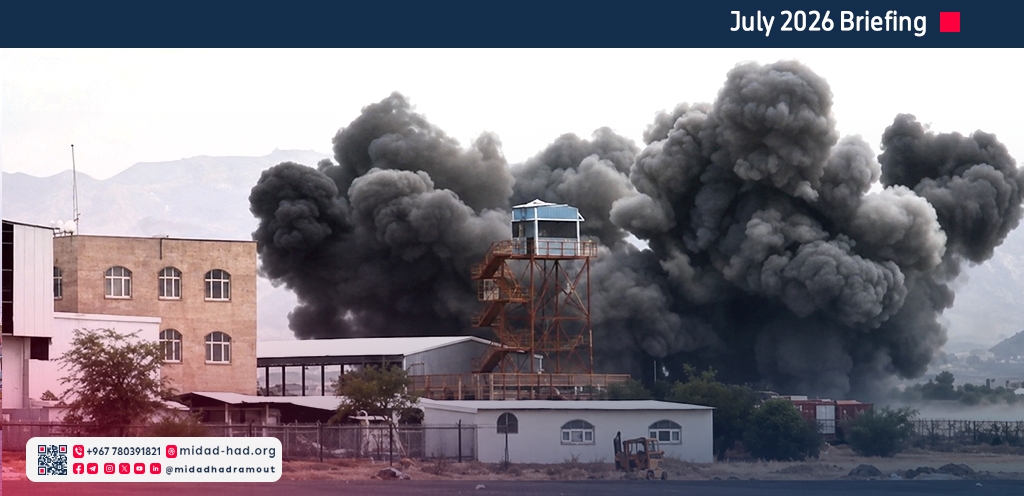
July has witnessed a broader and more complex escalation than the previous month; the signs of rhetorical escalation in June turned into actual on-the-ground events on multiple fronts, bringing Yemen closer than ever to all-out war since the signing of the ceasefire. The month has witnessed the first direct military response by the Saudi-led coalition against Houthi positions in Al-Hodeidah, Kamar, and Sana’a Airport since the collapse of the 2022 truce, in response to the Houthis’ declaration of a naval blockade against Saudi Arabia and their targeting of Saudi oil tankers and Aramco facilities with missiles and drones. Nevertheless, the absence of any definitive official announcement from either side regarding a full return to war, coupled with the continuation of UN-mediated negotiations in parallel with the escalation, keeps the situation in a state of uncertainty: there is actual escalation on the ground, but no declared decision to wage all-out war has been made so far.
This uncertainty is also reflected in a growing state of general mobilization within the legitimate areas; as resistance councils in ten governorates declared their readiness for the battle to restore the state, Taiz Resistance announced a general mobilization, and formed field committees to support the army, while Al-Hodeidah, Taiz, and Moza witnessed successive tribal and popular rallies affirming their readiness to support the front lines. This coincided with the expansion of the tribal uprising against the Houthis in Al-Jawf Gov., which escalated from sporadic skirmishes to sustained armed confrontations that lasted for weeks. Taken together, these indicators suggest that popular and military preparedness for a war scenario has become more serious than at any other time this year, though this does not necessarily mean that the political decision to pursue this course has actually been finalized.
As for Hadhramout specifically, the month has seen a notable development that reflects the growing fragility in the relationship between the governorate and the Kingdom of Saudi Arabia on the one hand, and its internal components on the other. On July 23, Saudi authorities prevented Sheikh Amr Bin Habrish, head of the Hadhramaut Tribes Confederacy and president of Inclusive Hadhramout Conference, and First Deputy Governor of the governorate, from returning to Hadhramout via Al-Wadiah Port, following an official visit to Riyadh that lasted about six months at the invitation of the Kingdom’s leadership since January 25. This unusual measure has sparked widespread condemnation, emergency meetings among a number of tribal leaders, and calls for an investigation into its reasons, with Riyadh failing to issue any official explanation by the end of the month. This development comes just a few days after Bin Habrish announced his resignation from the Preparatory Committee of Hadhramout Supreme Coordinating Council earlier this month, raising serious questions about the nature of the actual dispute between Riyadh and one of the most prominent tribal and a prominent political figure in the governorate, and its potential implications for its internal balance at an extremely sensitive juncture.
This tension intersects with other issues in Hadhramout that reveal the fragility of the internal situation, as exemplified by the attack that targeted members of the National Shield Forces in Romah the desert district, killing six soldiers amid conflicting accounts regarding the perpetrators. Controversy has also resurfaced over Hadhramout’s demand to secure its share of oil revenues before exports resume, a dispute that positions the region as a third party in the conflict between the legitimate government and the Transitional Council. Taken together, these indicators paint a picture of a governorate facing increasing pressure from both outside and within, amid an urgent need to stabilize its local leadership and clarify its relationship with the coalition.
The Political Briefing:
The significance of the political developments that took place last July lies in four main aspects:
The first one: regional escalation linked to the Houthi-Iranian reconciliation, following the landing of an Iranian Revolutionary Guard aircraft at Sana’a Airport, which transported a Houthi delegation to Tehran. The legitimate government considered this a clear violation of Yemeni sovereignty and a military escalation that would lead to the transfer of military equipment to the Houthi group. The Saudi-led coalition responded by vowing a firm and unprecedented response to any threat to its security, while the U.S. president threatened to intervene should shipping in Bab al-Mandab face any threat. Although the Houthi group announced that flights between Sana’a and Tehran would continue, its leader later escalated the situation by threatening “escalation for escalation” against Saudi Arabia. The United Nations described these developments as pushing Yemen toward the war, this reflects the extent of international concern over the course of events. That same month, events accelerated, and Saudi Arabia and the Houthi group exchanged attacks; the group claimed to have targeted certain sensitive areas in Saudi Arabia, including Aramco in Jizan and other sensitive areas in Abha.
The Second: The escalating dispute between the legitimate government and the Southern Transitional Council (STC) over oil exports. After the Yemeni Defense Council approved measures to deter the Houthis and resume exports, STC has totally rejected this decision. This dispute coincided with the deployment of the National Shield Forces in Aden for the first time and STC’s announcement of what it described as a “revolutionary escalation.” Hadhramout, for its part, has demanded that its share of oil revenues be guaranteed before exports resume, adding a third party to the dispute that could complicate any swift resolution of the issue. In the context of the dissolved Southern Transitional Council, numerous tribal groups have entered Aden, suggesting to all parties that armed tribal groups could easily reach the capital, Aden, under the pretext of rejecting the exchange of those accused of killing military commander Jawwas as part of a comprehensive prisoner exchange deal recently concluded with the Houthi group.
Third: Continued UN efforts to de-escalate tensions and address the issue of the exchange of prisoners and detainees; the UN envoy held a series of talks in Muscat and Riyadh, warning against a wider escalation following the targeting of Sana’a Airport and the arrival of an Iranian aircraft in Al-Hodeidah. Although the envoy later announced that he had received assurances from both the government and the Houthis regarding the implementation of the detainee exchange agreement, the Yemeni government renewed its accusation that the Houthis were obstructing the deal, while the group refused to actually begin implementation, according to statements by the head of the government negotiating delegation. This gap between diplomatic statements and on-the-ground realities remains one of the most prominent indicators of the fragility of any partial understandings between the two sides.
The fourth: This consists of notable administrative and institutional changes within the legitimate regions, which took the form of a limited change involving the appointment of three new ministers, presidential resolutions appointing a new governor for Sa’ada and a commander for Abyan sector, as well as the restructuring of the Civil Chamber of the Supreme Court and the referral of twelve judges for disciplinary action. However, the resignation of Planning Minister just one week after taking office raises questions about the stability of these appointments and their alignment with the balance of power within the government. This is especially true given the growing speculation that these decisions were unilateral moves by the Chairman of the Presidential Leadership Council, Dr. Rashad Al-Alimi, rather than consensus decisions among all members of the Council. Furthermore, the case of the incomplete body attributed to the politician; Mohammad Qahtan, has reopened an old issue related to the fate of detainees and politically disappeared individuals, at a time when the government is seeking to project a more disciplined institutional image.
Key indicators of political monitoring:
| Date | Event | Political Implications |
| July 3 | An Iranian Revolutionary Guard aircraft lands in Sana’a, transporting a Houthi delegation to Tehran | Reflects the continued strength of the military relationship between Tehran and Sana’a despite international pressure, which threatens to reignite the war within Yemen |
| July 4 | The Saudi-led coalition vows a firm and unprecedented response
to any threat to its security |
This indicates a hardening of the coalition’s stance toward any new Houthi violation and increases the likelihood of a limited military confrontation should such a violation recur |
| July 6 | Al-Alaimi to ambassadors of the sponsoring nations: The revolutionary guard’s flight was a violation of Yemeni sovereignty | Documents the legitimate government’s official position before international partners and lays the groundwork for subsequent diplomatic escalation at the UN |
July 9
An investigative committee takes samples from an incomplete body believed to be that of the politician; Mohammad Qahtan in Sana’a
Reopens a sensitive issue regarding the fate of long- term political detainees, which may spark renewed human rights and international pressure on the Houthis
July 10
The Houthis refuse to begin implementing the agreement on the exchange of prisoners and detainees
Reveals the fragility of previous understandings regarding the detainees issue and complicates the UN envoy’s efforts to build trust for negotiations
July 13
The UN envoy warns of a broader escalation following the targeting of Sana’a Airport and the arrival of an Iranian aircraft in Al-Hodeidah
Reflects growing UN concern that the crisis is sliding toward a broader regional confrontation that goes beyond Yemen’s internal context
July 14
United Nations: Tehran’s flights to Sana’a are pushing Yemen to war
This represents the UN’s strongest warning this month and reinforces the hypothesis that the current ceasefire is under a real threat, not just a nominal one
July 16
Houthi leader escalates tensions with Saudi Arabia, threatening to respond to escalation with further escalation
This confirms the group’s intention to keep escalation as a bargaining chip, without completely closing the door on a ceasefire.
July 19
The Judicial Council restructures the Civil Chamber of the Supreme Court and refers twelve judges for disciplinary action
Indicates a serious attempt to reform the judiciary in the legitimate areas, although its actual impact on judicial independence remains uncertain
July 20
Yemeni Defense Council approves measures to deter the Houthis and resume oil exports
Represents an attempt by the legitimate government to regain the economic initiative, but it opens a direct confrontation with the Transitional Council over the distribution of revenues
July 21
The Transitional Council rejects the decision to resume oil exports from southern Yemen
This deepens the rift between the legitimate government and the Transitional Council, and makes the future of the export decision dependent more on the balance of power on the ground than on central decisions
July 24
Presidential resolutions
appointing a governor for Sa’ada and a new commander for the Abyan sector
This reflects an attempt to fill the institutional gap in sensitive areas, particularly in Sa’ada, which holds special symbolic significance as a historic stronghold of the Houthis
July 25
Yemeni resistance councils in ten governorates declare their readiness for the battle to restore the
state
Indicates an escalation in pro-government military rhetoric among the populace, which may reflect actual readiness or political pressure regarding the decision to go to war
July 30
Saudi Arabia seeks to form an international coalition against the Houthis in the Red Sea
Expands the scope of the confrontation from the regional to the international level and may pave the way for greater military or economic pressure on the group
July 31
Yemeni Minister of Planning resigns one week after taking office
This raises questions about the cohesion of the recent change and its alignment with the balance of power within the government
The significance of economic developments last July lies in five main aspects:
First: The escalating energy crisis, affecting both electricity and natural gas. The domestic gas crisis has flared up again in Taiz city amid widespread complaints from local residents about supply disruptions, while the Joint Gas Operations Room in Marib approved measures to combat smuggling and the black market. As for electricity, the debate was dominated by leaked documents from the Ministry of Electricity and Energy that included a proposal to raise rates for high residential consumption—that is, consumption exceeding 1,000 kilowatt-hours per month—from 19 to 700 riyals per kilowatt. This leak sparked widespread public concern, before the government settled the controversy by denying any adjustment to residential consumption rates below this threshold, asserting that the leak was linked to attempts to obstruct reforms, while it did in fact approve adjustments to rates for the commercial and industrial sectors to enhance the sector’s financial sustainability. This issue reflects the public’s high sensitivity to any changes to electricity rates amid declining income levels.
Second: The worsening food security crisis and increasing reliance on international aid. The Food and Agriculture Organization of the United Nations (FAO) has warned that more than 53% of Yemen’s population, or about 18.7 million people, will face severe food insecurity or worse by the end of the year, making Yemen the country with the highest global rate of people in a state of food emergency, with the situation in Houthi-controlled areas reaching a critical stage due to the near-complete suspension of United Nations operations there and a funding shortfall that has not exceeded 15 % of the 2026 Humanitarian Response Plan. The organization linked regional unrest in Hormuz Strait and rising global fuel prices, on the one hand, to the increasing number of Yemeni children at risk of hunger, on the other, highlighting how the regional escalation is spilling over into the domestic humanitarian crisis. In response to this deterioration, the United Nations has allocated an additional $10 million to address the food crisis in Yemen.
Third: The Houthi group continues to impose new taxes on basic foodstuffs in the areas under its control, mostly by imposing an additional customs duty of 3,600 riyals (in the old currency) on every bag of white flour arriving from Aden, through a newly established customs post in Al-Rahida area that specifically targeted Sanabel flour produced at Hayel Saeed Anam silos. The group raised the fees on trucks several-fold in just one week, from about one million riyals to nearly 3.7 million riyals per truck, while detaining dozens of trucks at the new customs post—a move that violates Yemeni customs law, which exempts basic foodstuffs from duties. This measure reflects the group’s continued use of economic leverage as a tool for pressure and a parallel source of funding, which directly increases the cost of the food basket for residents in areas under its control.
Fourth: Intensified market monitoring and consumer protection campaigns, most notably the discovery of a shipment of Brazilian sugar contaminated with high levels of lead, arsenic, and copper, according to laboratory tests. This prompted the Ministry of Industry and Trade to issue a circular on July 27 directing its provincial offices to conduct field operations to seize and destroy the shipment. The seizure campaigns extended to Al-Mahra, Taiz, Marib, and Hadhramout; in the port of Mukalla alone, large quantities of non-compliant bags were seized. Earlier this month, authorities in Hadhramout also destroyed approximately four metric tons of cigarettes and expired food products.
Fifth: Tensions are escalating over the conditions of public sector employees in the areas under government control. In Taiz, a labor union coalition warned of an educational crisis due to the denial of scheduled pay raises and allowances to thousands of teachers and educators. In Abyan, the governor pledged to improve the conditions of sanitation workers by raising their salaries and providing them with health insurance, in an implicit acknowledgment of the deteriorating conditions faced by this category of local service employees. The recurrence of such demands across multiple governorates reflects the widening gap between nominal public-sector wages and actual living standards, amid the absence of comprehensive solutions to the salary issue.
Key indicators of economic monitoring:
| Date | Event | Economic Implications |
| July 1 | World Bank grants Yemen $100 million to combat malnutrition | Yemen’s continued reliance on international funding to address the food crisis reflects that this does not represent a structural solution to the decline in domestic production |
| July 1 | With Japanese funding, a $5 million project to support displaced persons in Marib | This indicates continued Japanese support for the issue of internal displacement, which is gradually expanding as military operations continue near Marib |
| July 2 | Socotra receives 7,500 metric tons of diesel as part of a Saudi grant to support the electricity sector | Saudi Arabia’s continued direct support for Socotra’s energy sector reflects and reinforces the island’s dependence on external funding sources to meet its basic needs |
| July 3 | New generators arrive in Mukalla to increase generating capacity and reduce power outages | This reflects a local effort to alleviate the chronic electricity crisis in Hadhramout, though it does not constitute a fundamental solution to the sector’s weak infrastructure |
| July 11 | Abyan governor emphasizes the priority of stabilizing gas prices and ensuring the stability of supplies | Reflects the local authority’s attempt to contain potential public anger over any increase in the prices of basic petroleum products |
| July 13 | Aden Civil Aviation Authority announces that Yemeni airports will continue to operate and denies previous reports of their closure | Reflects the government’s attempt to reassure markets and travelers amid escalating security tensions related to Sana’a Airport, to avoid any economic impact on the air transport sector |
| July 15 | Al-khanbashi orders a study of an initiative to convert sovereign assets in Hadhramout into productive investments | This indicates a local trend toward the economic utilization of public assets, although it remains uncertain whether this will translate into actual implementation measures |
| July 16 | Saudi Arabia and the United Kingdom provide $10 million in food aid to Yemen | The ongoing coordination between Riyadh and London in funding urgent humanitarian response programs in Yemen |
| July 16 | Yemeni Prime Minister: The new tender committee is a cornerstone for enhancing transparency and preventing the waste of public funds | This indicates a government effort to improve the image of public financial management, but its actual impact depends on implementation mechanisms and follow-up on the ground |
| July 28 | Hadhramout: Al-Khanbashi orders a ban on all gold mining activities | This reflects the local authorities’ attempt to regulate the unregulated mining sector and prevent the environmental and security damage associated with uncontrolled mining operations |
| July 28 | Strict government measures to ensure gas supplies reach the governorates | Reflects the government’s ongoing efforts to address the domestic gas distribution crisis, although complaints on the ground regarding supply shortages continue to be frequent |
The significance of social developments last July lies in five main aspects:
First: An escalating multi-epidemic health crisis amid declining funding. The World Health Organization recorded approximately 4,800 cases of cholera and seven deaths over a five-month period, while the number of diphtheria deaths reached 37 in government-controlled areas during 2025, with an additional 10 cases recorded in the first six months of this year. Regarding measles, Yemen has recorded 78 child deaths since the beginning of the year, while Marib alone has reported approximately 1,500 cases and 10 deaths from the same disease. In addition, 5,700 cases and 30 deaths from dengue fever have been recorded over the past half-year, alongside reports from Ibb of a rise in cancer cases and the emergence of new tumors linked to environmental pollution. In Marib, officials warned that declining funding is pushing dozens of health centers to the brink of closure, while the Ministry of Health appealed to medical staff in Sana’a and Houthi-controlled areas to continue providing immunization services. This convergence of epidemic waves and declining funding reflects the fragility of the health system throughout the country, regardless of who is in control.
Second: Ongoing human rights violations and arbitrary arrests of activists, journalists, and religious leaders; In Ibb, the Houthi group abducted a well-known doctor just days after he opened a private medical center, while activist Raafat Al-Saadi was released in Aden two days after his abduction. A human rights organization has documented 772 cases of enforced disappearance in Houthi prisons since 2014, amid a union warning about the deteriorating health of detainee Walid Ghalib inside those prisons. Meanwhile, the group released four journalists while continuing to detain two others in Al-Hodeidah; it also abducted a tribal sheikh in Sana’a after breaking into his home and stealing his belongings. In Aden, a media activist was beaten and had his equipment destroyed by loyalists of the dissolved Transitional Council; he nearly lost his life after being accused of working for Al-Mahriya TV. This report reveals that human rights violations are not limited to areas under Houthi control but extend to similar practices within the legitimate government-controlled areas themselves.
Third: The expansion of the tribal and popular movement in support of the army and the military establishment in the face of the Houthis. Al-Hodeidah has witnessed two tribal gatherings in Al- Khokha and Hays that affirmed support for the armed forces and the completion of the liberation campaign, while Taiz witnessed a popular stands rejecting the Houthis’ escalation and affirming support for Saudi Arabia’s security, alongside the people of Mawza region confirming their readiness to reinforce the front lines. In Amran, Bani Suraim tribes gathered to prevent the Houthis from blowing up the home of a tribal sheikh in Khamr district, indicating ongoing friction between the group and the tribal structure even within its traditional areas of influence. A tribal sheikh in Al-Hodeidah also publicly criticized the Houthis’ taxes imposed under the name of taxes and zakat. The recurrence of such stances across multiple governorates reflects the ongoing social polarization surrounding the group’s legitimacy and its financial and military tools.
Fourth: The renewed internal tribal conflicts and attempts to address them through social means. In Shabwah, armed clashes between factions of Al-Adio Laqamush in Habban District resumed for the second consecutive day, following the death of Ahmed Saeed Bin Adio Al-Qamishi from injuries sustained in previous clashes; the clashes later spread, resulting in the injury of two women from Al-Shaybah. This occurred amid the arrival of tribal delegations from Shabwah and Abyan to mediate, and repeated calls for intervention by local authorities, who were absent from the scene. In Al-Sa’id district of Shabwah, tribal mediation succeeded in halting similar clashes between armed tribal members. In Hadhramout, Hadhramout Tribes Confederacy has condemned the killing of Saeed Saad Bin Al-Arabi Al- Tha’ini in Al-Raydah Al-Sharqiyah district while he was attempting to aid one of the wounded, issuing a strong warning against attempts to drag the governorate into tribal conflicts and revenges originating from outside its borders.
Fifth: The worsening humanitarian crisis linked to displacement and landmines. An international organization has classified Yemen as one of the world’s most heavily contaminated countries with landmines and unexploded ordnance, with a 61% during the first half of 2026, with 55 children killed or injured in just half a year by landmines and munitions. In Marib, displacement camps have recorded 16 deaths and injuries from fires since the beginning of the year, while the director of the displaced persons unit there warned that the upcoming rainy season threatens the camps amid a severe shortage of emergency supplies. The International Organization for Migration reported that 42 Yemeni families were displaced in just one week as a result of the combined effects of the conflict, economic conditions, and the climate, while the United Nations confirmed that hundreds of thousands of migrants remain stranded in Yemen amid dire humanitarian conditions. This report reflects that the humanitarian impact of the conflict extends beyond direct loss of life to affect shelter infrastructure and the daily safety of displaced persons.
Key indicators of social monitoring:
| Date | Event | Social Significance |
| July 1 | A widespread online campaign marking the first anniversary of Sheikh Saleh Hantous’s death | It reflects the enduring symbolic presence of social and tribal figures who have passed away in the collective memory, and is sometimes used as a tool for social and political mobilization |
| July 2 | The Aden Civil Forces Coordination Committee affirms that it will continue its efforts to secure the release of all abductees | This indicates the continuation of organized civil pressure on the authorities to address the issue of kidnapping and arbitrary detention— not only of individuals but also of groups |
| July 2 | The head of Seiyun Hospital Authority submits his resignation and appeals to Governor; Salem Al- Khanbashi | Reflects administrative tensions within the local health sector and calls for intervention by the governorate’s highest authority to address the reasons behind the resignation |
| July 5 | Retirees and workers at the Aden oil refinery are demanding the company to start operations immediately and pay their wages. | Reveals a package of demands from a broad segment of workers and retirees linked to the fate of a strategic economic facility that has been shut down |
| July 6 | Yemeni talks with the International Monetary Fund to draw up a plan for economic resilience | Indicates the government’s continued seek of an internationally supported economic reform program, the consequences of which directly impact the living conditions of the population |
| July 8 | Presidential council member Al- khanbashi sponsors the signing of an agreement to support and employ cardiac surgeons in Hadhramout | This reflects an effort to bridge the gap in medical specialties that are locally rare and to reduce the need for patients to travel outside the governorate |
| July 10 | The fall of another “Blood of the Brothers” tree in Socotra renews warnings of a worsening environmental disaster | Reflects the worsening cumulative impact of climate change on the Socotra Archipelago’s unique environmental heritage and the weakness of mechanisms to protect it |
| July 10 | Protesters at Al-Jawf wheat farms: We will not end our sit-in until we receive payment for the wheat | Reveals a direct financial dispute between local farmers and buyers or financiers, which may threaten the continuation of agriculture as an alternative source of income |
| July 15 | Hadhramout officially launches the 2026 Al-Balada Tourism Season | Reflects a local effort to revive tourism and cultural activities despite the country’s overall security conditions, thereby benefiting the local economy indirectly |
July 17
Conclusion of a training program for 39 female union leaders in Al-Mukalla to enhance leadership and negotiation skills
Indicates limited institutional investment in building the capacities of women union leaders, which may strengthen their negotiating presence in the future
July 22
They threatened a general strike. Socotra Airport employees demand the management’s dismissal
This reflects a labor dispute at a vital facility on the island, and could threaten the continuity of air traffic to the island if the strike escalates
July 26
Human Rights Report: More than 6,000 Houthi violations against the health sector since 2020
Documents a significant cumulative number of violations against the healthcare system, strengthening the case for future international accountability
July 28
Al-Khanbashi discusses activating the technical education council in Hadhramout and strengthening partnerships with the private sector
Reflects a local trend to link technical education to the needs of the labor market, although its actual impact depends on implementation
July 29
The Houthi militia in Ibb has issued a directive to private schools to require their teachers to attend military training courses
Reveals the group’s ongoing efforts to militarize the education sector, even in its private schools, thereby undermining the independence of the educational process
July 30
Abyan Governor suspends the director of Al-Razi Hospital and referrals him for investigation due to mismanagement
Reflects an oversight effort by local authorities to regulate administrative performance within public health facilities
The significance of security developments last July lies in four main aspects:
First one: Escalation in the Red Sea, after the Houthi group announced a naval blockade against Saudi Arabia as part of a strategy it termed “blockade for blockade” and “comprehensive escalation for comprehensive escalation.” On July 28, the group carried out a ballistic missile attack targeting the Saudi oil tanker NCC Ghazal, alleging that it had violated the blockade, after having targeted two other Saudi tankers on July 22 and 23. These attacks forced five oil tankers to divert their course at Bab Al-Mandab, while three tankers loaded with Saudi oil and bound for China and India turned back. The Saudi-led coalition responded for the first time since the collapse of the 2022 truce by carrying out airstrikes on Houthi positions in Al-Hodeidah and Kamran Island, as well as bombing the runway at Sana’a Airport. In response, the Houthis announced that they had targeted Aramco facilities in Jizan and Yanbu with dozens of missiles and drones on July 25. This escalation reflects a Houthi attempt to exert pressure on the regional conflict by disrupting energy flows and navigation through the Strait of Hormuz and Bab Al- Mandab, and has significantly increased the cost of insurance for transiting ships.
Second: Escalating clashes on the ground, most one on Hareeb front in Marib Gov.; four soldiers were killed and others wounded in a Houthi drone attack on July 20, the same day that four additional Yemeni soldiers were killed in clashes with the Houthis south of Marib. On Al- Dhale’ front, the death toll among pro-government forces rose to four in a Houthi attack west of the governorate on July 23, before joint forces succeeded in destroying a Houthi missile depot following clashes northwest of Al-Dhale’ on July 28. The Yemeni Army also announced that it had thwarted a Houthi attempt to seize control of Zuqar island in western Yemen on July 19, and shot down a Houthi drone that attempted to target a training camp south of Taiz on July 29, at a time when the Taiz Resistance declared a general mobilization, and formed field committees to support the army and complete the battle for liberation. This opens the door even wider to a more prominent role that the armed popular resistance groups may play. It represents a significant shift in the nature of the relationship between the legitimate government and the social structure that supports it.
Third: The tribal uprising against the Houthis in Al-Jawf Governorate has spread, after the group took the initiative early this month to cut off telecommunications services to tribal areas in an effort to isolate them and prevent the popular movement against it from expanding. Tensions gradually escalated until they reached a peak in late July, when three members of Al-Ja’id tribe—part of Dahm tribes—were killed by gunfire from a Houthi checkpoint in Al-Mahir area. The tribes retaliated with an attack on the checkpoint that resulted in the deaths of two Houthi fighters, bringing the death toll from that confrontation to six on both sides. In Al-Yatima area of Khab and Al-Sha’af districts, clashes broke out between Dhu Hussein tribe and Houthi forces at Al-Qaeif checkpoint following the killing of a member of the tribe; the clashes then spread to the local market in two simultaneous attacks targeting Houthi vehicles and positions. This was followed by a tribal ambush that resulted in the deaths of three Houthi fighters and the destruction of a military vehicle, as well as the death of the Houthi deputy security director of Al-Yatima. In Bart District, similar clashes broke out between the tribes of Dhu Mohammad Al-Jazilan and Houthi elements, resulting in the burning of a number of the group’s vehicles. This escalating situation indicates that tribal tensions in Al-Jawf have shifted from sporadic protests to a sustained armed confrontation that has been ongoing for weeks.
The fourth: This involves the escalation of internal security threats in the legitimate areas, most one the attack on the evening of July 17 that targeted members of National Shield Forces affiliated with the 4th Brigade of the 2nd Division while they were having dinner at a restaurant in Ramah District of Hadhramout, killing six soldiers and wounding three others. Amid conflicting accounts regarding the perpetrators—ranging from a blood feud linked to the killing of a smuggler in a previous security operation to the possible involvement of extremist elements—tribal clashes resumed for the second consecutive day in Al-Khabar area of Habban District in Shabwah between Al-Ahmad Bin Hussein and Al-Shaybah of Adio Laqmush tribe over an old blood revenge, resulting in one death, six injuries, and severe damage to residential homes, with no intervention from security forces. Hadhramout also has witnessed an assassination attempt targeting a prominent tribal sheikh, which resulted in the deaths of his son and his bodyguard. Taken together, these incidents reveal the fragility of security control in the legitimate regions, specifically in the desert and border districts far from centers of authority.
Key indicators of security monitoring:
| Date | Event | Security Implications |
| July 1 | Security operation raids smuggling hideouts on Ahwar coast in Abyan; several suspects arrested | Reflects the ongoing efforts of security agencies to combat coastal smuggling networks, although their impact remains limited given the vast, uncontrolled coastal strip |
| July 2 | Lahj: a resolution to replace Al-Hawta security director sparks dispute between local authorities and security administration | Reveals a conflict of authority between local authorities and security agencies regarding the management of security affairs in the governorates, which could disrupt the local
security chain of command |
| July 4 | Houthi assassination cell dismantled in Al-Hodeidah, western Yemen | Indicates continued attempts by the Houthis to plant sleeper cells within areas under legitimate authority to carry out assassination operations, and also reflects counterintelligence activity to monitor them |
| July 6 | Aden police say they have discovered a cache of explosives and suicide vests | This raises serious security concerns about the possibility of planned bombings inside Aden and calls for heightened
security measures in the city |
| July 7 | UN report: nearly 100,000 irregular migrants arrived in Yemen in half a year | This reflects Yemen’s continued role as a major corridor for irregular migration from the Horn of Africa, which exacerbates security and humanitarian challenges in transit areas |
| July 8 | Security source reveals details of an exchange of gunfire between security leaders in Abyan | Indicates that there are disagreements within the security forces in Abyan that could escalate into armed clashes, threatening the unity of security decision-making in the governorate |
| July 11 | Ibb is sinking into chaos and crime, deaths, injuries, and attacks on homes and citizens’ property in several towns | This reflects an escalating breakdown in security in Houthi-controlled areas and the weakness of local authorities’ ability to control common crime |
| July 13 | Yemeni Ministry of Defense: Sana’a Airport runway targeted to prevent an Iranian aircraft from landing | Documents the transformation of Sana’a Airport into a direct flashpoint between the legitimate government and the Iranian-Houthi hub, raising the likelihood of it being targeted again |
| July 14 | Abyan Security: Two soldiers killed in an Al-Qaeda attack on a security headquarters in Loder | Confirms the continued activity of Al-Qaeda in the Arabian Peninsula in Abyan and notes that the group is exploiting the security vacuum to directly target government
facilities |
| July 17 | Maritime Center: Armed men seize a tanker in Gulf of Aden and are heading toward the Somali coast | Reopens the issue of maritime piracy in the Gulf of Aden after years of relative decline, and may signal a resurgence of this threat to international
shipping |
| July 21 | Aden: Clashes between armed men and security forces in Al- Mansoura | Indicates that security tensions persist within Aden’s neighborhoods themselves, despite talk of the government regaining control of security in the city |
| July 27 | Marib: security forces seize two drug shipments bound for the Houthis | Reveals the use of drug smuggling networks as a source of funding for the Houthi group and reflects a relative tightening of security at Marib ports |
| July 29 | An woman kills Houthi leader as he attempts to break into her home in Amran | An isolated incident highlights the extent of daily friction between residents and Houthi fighters in areas under their control, and may carry broader symbolic significance than its scale suggests |
| July 30 | With Yemen’s participation… The first meeting of the Maritime Coalition for the Protection of the Red Sea is held in Saudi Arabia | This represents a step toward internationalizing the issue of ensuring navigation safety in the Red Sea and grants the legitimate government a role in regional arrangements that extend beyond the Yemeni issue alone |
| July 31 | Coast Guard seizes a vessel in Bab Al-Mandab on suspicion of links to a smuggling network | Reflects ongoing efforts to control navigation in Bab Al-Mandab amid a highly complex maritime security environment due to the simultaneous Houthi escalation |
Your Content Goes Here