

Executive Summary:
August marks a direct continuation of the escalation that began to take shape in July; this time, the Houthi group’s escalation has turned into actual and repeated targeting of Marib and Hadhramout at the start of this wave, alongside intense missile and drone attacks that targeted Al-Makha port and shipping in the Red Sea, culminating in a single attack that killed one person and injured twenty-two. Nevertheless, until the end of the month, the legitimate government remained more inclined toward diplomatic responses and limited targeted operations rather than declaring all-out war, while the Omani-UN mediation process reached a clear impasse amid the Houthi group’s rejection of any compromise regarding the issue of detainees. This combination keeps the situation in a state of actual escalation without a definitive resolution—more evident than in July, but without a declared decision to go to war thus far.
This trend is reinforced by signs of preparedness and mobilization from multiple sources. The National Parties Coalition has declared that the battle against the Houthi group will be all-out and decisive until what it described as the “coup” is defeated. Meanwhile, exclusive reports have documented the Houthi group’s burial of more than 100 dead over just two consecutive days, including leaders holding high military ranks. This alignment took on a popular dimension that transcended official frameworks when Sheikh Ben Fadgham in Al-Jawf Gov. announced the severing of commercial supply lines to the Houthi group. However, the broadening scope of these indicators—from partisan to tribal to military—does not necessarily mean that a decisive political decision to wage all-out war has actually been made; rather, it reflects a growing hardening of popular and institutional opposition to the Houthi group’s continued escalation without a response.
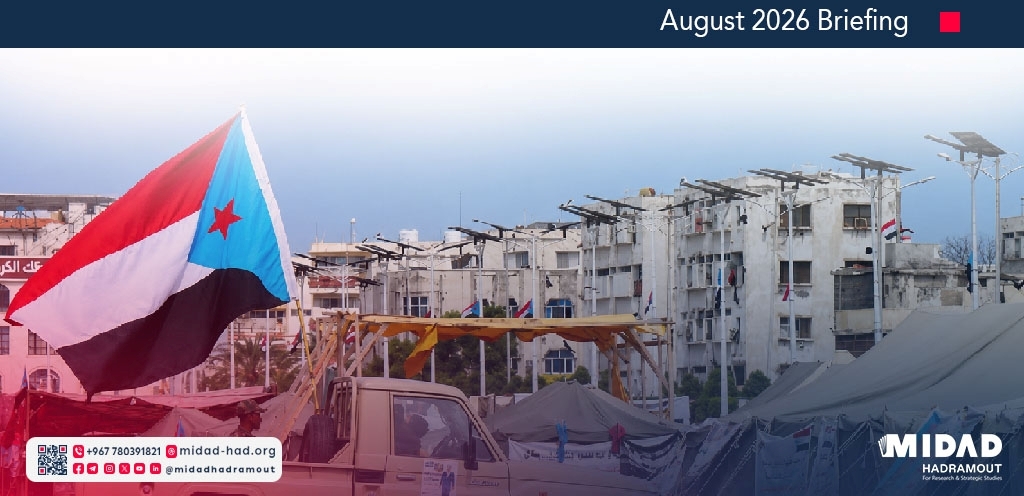
As for Hadhramout specifically, the month witnessed a direct development that reveals escalating tensions between the governorate and the Southern Transitional Council (STC). On August 24, a security and military force broke into and surrounded STC’s headquarters in Mukalla city, just a few days after the Council’s Executive Committee had renewed its demand that Hadhramout Governor Salim al-Khanbashi resign and had approved the organization of a large public rally in early September to commemorate the founding of the so- called Southern Army. The bodies of STC and the General Union of Southern Tribes described this raid as a direct attack on peaceful political activity, though no official comment had been issued by the local authority by the end of the month. This tension coincides with another notable development: after Sheikh Amr bin Habrish, head of Hadhramout Tribes Confederacy and Inclusive Hadhramout Conference, was prevented from returning to Hadhramout via Al-Wadea border crossing last July, he appeared on August 20, from Mukalla itself, announcing a decision on sweeping leadership changes within the conference, including the dismissal of two officials linked to the competitive coordinating council. This raises serious questions about whether the issue of his being stopped from returning has actually been resolved, and what has changed in his relationship with Riyadh during the weeks between the two events.
The Political Briefing:
The most significant political developments during August can be divided into six main categories. Foremost among them is the legitimate government’s response to the Houthi group’s escalation through military, diplomatic, and economic channels, then the Houthi group’s own escalation in the Red Sea and the immediate international reactions to it. Later, comes the effort to build international and regional coalitions against the Houthi group. Following that is the UN mediation process and the issue of detainees. The discussion then expands to the escalating political tensions in Hadhramout. Finally, there are institutional and administrative developments within the legitimate government.
The First Focus Area: The Legitimate Government’s Response to the Houthi Group’s Escalation
The legitimate government’s response to the Houthi group’s escalation was the most prominent political development of the month, as the government took action on multiple fronts. The Presidential Council reaffirmed the unity of its military resolve and held the Houthi group responsible for its attacks in the Red Sea, including the sinking of an Indian ship, while the Chairman of the Presidential Leadership Council, Dr. Rashad Al-Alimi, called for international support to restore state institutions. Al-Alimi’s tone later intensified before the ambassadors of the sponsoring countries when he declared that the phase of Houthi aggression without consequences had ended, demanding support for the state’s right to respond. The Yemeni government also appealed to the UN Security Council, demanding that the state be given a chance and that what it described as the Houthi group’s blackmail be stopped; Yemen also requested additional British and international support to counter the escalation. On the regional front, the Yemeni foreign minister discussed with her Saudi counterpart how to confront common threats, while Yemen’s ambassador to Washington proposed a trilateral roadmap to curb Iranian influence in the Red Sea.
The Second Focus Area: The Houthi Group’s Escalation in the Red Sea and Immediate International Reactions
In addition to the government’s response, the Red Sea witnessed a widespread wave of escalation by the Houthi group targeting ships and ports, which was met with successive international condemnations. The European Union described the attacks as a “dangerous escalation” that undermines regional stability. The coalition led by Saudi Arabia reaffirmed its full support for the Yemeni government in confronting these attacks. UN Special Envoy Hans Grundberg has warned that the escalation threatens to drag Yemen into a broader regional conflict.
The issue was not limited to the international level; the Yemeni National Parties Coalition affirmed that the battle against the Houthi group would be all-out and decisive until the defeat of what it described as a “coup.” The UN Security Council also condemned the attacks and called for avoiding further escalation. Taiz Gov. authority described the targeting Al-Mokha port as a war crime that severed a vital economic and humanitarian lifeline. UN officials expressed concern that the attacks could spread to include Saudi Arabia. A joint Saudi-French statement was also issued condemning the Houthi group’s targeting of civilian facilities and ships.
The escalation took on a new popular and tribal dimension when Sheikh Ben Fadgham in Al-Jawf Governorate announced cutting off commercial supply lines to the Houthi group, indicating that opposition to the group’s actions is expanding beyond official circles.
The Third Focus Area: The International and Regional Coalition Against the Houthi Group
In addition to direct condemnations of the attacks, the month witnessed moves to build a broader international coalition against the Houthi group. The U.S. Embassy announced the arrival of Neil Hope to assume the duties of chargé d’affaires in Yemen, while a Saudi official confirmed that there were no talks with the group. Turkish Foreign Minister Hakan Fidan also announced his country’s readiness to join the Saudi-led coalition, noting that security in the Red Sea directly affects Turkey’s interests. Both Washington and London warned that the Houthi group’s repeated attacks are pushing Yemen toward a broader regional conflict.
This development reflects that the formation of the coalition is no longer limited to momentary condemnations but has expanded to include more sustained diplomatic and security coordination between the Yemeni government and its regional and international allies.
The Fourth Focus Area: The UN Mediation Process and the Issue of Detainees
The UN mediation efforts have clearly failed during the month. The United Nations called for the release of dozens of humanitarian workers detained in Yemen. By the end of the month, a clear impasse had emerged in the Omani-led UN mediation, as the Houthi group rejected any compromise.
This sequence of events suggests that a resolution regarding the detainees remains far from being reached, despite ongoing diplomatic efforts on multiple fronts.
The Fifth Focus Area: Political Developments in Hadhramout
Hadhramout was one of the most sensitive issues during the month, with three parallel developments intersecting: tensions between local authorities and the Southern Transitional Council; a realignment of tribal and traditional political factions; and the escalation of popular protests demanding the governor’s resignation.
The scene began when Hadhramout Tribes Confederacy summoned its civilian and military leaders to an extraordinary meeting. Then, Shabwah Transitional Council mobilized its supporters against the Presidential Council and Saudi Arabia, at a time when Southern leader Ben Breik announced he was reversing his decision to suspend his membership in the Preparatory Committee for Hadhramout Coordination Council. Hadhramout Governor Salem Al-Khanbashi called on the governorate’s various groups to stand behind state institutions, in a message that appeared aimed at countering attempts at internal escalation, while STC escalated its demand for the withdrawal of emergency forces from Hadhramout. A member of the Presidential Leadership Council also inspected Al-Dabbah oil port and emphasized the need to strengthen its security, in a further indication of the sensitivity surrounding the issue of oil resources in the governorate. Al-Khanbashi later met with a delegation from Hadhramout National Council and stressed the importance of unity.
In this context, the Supreme Coordinating Council of Hadrami Political and Social Constituents emerged as one of the most important channels of political activity in the governorate during August. Its preparatory committee intensified its meetings and field visits to a number of districts as part of preparations for the founding general conference, holding introductory meetings and sector-specific consultations—reflecting an effort to broaden the base of participation and ensure broader representation within the council. The preparatory committee also approved the political platform, the code of honor, and the founding documents in preparation for presenting them to the general conference, a move that elevated the council from the level of an idea or administrative initiative to that of a political-coordinating project currently taking shape.
The significance of the Coordinating Council lies in the fact that it was proposed by the local authority and its organizers as an inclusive framework for coordinating the positions of Hadrami forces and constituencies on local issues and national priorities, and for building a shared vision for the future of Hadhramout. However, its emergence is inextricably linked to the prevailing polarization in the governorate; some view it as an attempt to reorganize representation in Hadhramout under an umbrella closely aligned with the local authority, in contrast to existing frameworks such as the Hadhramout Tribes Confederacy, Inclusive Hadhramout Conference, and Hadhramout National Council. Consequently, its ability to evolve into an inclusive framework will depend on the breadth of its representation, the transparency of its selection mechanisms, and its capacity to accommodate cautious or opposing factions—not merely on holding its founding conference.
These tensions escalated significantly as the end of the month approached. The Executive Committee of the Transitional Council in Hadhramout renewed its demand that the governor of the governorate resign and approved the holding of a large public rally in early September to commemorate the founding of the so-called “Southern Army.” Ahead of this event, a military committee affiliated with the Transitional Council organized demonstrations in front of the Hadhramout governor’s residence. Subsequently, a security and military force broke into and surrounded the Transitional Council’s headquarters in Al-Mukalla—an action described by the Executive Committee and other southern groups, including the General Union of Southern Tribes, as an attempt to prevent the aforementioned event from taking place and a direct attack on peaceful political activity. As of the preparation of this briefing, neither the local authority nor the government had issued an official statement regarding this raid, and this account remains to be confirmed by an independent source, as it has been reported exclusively by parties supportive of the Transitional Council.
In parallel with this tension, the traditional tribal and political framework in Hadhramout witnessed significant internal upheaval. Sheikh Amr Ben Habrish Al-Alie, head of Hadhramout Tribes Confederacy and Inclusive Hadhramout Conference, issued a decision to make changes in the conference’s leadership, including the removal of Political Department Head Abdulaziz Jaber and Secretary-General Akram Al-Amri from their positions, and appointing new leaders in their positions. Sources tracking these changes linked them to the involvement of the dismissed leaders in the work of the Hadhramout Coordination Council—a framework supported by local authorities that had previously sparked controversy over its relationship with Inclusive Hadhramout Conference. Hadhramout is currently experiencing polarization between the Tribes Confederacy initiative and the Coordination Council initiative.
This sequence reflects a multi-layered landscape in Hadhramout : escalating tension between the local authority and the Transitional Council over the issue of the governor and public events, and the rise of the Supreme Coordination Council as an attempt to reorganize the political and representative sphere in the governorate, alongside a realignment within the traditional tribal and political frameworks themselves, against the backdrop of the ongoing sensitivity surrounding oil resources as one of the unspoken drivers of this conflict.
The Sixth Focus Area: Institutional and Administrative Developments within the Legitimate Government:
The Yemeni government also witnessed a series of appointments and notable fall back at the central level. The Presidential Council fallen back its decision to appoint Ahed Ja’sus as Minister of Local Administration, without providing a clear explanation for this action. The government also announced the launch of a process to reform state institutions and modernize their structures. In a subsequent move, Yemeni President Mohammad Al-Faqmi appointed a minister of planning and international cooperation.
It should be noted that this institutional activity has been sporadic and unconnected to any announced, clearly defined reform plan, raising questions about its compatibility with the balance of power within the government, as observed in previous months.
Key indicators of political monitoring:
| Date | Event | Political Implication |
| August 1 | Hadhramout Tribes Confederacy calls for an extraordinary meeting of its civilian and military leaders | It indicates to early tribal activity that may reflect a readiness to confront anticipated political or security developments in the governorate |
| August 6 | The Transitional Council incites civil disobedience in Aden | This reflects a direct escalation by STC in its traditional areas of influence that may pave the way for broader pressure on the government |
| August 9 | STC calls for the withdrawal of emergency forces from Hadhramout | STC is escalating its direct security demands regarding Governorate, which falls outside its effective control |
| August 10 | Salem Al-Khanbashi, a member of the Presidential Leadership Council, inspects Al-Dabbah Oil Port and stresses the need to strengthen its security | It confirms that the issue of oil and resources remains sensitive, as one of the unspoken drivers of the conflict over Hadhramout |
| August 13 | Washington and London warn that Houthi attacks are pushing Yemen toward a broader regional conflict | This reflects growing Western concern over regional instability, going beyond the usual diplomatic condemnation |
| August 14 | The Presidential Council vows a harsh response after ports and civilian infrastructure were targeted | This repeats the pattern of verbal escalation by the government without disclosing any new practical deterrence measures |
| August 16 | Yemeni Foreign Minister discusses countering common threats with her Saudi counterpart | The continued high-level Saudi- Yemeni coordination reflects the management of the escalation |
| August 16 | Al-khanbashi meets with a delegation from Hadhramout National Council and stresses the importance of unity | Reflects an official effort to bridge internal divisions through direct dialogue with local forces |
| August 18 | Hadhramout Transitional Council renews its demand for the governor’s dismissal and approves a “million-strong” rally in early September to commemorate the “Southern Army” | The Transitional Council escalates its direct pressure on local authorities by calling for a major mass rally |
| August 20 | The national parties group announces that the battle against the Houthis will be all-out and decisive until the “coup” is defeated | This reflects the hardening of the local political stance in support of a military solution |
| August 20 | Bin Habrish issues a decision on leadership changes within Inclusive Hadhramout Conference, dismissing the head of the political bureau and the secretary-general | This reflects a division within the traditional tribal framework itself regarding relations with the competing Coordinating Council in Hadhramout |
| August 23 | The Yemeni government begins implementing a plan to reform state institutions and modernize their structures | This represents an attempt to project an image of institutional reform, but its actual impact remains contingent on implementation on the ground |
| August 23 | The Transitional Council prepares for protests in front of the Hadhramout governor’s residence | This sends a direct, symbolic message of pressure from the Transitional Council to the government authorities before the planned event |
| August 24 | The Yemeni president confirms the continuation of military strikes, and Yemen’s ambassador to Washington presents a roadmap to curb Iranian influence | Combines a declared escalation on the ground with a parallel diplomatic track aimed at the Iranian root of the crisis |
| August 24 | Security and military forces broke into and surround the Transitional Council’s headquarters in Al-Mukalla, after the planned event | This escalates the confrontation from verbal exchanges to direct security clashes, according to statements by the Transitional Council’s bodies and other southern factions; as of the preparation of this briefing, no official comment on the incident had been issued by local authorities |
| August 25 | Joint Saudi French statement condemns Houthi attacks on civilian facilities and ships | Strengthens European international backing alongside traditional gulf support for the Yemeni position |
| August 25 | Omani and UN mediation efforts continue amid Houthi rejection of compromise solutions | Confirms that the prisoner exchange process remains stalled despite months of ongoing mediation |
| August 25 | Yemeni President appoints Mohammad Al-Faqmi as Minister of Planning & International Cooperation | This comes as part of a limited round of appointments that may reflect internal adjustments rather than a comprehensive reform plan |
The Economic Briefing:
The economic landscape in August can be classified into five main focs area. Foremost among them is the domestic gas crisis, which has affected most governorates. Then, the electricity sector and efforts to reform it. Next is the issue of water and humanitarian aid. Later, comes the economic impact of attacks on shipping in the Red Sea. Finally, there is the focus on services and development in Hadhramout specifically.
The First Focus Area: The domestic gas crisis—a nationwide escalation and discrepancies in official reports
The domestic gas crisis was the most significant economic issue this month, affecting multiple governorates to varying degrees. In Sana’a, a severe gas crisis prevailed, accompanied by speculation about efforts by the Houthi group to impose a new price hike on the commodity. In contrast, the Yemeni Gas Company confirmed that gas supplies to Aden and the liberated governorates were proceeding normally. It later denied reducing the governorates’ share, announcing the shipment of approximately 36,800 metric tons of gas during July in an effort to reassure the public regarding the adequacy of reserves.
However, this official reassurance did not prevent the crisis from flaring up again in other governorates. In Marib, the oil minister directed the gas company to increase daily distribution shares, while Shabwah experienced a severe household gas crisis accompanied by the complete absence of officials from the Ministry of Oil’s office there, sparking widespread local discontent. The crisis reached its peak when the director of the Yemeni Gas Company stated that there were no reserve stocks and that the matter required an urgent strategic decision from the government—a statement that partially contradicted his company’s own previous official assurances.
The crisis has had a direct impact on the cost of daily living; Taiz raised public transportation fares by 50 percent amid the gas crisis and rising gas prices, indicating that the crisis’s impact has extended beyond household kitchens to the transportation system and public services.
This sequence reveals a clear contradiction between the repeated official rhetoric regarding the stability of supplies and the reality on the ground in several governorates, which undermines public confidence in government statements regarding basic commodities and raises questions about the existence of a structural flaw in the distribution chain rather than a temporary supply crisis.
The Second Focus Area: the electricity sector, reform plans, and limited external support.
The electricity sector witnessed notable movement this month toward partial reform. Equipment for a new emergency power plant arrived in Aden with Saudi support, and the Minister of Electricity announced an expected improvement in service in Aden and Hadhramout with the commissioning of new power generation projects. The Yemeni government then unveiled a new plan to reform the electricity sector, address recurring outages, and improve the overall level of service.
In a move that reflects the limited domestic resources available to the government, the Yemeni government has called on the United Nations to support the electricity sector, indicating that the reform plans announced locally remain largely subject to on the availability of additional external funding.
This path reflects a recurring trend in the management of public services: government announcements of reforms coincide with parallel requests for international support, raising questions about the government’s ability to finance these plans on its own without external assistance.
The Third Focus Area: Water and Humanitarian Aid
A report warned that the ongoing geopolitical conflict threatens millions of Yemenis’ access to clean water, drawing a direct link between the continuing political and military crisis and the deterioration of basic services. In the context of the humanitarian response, a shipment of humanitarian aid consisting of rice arrived at Aden port through a UN program, indicating that international food aid channels remain open despite the complexities of navigation in the region.
This section highlights the interdependence between the political and military crises on the one hand, and the deterioration of basic services such as water on the other, making the humanitarian situation more dependent on the course of a political settlement than on independent development efforts.
The Fourth Focus Area: the economic impact of targeting shipping in the red sea
The Yemeni Minister of Industry and Trade explicitly linked the Houthi group’s escalation in the Red Sea to the direct economic damage to Yemen, stating that Yemen is the country most affected by the Houthi group’s attacks on international shipping, given its direct reliance on ports and maritime corridors for importing essential goods. In a related development with long-term investment implications, Japan announced that it is close to launching a project to rehabilitate the Port of Aden and that it is considering participating in the Red Sea security initiative.
This timing reflects the fact that attacks on shipping have an impact not only on security and military aspects but also extend to the very heart of the national economy by disrupting supply chains, at a time when international actors such as Japan are attempting to capitalize on this crisis to strengthen their presence in Yemen’s port infrastructure.
The Fifth Focus Area: Hadhramout, service and development projects
This month, Hadhramout witnessed service and development initiatives running parallel to its political and security developments. Hadhramout Governor Salim Al-Khanbashi thanked Kuwaiti support for humanitarian and development projects in the governorate and later approved the awarding of new service and educational projects in Al-Mukalla city.
This movement indicates that local authorities in Hadhramout continue to strive to project an image of effective administration in the areas of public services and development, in parallel with the political tensions the governorate experienced during the same month. This reflects an attempt to separate public service issues from the escalating political tensions with the Transitional Council.
Key Economic Indicators:
| Date | Event | Significance |
| August 2 | A meeting in Hadhramout approves regulatory mechanisms to strengthen oversight of household gas trailers | The local authority in Hadhramout demonstrates an early regulatory response to the gas issue before the crisis escalates into a national concern |
| August 3 | UNICEF: Only one in five children in Yemen is breastfed | Documents a deep educational and health gap in breastfeeding indicators, as one of the indirect measures of child food security |
| August 3 | Modern equipment delivered to Al-Mahra Water Authority with international support | Reflects continued international support for improving the water sector in a remote governorate like Al-Mahra, far from the usual spotlight |
| August 16 | Hadhramout: official steps to address the household gas shortage and boost supplies | Reflects a further local effort to address the gas crisis in Hadhramout by improving supply mechanisms following the first oversight meeting |
| August 22 | Aden: Distribution of 207,000 household gas cylinders across five districts | Represents a partial and geographically limited relief response to the household gas crisis in the temporary capital |
The Social Briefing:
The social and humanitarian situation in August can be divided into six main focus areas. The first; is the measles crisis and the suspension of immunization efforts in areas controlled by the Houthi group. The second, the humanitarian toll of the Houthi group’s attacks on civilians. The third is the issue of displacement and homelessness. The fourth, the education sector, facing on-the-ground challenges and violations by the Houthi group. This is followed by Houthi violations involving kidnapping, detention, and extortion. Next is the social situation in Hadhramout specifically. Finally, there are general health challenges and the institutional response to them.
The First Focus Area: the measles crisis and the disruption of immunization in areas under Houthi control
The measles crisis was one of the most serious public health issues this month and was directly linked to the Houthi group’s policies toward immunization campaigns. Marib authorities declared a public health emergency to address the outbreak in the governorate, and Marib Health Director revealed that the prevention of vaccinations in Houthi-controlled areas was what brought measles to Marib in the first place—a direct accusation linking the outbreak to the group’s health policy.
Subsequent official statistics documented the scale of the crisis at the national level: 93 deaths and more than 16,000 cases of measles were recorded in just seven months. Marib authorities responded to the worsening crisis by launching an emergency response to limit the spread of the disease in the governorate.
This reveals that the suspension of vaccination campaigns in areas under Houthi control did not remain an isolated local crisis but rather became a source of disease transmission to neighboring governorates, thereby placing direct responsibility for the deterioration of health indicators on the group’s health policies.
The Second Focus Area: the human casualties of the Houthi group’s attacks on civilians
Official and human rights sources have documented a number of incidents that resulted in direct civilian casualties due to attacks by the Houthi group this month. The Ministry of Health announced that two civilians were killed in a Houthi missile strike on Marib. In a more comprehensive report, a human rights network documented that eighteen civilians were killed or wounded as a result of Houthi attacks in just one week across three different governorates.
This simultaneous geographic distribution of civilian casualties indicates that the Houthi group’s escalation this month did not limit its humanitarian impact to a single front, but rather extended simultaneously to several governorates at once.
The Third Focus Area: Continued Displacement and Homelessness
Displacement rates rose significantly during the month. The International Organization for Migration documented the displacement of nearly 10,000 Yemenis since the beginning of this year, and subsequently recorded the displacement of an additional 50 families in just one week. By the end of the month, reports indicated that the Houthi group’s escalation had raised weekly displacement rates to unprecedented record levels.
This gradual rise in displacement figures reflects a direct correlation between the pace of military escalation documented on the security front this month and the resulting scale of population displacement, making the displacement issue a direct humanitarian reflection of the course of the conflict on the ground.
The Fourth Focus Area: the education sector: between on-the-ground challenges and violations by the Houthi group
The education sector faced challenges from multiple sources this month. In Marib, a government official acknowledged that the educational process is facing serious challenges amid ongoing displacement and a lack of donor support. In areas under Houthi control, the group issued a directive to private schools in Sana’a requiring teachers to attend military training courses, a sign that the policy of militarizing the education sector there continues. In contrast, Hadhramout Governor; Salim Al-Khanbashi affirmed the local authority’s support for teachers and stressed the importance of maintaining the regularity of the educational process in the governorate.
This geographical disparity in educational realities reveals a clear divide between areas under Houthi control—where the education sector is used as a tool for militarization and recruitment—and areas under the legitimate government, which face operational and financial challenges rather than direct political ones.
The Fifth Focus Area: Houthi Group Violations; Abductions, Detentions, and Extortion
This month, a number of cases of Houthi violations—extending over time and across geographical areas—were documented. Al-Mudawahi’s wife revealed details of his detention and torture by the Houthis over a period of sixteen months in an underground facility, in a testimony that documents the group’s practice of long-term arbitrary detention. In Dhamar, the Houthi group continued to detain tribal sheikh; Sadiq Ahmed Saeed Al-Rajhi. At the international level, Human Rights Watch reported that the Houthi group referred UN staff members to the public prosecutor’s office in Sana’a; the organization later confirmed that seventy-three UN staff members remain in the group’s custody.
This sequence reflects a systematic pattern of arbitrary detention affecting multiple groups—from ordinary citizens to tribal leaders to UN staff—suggesting that the list of detainees held by the Houthi group is far broader than the political framework addressed by this month’s political section.
The Sixth Focus Area: Hadhramout, social issues, and local labor unions
This month, Hadhramout witnessed a local social dynamic separate from the political tensions with the Transitional Council. In Al-Shehr, leaders of Al-Hamum tribe reached a truce agreement following a local exchange of gunfire, indicating the ability of traditional tribal mediation mechanisms to contain minor security tensions before they escalate. In an incident that further highlights the deteriorating working conditions in the health sector, 831 nurses resigned from Seiyun General Hospital in protest against the failure to improve their professional conditions, in one of the largest documented waves of mass resignations this year.
Together, these two events point to a dual reality in Hadhramout: on the one hand, a traditional communal capacity to contain minor civil tensions; on the other, an escalating institutional crisis in the government service sector—specifically the health sector.
Key indicators from social and humanitarian monitoring:
| Date | Event | Significance Implication |
| August 4 | Human Rights Organization: The Houthis are putting millions of children at risk of paralysis by disrupting vaccination campaigns | The health impact of the suspension of immunization campaigns in Houthi- controlled areas extends beyond measles to include polio |
| August 4 | Ninety-five hundred and fifty cases of cancer in Taiz since the beginning of the year, including ninety-six children | It documents an additional chronic health burden in Taiz that is not directly related to the military escalation, but reflects the overall deterioration of the health system |
| August 15 | Taiz Health Authority: Fifty-three injured and sixteen deaths due to Houthi attacks since the beginning of August | Provides a detailed local assessment of the impact of Houthi attacks on Taiz Governorate specifically since the beginning of the month |
| August 16 | 8th session hearing in “Al-Sha’ir” assassination case: The mother of a defendant intervenes, leading him to confess and changing the course of the trial | A sensitive local assassination case in Hadhramout is reopened following an unexpected judicial development during a court hearing |
| August 23 | Hadhramout Coast Teachers’ Union approves a protest program to demand payment of their financial entitlements | Documents an additional union dimension to the cost-of-living crisis facing teachers in Hadhramout specifically, parallel to the national education movement |
| August 24 | In protest against Houthi Taxes, Qat farmers in Amran burn their crops | This represents an additional form of economic pressure exerted by the Houthis on residents in areas under their control, this time through agricultural taxes |
| August 26 | Floods in Yemen: Ten dead, 100 injured, and 607,000 families affected in a month and a half | Natural disasters add another cause of displacement and family hardship, in addition to the displacement caused by the conflict |
| August 27 | Amran: young man killed a day after accusing Houthi leaders of running drug smuggling networks | This documents an extrajudicial killing linked to accusations that Houthi leaders are running drug-smuggling networks, in a sign of the entanglement of organized crime with the de facto authority in Houthi-controlled areas |
Security & Military Briefing:
The security and military landscape in August can be divided into seven main focus area. Foremost among them was the Houthi group’s bombing of Marib and Hadhramout at the outset of this escalation, as the front most indicative of the nature of this phase. This was followed by the situation on the Taiz front, which witnessed the most intense and widespread clashes. Then comes Al-Dhale. Next is the Red Sea issue, Al-Mokha port, and attacks on maritime traffic. Then there are signs of attrition within the Houthi group’s ranks. This is followed by the situation in Al-Hodeidah, Aden, and Shabwah. Finally, there are security and institutional developments, including those related to the political situation in Hadhramout.
The First Focus Area: The Houthi Group’s bombing of Marib and Hadhramout at the beginning of the escalation
The targeting of Marib and Hadhramout was the primary driver behind the Houthi group’s wave of escalation this month, and it occurred chronologically at the forefront of events; the Houthi group bombed camps belonging to the legitimate government in deserts of Marib and Hadhramout , resulting in a large number of deaths and injuries. In addition, a number of government soldiers were killed or wounded in direct clashes with the Houthis south of Marib. Following a period of relative calm, rocket and drone attacks continued to target the city and the camps for internally displaced persons within it, in a pattern of intermittent escalation that never lasts long. Meanwhile, two soldiers from Shabwah defense forces were killed in a Houthi drone attack south of the city.
The Houthi group also resumed bombing Hadhramout later in the month using drones, resulting in deaths and injuries among government forces. In response to this escalation, the army carried out a targeted operation against the Houthi group south of Marib, A drone strike by the armed forces targeted one of the Houthi group’s field commanders in Marib sector, Brigadier General Al-Qasim Al-Marani, commander of the so-called Third Brigade within the group’s Al-Fateh Brigades, and killed two of his bodyguards. Government drones also targeted Houthi positions and gatherings in Marib and Al-Jawf. A UN report released late last month documented the deaths and injuries of 63 civilians as a result of Houthi attacks in Marib and Al-Mokha combined—the highest officially documented civilian casualty figure for the month.
This sequence of events shows that Marib and Hadhramout were the primary focal points of the Houthi group’s escalation this month, given their strategic location, their population density, and their economic importance. The attacks targeted civilians and camps for internally displaced persons as well as military forces, while the government’s response consisted of a combination of air defense and limited targeted operations, without a clear decisive victory on the ground by the end of the month.
The Second Focus Area: Taiz Front—the heaviest clashes over the month
Taiz front remained active throughout the month, with clashes between the army and the Houthi group resuming on an almost daily basis in several areas west and south of the governorate. Government forces repelled a Houthi attack on Al-Mafalis front south of Taiz, and a number of the group’s field commanders were killed in airstrikes west of the city. Widespread clashes erupted between the army and the Houthi group on the western and southern fronts of Taiz, while the army directly targeted a Houthi command center within the governorate.
At the end of the month, the army announced that 23 members of the Houthi group had been killed or wounded in battles in Taiz, marking one of the highest reported casualty figures on this front during the month.
This frequency reflects the fact that Taiz remained the front most actively engaged in direct combat throughout the month, compared to other fronts that witnessed intermittent or seasonal escalations.
The Third Focus Area: Al-Dhale’ Front
Al-Dhale’ front constituted a point of engagement parallel to Taiz, however, it was relatively less intense. Casualties were reported on both sides in clashes in Al-Dhale’a and Taiz at the beginning of the month, and government shelling resumed later against Houthi reinforcements north of Al- Dhale’a. Around the middle of the month, government strikes there were described as painful and debilitating for the Houthi group, as the army announced it was raising its readiness to what it described as “ending the coup.”
This pattern indicates that Al-Dhale’a remained a front of continuous attrition, without reaching the level of the media or military attention that Taiz or Marib received.
The Fourth Focus Area: The Red Sea, A-Makha Port, and Attacks on Shipping and Ports
The port of Al-Makha and shipping in the Red Sea were among the most intense issues this month. The month began with the sinking of an Indian ship off the western coast of Yemen after it came under attack, though its crew survived. The Houthi group then announced that it had targeted a Saudi oil tanker in the northern Red Sea. The second week of the month witnessed the peak of attacks on Al-Makha port of itself, as the Houthi group launched a series of missiles and drones at the port, killing and wounding twenty-two people in a single attack.
Later, The Houthi group announced that it had targeted Aramco refinery in Jazan for the second time in a few days, while the Yemeni Navy destroyed two Houthi boats in the Red Sea. A separate piracy incident was reported when armed men seized an oil tanker in the Gulf of Aden and diverted it toward Somalia, indicating that threats to navigation in the region are not limited to the Houthi group alone. As part of international efforts to secure the maritime corridor, the European “Aspeeds” mission ensured the safe passage of a new batch of commercial vessels. Toward the end of the month, Saudi Arabia confirmed that the oil tanker “Amzan” had been attacked in the Red Sea.
This sequence of events shows that Al-Makha port, in particular, was the focus of the most intense maritime targeting this month by the Houthi group, alongside a broader threat to commercial and oil shipping throughout the Red Sea and the Gulf of Aden, with multiple sources of threat not limited to a single party.
The Fifth Focus Area: Signs of attrition within the Houthi movement’s ranks:
Several exclusive reports have documented the extent of human losses within the Houthi group’s ranks during the month. The Houthi group held funerals for ninety-three casualties from the battles in July alone, including twenty-nine officers, followed by the funerals of more than 100 killed over two consecutive days, including high-ranking military leaders; thirty brigadier generals and colonels from the Houthi group were laid to rest during the first half of the month alone. In a related development, military sources reported that Iranian and Iraqi fighters fighting alongside the Houthi group were killed during the final days of the month. Commander Tariq Saleh commented on this trend, stating that the situation has changed and that the Houthi group is suffering heavy losses.
This frequency of reports on funeral processions—though difficult to verify—suggests that the month witnessed a relatively high level of attrition within the Houthi group, particularly among mid- and high-ranking military officers.
The Sixth Focus Area: Al-Hodeidah, Aden, and Shabwah—Scattered Fronts and Civilian Impact
In addition to the major fronts, the governorates of Al-Hodeidah, Aden, and Shabwah witnessed scattered but significant incidents. In Al-Hodeidah, the Houthi group displaced dozens of families, converted their villages into military barracks, and launched a widespread campaign to forcibly recruit young men and children and send them to the front lines.
In Shabwah, the commander of the 2nd Marine Infantry Brigade survived an assassination attempt, while Houthi shelling targeted government forces and residential areas in the governorate.
This distribution reflects that the direct civilian impact of the Houthi group’s escalation was not limited to the declared battlefronts but extended to displacement, forced conscription, and indiscriminate shelling of residential areas far from the lines of contact.
The Seventh Focus Area: Security and Institutional Developments:
The month witnessed institutional developments parallel to the escalation on the ground. President Al-Alimi issued decrees regarding appointments in the Air Force and the State Security Agency; the National Defense Council raised its state of readiness and approved holding permanent sessions following the Houthi group’s attacks; and the Yemeni Defense Council subsequently approved the expansion of air and missile deterrence against the group. The Yemeni president promoted Hashem Al-Ahmar to the rank of lieutenant general and appointed him as a military adviser.
In terms of internal security, a major security operation in Hadhramout seized an explosives laboratory, apprehended individuals wanted by security forces, and Hadhramout security authorities uncovered that a cell affiliated with the Houthi group was behind the assassination of journalist Mohammad Aidah. Yemeni customs authorities also foiled an attempt to smuggle optical fibers used to control drones. Abdulrahman Al-Masllami, a leader of the Al- Jawf Resistance, survived an assassination attempt in Marib.
In a development directly linked to this month’s political landscape, a security force in Hadhramout raided the headquarters of the Southern Transitional Council in Mukalla following its call for a protest event; security authorities in the governorate subsequently warned against “illegal gatherings” in conjunction with the Council’s calls for demonstrations.
This focus area shows that the escalation on the ground has been accompanied by multi-level institutional activity, combining the strengthening of military capabilities with responses to a variety of internal security issues—ranging from assassinations to the smuggling of drone equipment to the management of political tensions in Hadhramout.
Key indicators from security and military monitoring:
| Date | Event | Significance Implication |
| August 1 | Three Houthis were wounded in clashes with government forces west of Taiz | Reflects the ongoing daily clashes on Taiz front even before the start of the widespread Houthi escalation |
| August 1 | Dead and wounded in tribal clashes in Al-Shehr, east of Hadhramout | Indicates the presence of local tensions parallel to the conflict with the Houthis within Hadhramout itself |
| August 1 | The Minister of the Interior praises the arrest of those accused of assassinating journalist Mohammad Aidah in Hadhramout | Closes a sensitive security case and demonstrates the ability of Hadhramout ’s security agencies to investigate political assassination cases |
| August 2 | Clashes have resumed on Taiz fronts, and a Houthi infiltration attempt west of the city was defeated | The semi-daily clashes in Taiz and the Houthis’ repeated infiltration attempts underscore this |
| August 3 | Al-Harsh chairs his first security meeting in Abyan and emphasizes improving performance and enhancing readiness | Reflects the ongoing changes in security leadership in Abyan at the beginning of the month |
| August 3 | Army forces target Houthi reinforcements on Maris front north of Al-Dhale’ | Dhale’a front has emerged as a battleground parallel to Taiz since the beginning of the month |
| August 3 | A number of Houthi militia members were killed and wounded by army artillery fire south of Taiz | Daily casualties among Houthi ranks on Taiz front continue to be documented |
| August 3 | The Houthi militia bombs populated areas in Al-Hodeidah and Taiz | Houthi bombing expands to populated areas far from the front lines |
| August 4 | The Houthis announce they have targeted the Saudi airport in Najran with a drone | Adds a regional dimension to the escalation that extends beyond Yemen’s internal battlefronts |
| August 4 | Taiz: Houthi militia sends new military reinforcements to the north of the city | Indicates Houthi readiness for an escalation on the ground in Taiz through the mobilization of new reinforcements |
| August 4 | Abyan Governorate witnesses the handover ceremony for command of the center in the presence of a ministerial committee | Reflects a routine rotation of military leadership in Abyan, away from the direct battlefronts |
| August 5 | An explosion near an oil tanker east of Aden; sources report a Houthi missile | A mysterious maritime incident adds to a series of incidents near the Yemeni coast that have not been officially attributed to any specific party |
| August 5 | The Houthi militia launches a widespread campaign of abductions in Al-Zahir district of Al-Bayda | Highlights the human rights dimension of the Houthi escalation through the targeting of civilians outside the context of direct combat |
| August 6 | The Houthis announced that they had targeted government positions in eastern Yemen with drone strikes, and the Third Emergency Division denied that there were any casualties among its ranks | It documents a Houthi claim of heavy losses among government forces, which the 3rd Emergency Brigade quickly and officially denied |
| August 6 | Saudi Arabia announces the appointment of a commander for the Multinational Maritime Defense Coalition | Reflects a Saudi move to unify international naval efforts in the face of threats in the Red Sea |
| August 6 | The Yemeni Ministry of Defense launches a large-scale security campaign to pursue the perpetrators of highway robbery and assassinations, and vows to retaliate against the Houthis | Indicates the government’s recognition of the escalation of assassinations and highway robberies as a domestic security issue separate from the battlefronts |
| August 6 | Army defenses shoot down a drone belonging to the Houthi militias over Marib city | Reflects the success of government air defenses in Marib in intercepting some Houthi drones since the beginning of the month |
| August 7 | The National Resistance foils an attack by a booby-trapped boat targeting an oil tanker in the Red Sea | Attacks on commercial shipping in the Red Sea expand beyond military vessels |
| August 7 | The coalition vows deterrent measures after eleven civilians are injured in Najran by Houthi projectiles | The first direct extension of the Houthi escalation into Saudi territory is documented, resulting in civilian casualties and prompting a Saudi threat of retaliation |
| August 7 | Shabwah Defense targets Houthi positions in Hareeb in response to the killing of soldiers in a drone attack | This marks the first direct response on the ground by Shabwah Defense Forces following the killing of their soldiers in a drone attack south of Marib |
| August 8 | The Houthis expand their escalation on four fronts; the army responds in Taiz, Al-Hodeidah, and Marib, while Aden raises its state of readiness | Documents a pivotal day of multi-front escalation accompanied by heightened government readiness in Aden |
| , August 8 | Government forces target Houthi militia gatherings south of Al-Hodeidah and defeat a Houthi advance there | Clashes continue in Hodeidah, emerging as a front parallel to those in Marib and Taiz |
| August 8 | In an extraordinary meeting, Hadhramout security authorities raise the alert level and warn against security breaches | This reflects a preemptive security response in Hadhramout as escalation spreads to other governorates |
| August 9 | Houthi attacks on Al-Makha port of escalate, with attempts to target its pier, as the Houthis announce they have targeted weapons depots and Aramco refinery in Jazan | Documents the peak of attacks on Al-Makha port during the month through mutual statements by both sides regarding the extent of the damage and the targeted warehouses |
| August 9 | Clashes resume between the army and the Houthis on several fronts in Taiz Governorate | Confirms that clashes continue in Taiz in parallel with the escalation in Al-Makha |
| August 9 | Djibouti announces that two soldiers were wounded in an exchange of fire with a Yemeni boat | A rare regional incident adds to a series of Red Sea tensions outside the immediate Yemeni-Houthi context |
| August 9 | The Houthis hold a funeral for ten of their dead, including individuals impersonating military personnel | Documentation of casualties among Houthi ranks continues through repeated funeral ceremonies |
| August 10 | The escalation of Houthi attacks on Al-Makha port continues, and the army announces that it shot down eleven drones during the attack | The ongoing confrontation at Al-Makha port is documented, with the army announcing it shot down eleven drones during the attack |
| August 10 | Al-Arrada calls on security agencies in Al-Mahra to intensify the fight against smuggling and raise their state of readiness | Security concerns over smuggling through the Al- Mahra border crossing are mounting |
| August 10 | Taiz: Houthi militia shells residential villages in Maqbanah and Sabr al- Mawadim | Houthi shelling in Taiz expands to residential villages far from the front lines |
| August 10 | Dead and wounded in Houthi attack on Shabwah Defense Forces in eastern Yemen | Documentation continues of repeated Houthi attacks on Shabwah Defense Forces in eastern Yemen |
| August 10 | A new brigade joins the ranks of the First Division of the Emergency Forces | This reflects a structural reinforcement of the government’s emergency forces in parallel with the escalation of clashes |
| August 11 | The army foils two Houthi infiltration attempts east of Taiz and in Al-Krifat, and captures a number of fighters | Documents the army’s success in defeating two separate Houthi infiltration attempts east of Taiz in a single day and capturing a number of militants |
| August 11 | Three people killed in a Houthi attack on a cargo ship in the Red Sea | Adds a new maritime attack to the series of attacks on commercial shipping |
| August 11 | The Houthis claim to have targeted weapons depots in Marib and Al- Makha | Reports indicate that the Houthis continue to claim they are targeting weapons depots in Marib and Al-Makha, though there is no independent confirmation |
| August 11 | A Houthi leader threatens Saudi Arabia with “all-out war” | This represents a direct verbal escalation by the Houthis toward Saudi Arabia that goes beyond the confines of Yemen’s internal battlefronts |
| August 12 | Widespread mobilization of Houthi militias in the streets of Ibb city and its entrances | Indicates security tensions within the Houthi ranks themselves in Ibb Governorate, far from the front lines |
| August 12 | The Houthi militia resumes shelling the port of A-Makha with ballistic missiles, and the port official reports that the damage has doubled | Reports document continued targeting of A-Makha port and worsening damage there, according to a statement by the port official himself |
| August 12 | Dozens of dead and wounded Houthis
arrive at hospitals in Sana’a |
Provides an indirect indication of the scale of Houthi casualties through overcrowding in
Sana’a hospitals |
| August 12 | Houthi casualties from Yemeni army shelling in Al-Dhale’a | Continues to document clashes on the Al-Dhale’a front, parallel to Taiz and Marib |
| August 13 | The army repels a Houthi attack in Taiz and targets militia positions south of Marib | Links the escalation in Al-Makha to Marib front in a single attack targeting government forces in two different areas |
| August 13 | Houthis: Saudi airstrikes target border areas in Sa’ada | A parallel border front is opening in Sa’ada, as the Houthis report that Saudi airstrikes have hit their border areas |
| August 14 | Four civilians killed in a Houthi attack with six missiles on Al-Makha | Direct civilian casualties are documented from Houthi shelling of the port of Al-Makha |
| August 15 | Haidan: The armed forces and security forces are engaged in a single national battle to defeat the Houthis | Reflects an official attempt to frame the battle as a joint effort between the military and security institutions |
| August 15 | Exchange of artillery fire between government forces and the Houthis on Al-Salou front; army artillery targets Houthi reinforcements west of the city | Continues to document near- daily artillery exchanges on the western Taiz fronts |
| August 15 | A government official visits those wounded in the clashes with the Houthis in Lahj | Reflects symbolic government concern for those wounded in the clashes on Lahj front |
| August 16 | The Yemeni Army announces that it carried out 180 military operations against the Houthis over a 24-hour period | Provides a quantitative indicator of the pace of daily government military operations against the Houthis |
| August 17 | A military meeting was held in Abyan to raise readiness along the front lines | Indicates preemptive military preparations in Abyan as tensions escalate in neighboring governorates |
| August 17 | Houthi ballistic missiles target the vicinity of Bab Al-Mandab and locations to Al-Makha | The Houthi missile threat expands to the Bab Al-Mandab area itself, not just Al-Macha port |
| August 17 | Simultaneous strikes by Yemeni government forces target the Houthis on three fronts | Reflects government coordination of simultaneous strikes on multiple fronts at once |
| August 17 | Army forces defeated a Houthi militia infiltration attempt west of Taiz | Continued documentation of repeated Houthi infiltration attempts west of Taiz |
| August 17 | Sources: Hospitals in Al-Hodeidah Governorate are overflowing with dead and wounded Houthis | The overcrowding in
Al-Hodeidah’s hospitals provides further on-the-ground evidence of the scale of Houthi casualties |
| August 18 | An expanded military meeting in Taiz to discuss the latest developments on the front lines, with the commander of the 4th Region emphasizing support for the forces stationed there | Reflects extensive leadership coordination to assess readiness on Taiz front, with direct support from the commander of the Fourth Region |
| August 18 | Al-Khanbashi appoints a director general for the General Telecommunications Corporation in Hadhramout Coast | Reflects routine administrative activity in Hadhramout Coast, separate from direct security and military matters |
| August 18 | The Giants conduct a maneuver to test their combat readiness and capabilities in unmanned aerial vehicles and air defense | Indicates continued efforts to raise combat readiness among the best-armed brigades in the government forces |
| August 18 | Casualties reported in a drone
exchange between Shabwah’s defense forces and the Houthis |
Continues to document the exchange of drone strikes between Shabwah Defense Forces and the Houthis |
| August 18 | Two drone brigades enter service, and the army prepares for a large-scale operation, according to a military official | Indications of a qualitative upgrade in the government’s drone force coincide with preparations for a broader military operation |
| August 18 | Yemeni Army Spokesperson: We carried out thirty-three military operations against the Houthis over a twenty-four-hour period | Provides another daily update on the high pace of government military operations during the middle of the month |
| August 18 | Maritime Authority: Report of an incident 40 nautical miles from Al-Makha | An unspecified maritime incident near Al-Makha port adds to the record of navigation tensions |
| August 19 | Drones strike Houthi positions and personnel on the Sa’ada, Marib, and Taiz fronts | Government drone operations link Sa’ada, Marib, and Taiz fronts in a single operation |
| August 19 | Army forces defeat a Houthi infiltration attempt on Al-Qasr front east of Taiz city | Continues to document Houthi infiltration attempts east of Taiz |
| August 20 | The Yemeni Army announces that it carried out 81 military operations against the Houthis over a 24-hour period | Provides an additional daily update on government military operations on the 20th of the month |
| August 20 | The Houthis claim to have carried out two drone attacks on targets in Saudi Arabia | Expands the scope of alleged Houthi attacks deep into Saudi territory using two drones |
| August 20 | One civilian killed and three injured in an attack targeting a security commander in Abyan | This constitutes a direct assassination attempt targeting a security commander in Abyan outside the context of routine military confrontations |
| August 22 | Twelve Houthis, including four officers, were killed by government forces’ fire | Continues to document Houthi casualties in clashes with government forces without specifying a particular front |
| August 23 | Government forces repel Houthi advances west of Aden and target militia barracks in Al-Bayda | The conflict expands to both Aden and Al-Bayda fronts simultaneously |
| August 23 | Yemeni Assistant Minister of Defense: We are ready to eliminate the Houthi threat | Reflects a firm official statement from the military leadership regarding the resolution of the conflict with the Houthis |
| August 24 | Government forces announce they have once again repelled Houthi drones west of Aden | Confirms that Houthi attempts to infiltrate with drones west of Aden continue for the second consecutive day |
| August 24 | Houthi artillery shelling targets residential villages in western Yemen | Houthi artillery shelling expands to residential villages in western Yemen outside the immediate front lines |
| August 24 | An attack with an unidentified projectile targets an oil tanker off the Saudi coast | A mysterious maritime attack of unknown origin adds to a series of navigation tensions off the Saudi coast |
| August 25 | Weapons and ammunition seized in Al-Mahra, eastern Yemen | Indicates ongoing security efforts to curb arms smuggling through the Al-Mahra border crossing |
| August 25 | One government force member killed and six wounded; eleven Houthis killed and wounded in violent clashes northeast of Taiz | Continues to document violent clashes in Taiz with casualties on both sides |
| August 27 | The Yemeni government orders increased readiness and enhanced coordination to counter Houthi escalation | It directly links the government’s security rhetoric to the political situation in Hadhramout, as it follows the documented events in Mukalla on the political front this month |
| August 27 | The Houthis target a residential village west of Taiz with a missile | Sporadic Houthi shelling of villages in western Taiz continues to be documented until the end of the month |
| August 27 | Naval forces thwart a Houthi attack and an attempt to smuggle military equipment in the Red Sea | Reports document ongoing naval clashes and the thwarting of an attempt to smuggle military equipment in the Red Sea through the end of the month |
| August 27 | Head of the Coast Guard inspects the readiness of forces in Bab Al-Mandab and Mayun | Field inspection assesses Coast Guard readiness at the most sensitive points in Bab Al- Mandab and Mayun |
| August 27 | Houthi militia targets Marib and Al-Makha with ballistic missiles and drones | Confirms that Marib and Al-Macha have continued to be targeted simultaneously through the final days of the month |
Your Content Goes Here