


Executive Summary:
In October, the war entered a new phase. Following the loss of the western coast in September, the government, with the support of the coalition, launched Operation “Fajr Al- Yemen”, and its forces shifted from defense to offense on several fronts. In the operation’s early days, the government announced the recapture of Bab Al-Mandab, Dhubab, and Mokha, then advanced south of Marib and into the countryside around Taiz, while airstrikes hit Sana’a for the first time since the escalation began. In response, the Houthi group tightened its siege on Taiz and shifted its strikes to the liberated cities and deep into Saudi territory—from Ma’ashiq Palace in Aden and Al-Rayyan Airport to Riyadh Airport.
On the political front, the government made the designation of the Houthi group as a terrorist organization the centerpiece of its foreign policy, finding support in the Gulf and Europe—support that is expected to be formalized at next month’s session to renew UN sanctions. As for Riyadh, it pursued two parallel tracks: it engaged in joint defense with its partners in Mecca Alliance and, at the same time, opened a channel of dialogue with Tehran, while Washington signaled its willingness to participate in strikes against the group without formally announcing a decision to do so.
Civilians in Taiz have paid the heaviest price, after the group blocked the flow of water and gas into the city, causing fuel and food prices to skyrocket; the human rights center “154” documented 154 civilian casualties in the governorate during the month. The number of displaced persons since August has reached about “260,000”—two hundred sixty thousand—people, nearly half of whom are from Taiz, with cholera cases on the rise in the camps. Economically, the government has shifted the conflict to target the group’s resources, as the Central Bank froze the assets of “135” one hundred thirty-five people, one entity, and one ship linked to the group, while Saudi and international support for service projects continues.
The data indicates that the battle is likely to continue. The defense minister says the operation is still in the first of six phases, tribes are calling for mobilization in Marib, and army statements report that more than “16,000”—sixteen thousand—Houthi fighters have been neutralized. Furthermore, the siege of Taiz remains in place, and battles are ongoing to clear near Bab Al-Mandab; therefore, it seems most likely that fighting will continue on several fronts, with Taiz remaining the most critical test of the operation.
In Hadhramout, however, the nature of the threat has changed. In September, the threat came in the form of drones, but in October, strikes reached Mukalla itself, targeting Al-Rayyan Airport for the fourth time. Nevertheless, the governorate played an important role: the airport received flights diverted from Aden; the people of Hadhramout donated blood for the wounded at Al-Alam Camp in Shabwah; and the transfer of “1,324” security and police personnel to Al-Wadi was completed.
Politically, the events of September carried over into October. After the meeting between Al-Khanbashi and Bin Habrish resolved the dispute over the Supreme Coordinating Council, the rivalry shifted to Hadhramout’s representation on the southern political scene. The dissolved Transitional Council has mobilized its supporters in Mukalla and Seiyun, and Al-Zubaidi reemerged, while Fadi Ba’oum returned to Mukalla with a conciliatory message and met with Al- Khanbashi. Thus, next month, Hadhramout will find itself caught between external pressure in the form of Houthi strikes, internal pressure stemming from the competition over its representation, and the domestic gas crisis.
The Political Briefing:
Two interrelated issues came to the fore this month on the political front: The first is the government’s handling of the conflict after the Houthi group expanded its attacks to Al-Ma’ashiq Palace in Aden and tightened its siege on Taiz. The second is the course Riyadh will take—between deterrence and negotiation—after the group struck Riyadh Airport more than once. This month’s developments can be analyzed along four sections. First: the government’s continuation of Fajr Al- Yemen Operation and its efforts to turn the siege of Taiz into an international issue. Second: the campaign to designate the group as a terrorist organization. Third: Saudi Arabia’s dual approach—balancing deterrence with the Iranian channel—amid Washington’s hesitation. Fourth: Hadhramout and the south, where Al-Zubaidi has reemerged and various factions are vying for representation in the governorate.
The First Focus Area: The Continuation of Fajr Al- Yemen Operation and the Internationalization of Taiz Siege
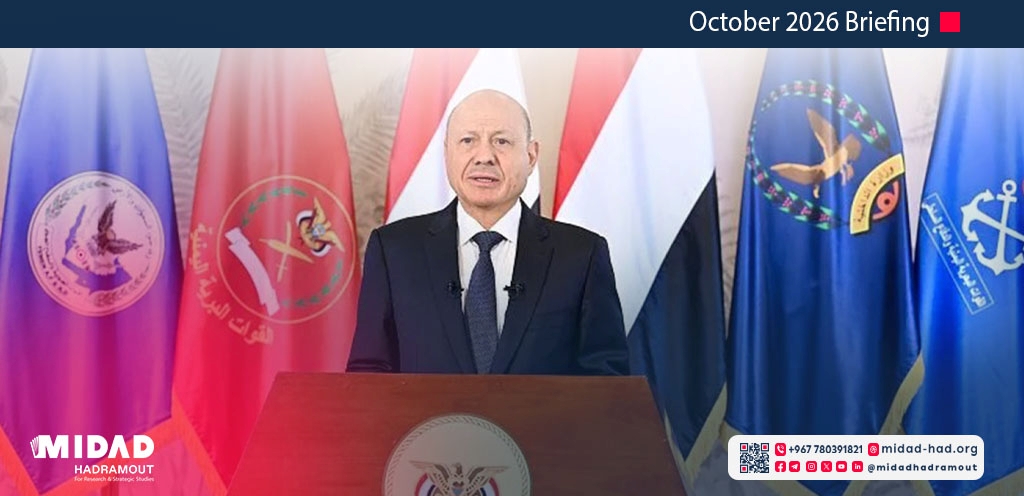
Fajr Al-Yemen Operation remained the focus of official speech throughout the month. In the middle of the month, Rashad Al-Alimi, Chairman of the Leadership Council, pledged to continue the operation despite what he described as temporary changes on the ground, signaling that the government views fluctuations on the battlefield as part of a protracted struggle. Then came the missile and drone attacks on Al-Ma’ashiq Palace in Aden, which resulted in casualties among the security personnel. Al-Alimi ordered a response against the sources of the threat and announced that the operation had surpassed “17,000”—seventeen thousand—strikes, and the government pledged to continue its work from Aden. In his meeting with the acting head of the U.S. Embassy, Al-Alimi presented the operation as a project to protect the population and restore services, not merely as a military operation. He then reiterated that the attacks on airports would not halt the battle to restore the state.
Meanwhile, Taiz has become the government’s top political priority. Its governor issued an urgent appeal to break the siege, and the governorate’s political parties called for mobilization and urged people to rally behind the army and the resistance. The prime minister then described the siege and the targeting of civilians as war crimes that warrant accountability, and the government called on the Security Council to take urgent action to lift it. The European Union joined this call by urging the group to open supply routes, while local authorities and the people of the governorate called on the group to withdraw unconditionally.
Thus, over the course of the month, the government managed to both continue military operations and turn the siege of Taiz into an international issue, in which the group bears the burden of targeting civilians before the international community.
The Second Focus Area: Designating the Houthi Group as a Terrorist Organization
The government made the designation of the Houthi group as a terrorist organization the focus of its foreign policy efforts this month. It approved the draft designation, after which Al-Alimi officially requested that the UN Secretary-General support a Security Council resolution that would include the designation, an arms embargo, and the drying up of funding sources. This effort found support in the Gulf and in Europe. The Gulf Ministerial Council called on the international community to implement the arms embargo and designate the group as a terrorist organization, while the European Parliament called for its designation and the freezing of its assets. At the end of the month, Al-Alimi warned Europeans of the cost of delaying this decision.
As for the Security Council, it emphasized the arms embargo on Yemen and support for a political settlement, and the government welcomed its stance on the attacks on its territory and on Saudi Arabia. However, its statement did not include a designation of the group; consequently, the government continued to exert pressure a few days later. The UN sanctions regime against the group expires in the middle of next month, and its previous renewal had passed with Russia and China abstaining from the vote; therefore, the renewal session will be the first real test of this campaign.
The Third Focus Area: Riyadh between deterrence and the Iranian channel; Washington between statements and decisions
As the Houthi group’s attacks on Riyadh Airport continued—with one attack resulting in fatalities and hundreds of injuries—Saudi Arabia escalated its rhetoric. It stated that it would not allow Yemen to be used to threaten its security, and then warned the group of the consequences of its attacks on airports, Mecca, and Medina. On the military front, a trilateral meeting was held in Riyadh with Turkey and Pakistan to discuss the attacks and activate the mutual defense treaty. At the end of the month, the Egyptian parliament authorized President Abdel Fattah Al-Sisi to take measures to support Saudi Arabia and defend its territory.
However, Riyadh kept another door open. Pakistan revealed that Tehran had proposed the idea of political engagement with the group and that members of the Mecca Agreement would discuss it. Iranian Foreign Minister Abbas Araghchi then offered his Saudi counterpart to facilitate talks between the Kingdom and the group. Riyadh publicly denied that it had requested any Iranian mediation, but Defense Minister Khalid Bin Salman visited Tehran a few days later, accompanied by the Pakistani army chief and the head of Turkish intelligence. The delegation met with senior Iranian officials during a visit that the Saudi Foreign Ministry said was aimed at de-escalating tensions. The following day, Iranian official Mohsen Rezaei met with the group’s ambassador in Tehran. In response, the Yemeni government clearly stated its position on this course of action, with the foreign minister declaring that the Tehran regime is a party to the war, not a mediator for peace.
In Washington, the situation remained suspended between words and action. Earlier this month, President Donald Trump said that the Saudi-Yemeni military campaign was going well, and Secretary of State Marco Rubio stated that Saudi Arabia and Yemeni forces would not tolerate the group’s presence near Bab Al-Mandab Strait. Following the airport attacks, Trump said he was considering joining Saudi Arabia in striking the group, and Rubio described the attacks as heinous. However, this threat had not turned into an official decision by the end of the month. Thus, Riyadh is pursuing two parallel tracks: military deterrence and dialogue with Tehran. In return, the government is keen to maintain a firm stance toward Tehran and to remain a key player in any de-escalation regarding Yemen.
The Fourth Focus Area: Hadhramout, the south, Al-Zubaidi’s return, and the competition for representation in Hadhramout.
The dissolved Transitional Council returned to the scene this month via Hadhramout. Its committees held a series of meetings in Mukalla and Seiyun to prepare for what it called a “million-strong popular mobilization” on the anniversary of the “14” Revolution on October 14. Then, Aidrous Al-Zubaidi appeared at the same event in his first public appearance since leaving Yemen. He announced a general popular mobilization to defend the South within its pre-unification borders, called on southern tribes to declare a state of mobilization, and included Hadhramout among the governorates where he called for mobilization. He also called on Saudi Arabia and the international community to recognize the constitutional declaration he had issued before his departure, while condemning the Houthi group’s attacks on Saudi Arabia. His appearance sparked outrage among Saudi writers and Twitter users, some of whom accused the UAE of stirring up trouble. On the same day, the transitional president of Shabwah appeared in public accompanied by armed men, despite arrest warrants having been issued for him.
Late last month, Fadi Ba’oum, head of the Political Bureau of the Southern Future Council, returned to Mukalla from Saudi Arabia, where he was greeted at the airport by sheikhs, dignitaries, and tribal and political leaders from the coast and Wadi. He stated that Hadhramout is a fundamental pillar of the southern national fabric, and called for dialogue and reconciliation among southern forces, urging them to unite in the face of the Houthi threat. He also thanked Saudi Arabia for its support. He then met with the governor and Leadership Council member; Salim Al-Khanbashi, along with Council leaders in Mukalla, and emphasized the need to unite efforts in the face of Houthi escalation.
Thus, Hadhramout has become an arena of competition for representing the South following the dissolution of the Transitional Council. Al-Zubaidi is proposing a mobilization parallel to that of the state, with a separatist agenda, while Ba’oum is presenting a conciliatory discourse to which Al-Khanbashi is receptive. However, the inclusion of Hadhramout within the southern framework remains a point of contention with Inclusive Hadhramout Conference, which presents the governorate as an entity with its own distinct identity.
The Economic Briefing:
The military escalation in October had a direct impact on the economy and people’s livelihoods. The Houthi group turned the siege of Taiz into an economic blockade affecting one million people, while the government launched a financial offensive against the group’s resources and continued to receive external support for service and development projects. We present this month’s developments under four focus areas.
The First Focus Area: Taiz under economic siege
Taiz was the hardest-hit city economically this month. After the group cut off the main road connecting the city to Aden, gas stations closed their doors, and prices skyrocketed. The price of a 20-liter can of gasoline rose from 30,000 riyals to 120,000, diesel from 46,000 to 90,000, and a household gas cylinder from 11,400 riyals to 40,000. The United Nations said that food and fuel prices have doubled and that water production has fallen by half. The group has blocked the delivery of household gas supplies to the city.
In response, local authorities took action to contain the crisis. The governor inspected the markets at the beginning of the month and confirmed the availability of goods; the Emergency Committee then announced efforts to bring in fuel and gas and is awaiting the group’s response. As the siege intensified, the governor ordered that the necessary measures be taken to secure drinking water. This comes amid a difficult national context; the United Nations has stated that the group’s attacks are causing 75 percent of Yemeni households to struggle to secure food.
The Second Focus Area: the financial front against the Houthi group’s resources
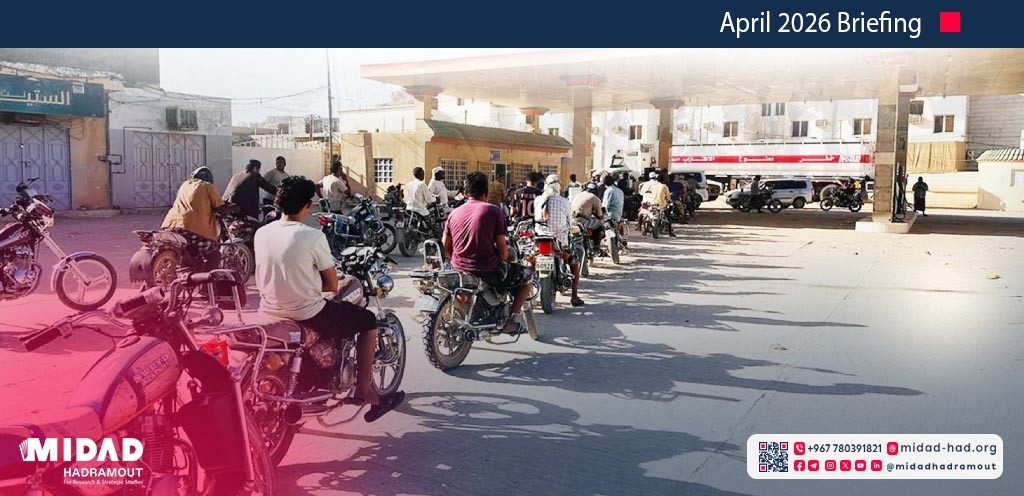
The government has shifted the confrontation to the financial front. The Central Bank in Aden ordered the freezing of assets belonging to “135” individuals, entities, and a ship linked to the Houthi group, in a move targeting its financing networks. In Sana’a, long lines formed at gas stations after the coalition ordered civilians to evacuate the central Al-Sabaha station, revealing the fragility of the fuel system in Houthi-controlled areas under military pressure.
The Third Focus Area: external support and service projects
International and regional support continues despite the war. Rashad Al-Alimi, Chairman of the Leadership Council, launched new Saudi-funded projects covering food, shelter, health, and housing. The government signed an agreement with the United Nations to support basic services and create job opportunities through 2029, and the European Union announced a 9-million-euro agreement to support local development. The government also discussed debt relief and support for displaced persons with the OPEC Fund, the World Bank, and the United Nations Development Program (UNDP). In Hadhramout, Governor Salim Al-Khanbashi praised the UNDP’s interventions and called for the expansion of development and service projects in the governorate.
The Fourth Focus Area: Hadhramout and the domestic gas crisis:
Hadhramout has experienced a domestic gas crisis despite being one of the leading oil- and gas-producing governorates. Citizens have complained about the rising price of a gas cylinder to “13,000”—thirteen thousand riyals—and supply shortages have emerged in districts of Wadi. The deputy governor for Wadi and Desert Affairs held a meeting with the Yemeni Gas Company and approved directing available supplies to citizens, as well as taking firm measures against those manipulating distribution. The crisis reveals that the gas problem in the governorate relates more to distribution and oversight than to production.
The escalation in October had a widespread social impact, concentrated in Taiz. The Houthi group turned the siege of the city into collective punishment affecting water, medicine, and food, and the wave of displacement expanded to exceed a quarter of a million people. In response, the community demonstrated remarkable resilience, from tribal mobilization to support the army to solidarity campaigns for the wounded. We present this in four focus areas.
The First Focus Area: Taiz, a city under collective punishment
The siege of Taiz has entered its third week, threatening the basic needs of some two million people, according to a government office. The Houthi group has prevented water tankers from entering the city, in a move described by local authorities as collective punishment. The United Nations has warned of a worsening shortage of food, fuel, and water, and the World Food Program stated that the escalating conflict has cut off life-saving aid to the city. The UN then said that time is running out to save the population.
The blockade had a direct impact on the health sector. The World Health Organization warned that twelve hospitals were at risk of running out of fuel within four days, and that 1,110 patients with kidney failure and 154 infants in incubators were at risk of having their care interrupted. Al-Thawra Hospital warned that its services would cease within “24” hours. Yemeni doctors living abroad, for their part, warned of the collapse of health services in the city.
Human rights groups documented the scale of the violations. A human rights network recorded “377” projectiles fired at neighborhoods in the governorate over “48” hours, and another report documented sixty-one incidents of violations in a single day. Authorities said that “237” civilians had been killed or injured in Houthi attacks since August. Twenty-eight human rights organizations condemned the shelling of residential neighborhoods, and Human Rights Watch described the group’s bombing of Hayja Al-Abd road as a war crime.
The government took action on multiple fronts. It appealed to international organizations for urgent action, and the governor warned of a humanitarian disaster and called for international intervention to end the siege. At the end of the month, the government demanded that the delivery of supplies to Sana’a be linked to a guarantee that aid would be allowed into Taiz—a stance that shifts the blockade issue from appeals to mutual pressure.
The Second Focus Area: Increasing displacement, and epidemics targeting displaced people:
The wave of displacement accelerated throughout the month, to the point that the United Nations Office for the Coordination of Humanitarian Affairs stated that the number of displaced people since August had reached approximately “260,000,” nearly half of whom are in Taiz Governorate. More than “230,000” displaced people from the western coast are living in difficult conditions, and a government official said that 15,000 displaced families from Al- Mudaraba in Lahj are facing tragic conditions. Officials inspected camps for displaced people arriving from the western coast in Abyan.
Epidemics have affected the displaced in their camps. The World Health Organization warned of outbreaks of cholera and measles among them, and subsequently announced a sharp rise in cholera cases. Al-Bayda has recorded an alarming rise in the number of children suffering from malnutrition, and health authorities in Al-Mahra, together with the Red Crescent, have emphasized the need to respond swiftly to infectious diseases. The Red Cross stated that some medical facilities in Yemen received more than 700 wounded people in a single week, while the United Nations has documented 251 civilian casualties since the escalation began, including 57 deaths, half of whom were children.
The Third Focus Area: the role of society in “Fajr Al- Yemen” operation
Operation “Fajr Al- Yemen” has found clear social support. The tribes of Marib have declared a general mobilization, and their sheikhs and leaders have affirmed their support for the operation and the restoration of state institutions. Most notably, the tribes of Al-Haimatin, Bani Matar, and Haraz—areas near Sana’a—declared a call to arms to support the army. Khawlan Al-Tiyal tribes accused the group of killing four of their sons and called for an urgent meeting. They also sent a food convoy to the fighters on the Marib fronts.
Meanwhile, the group continued to maintain its grip on society in the areas under its control. It carried out new raids and abductions in Mokha. A human rights report revealed that more than “461,000” children enrolled in its summer camps this year. The United Nations called for the release of its detained staff members, at a time when eight UN staff members and civilian workers face the risk of execution in the group’s prisons.
The Fourth Focus Area: Hadhramout— Stand with the wounded, and support the healthcare sector:
The social dimension in Hadhramout was evident through solidarity with the victims of the Houthi attack on Al-Alam Camp in Shabwah. The governorate increased the readiness of its hospitals to receive the injured, and the people of Hadhramout donated blood to save the wounded, in conjunction with the Shabwah governor’s directive to increase medical readiness. In terms of services, Governor Salim Al-Khanbashi sponsored an agreement to rehabilitate and operate al-Rahma Hospital in Mukalla.
Security and Military Briefing:
October has seen the conflict moved into a new phase with the government’s launch of Fajr Al- Yemen Operation, backed by the coalition. Government forces shifted from repelling attacks to launching offensives on multiple fronts simultaneously, while the Houthi group responded by tightening its siege of Taiz and intensifying its strikes on liberated cities and deep inside Saudi territory. We present the month’s events under five focus areas. First: the launch of Fajr Al- Yemen Operation and its results. Second: Taiz and the western coast as the focal points of the battle. Third: the targeting of liberated cities, including Hadhramout. Fourth: Marib, Al-Jawf, and Lahj fronts. Fifth: the attacks on Saudi Arabia and the international military support it receives.
The First Focus Area: the launch of Fajr Al- Yemen operation and its outcome
Rashad Al-Alimi, Chairman of the Leadership Council, announced the launch of a comprehensive military operation against the Houthi group and the transition from a phase of de-escalation to a phase of liberation. The announcement was accompanied by the initiation of executive measures for general mobilization within the Ministry of Defense and the government. The coalition stated that 100 fighter jets participated on the first day, destroying “324” high-value targets. For the first time since the escalation began, Sana’a witnessed intense airstrikes, which targeted missile launch pads and weapons depots in Sana’a and Sa’ada. The strikes then expanded to include fuel facilities used by the group in its operations, after the coalition ordered civilians to evacuate Al-Sabaha oil terminal in Sana’a. The coalition later announced the destruction of 127 mountain storage facilities and five tunnels.
The defense minister explained that the operation consists of six phases and that the forces are still in the first phase. The ministry designated the group’s gatherings as legitimate military targets. According to military statements, since the start of the operation through the last week of the month, forces have carried out more than 25,000 strikes, neutralized more than 16,000 Houthi fighters—killed or wounded—and destroyed or damaged approximately 4,000 vehicles. This cumulative figure exceeds the sum of the daily data listed in the tally table because the army did not issue a statement every day of the month; it reveals the extent of reliance on ground and air firepower during the first phase of the operation.
The Second Focus Area: Taiz and the western coast—the center of gravity in the battle
On the western coast, the operation achieved its most significant gains on its first day. Government forces announced the recapture of Bab Al-Mandab, Dhubab, its military airport, Al-Omari camp, and Mokha city, in conjunction with a coalition naval operation in Al-Hodeidah that it said thwarted imminent Houthi attacks south of the Red Sea. The group denied these gains, but the forces announced that they had surrounded hundreds of its fighters in Dhubab and repelled an attack north of Dhubab Airport. Fighting continued throughout the month to clear the remaining pockets near Bab Al-Mandab after Houthi reinforcements arrived there, and at the end of the month, the forces announced the recapture of new strategic positions there. The Coast Guard participated in securing the islands and maritime access points. On the high ground overlooking the strait, the forces repelled repeated attacks on Kahbub front. The Al-Sabiha tribes paid a heavy price in these clashes; Al-Sabiha, the vice-chairman of the Presidential Leadership Council, stated that more than “170” of their sons were killed, and another “700” were wounded.
As for Taiz, it was the most sensitive front. At the beginning of the month, the group took control of Al-Turba, cut off the main road connecting the city to the liberated areas, and tightened its siege on it. At the end of the month, the governor said that the city was now besieged on all four sides and that residents had lost the wells in Wadi Al-Dhabab after the group took control of them. The group destroyed Haija Al-Abd road bridge, through which supplies pass, and converted 21 schools into barracks and command centers. The government stated that more than 2,000 projectiles had fallen on the city’s neighborhoods over the course of several days, and the Taiz coalition accused the group of desecrating the bodies of its dead.
Meanwhile, government forces fought battles on more than fifty fronts in the governorate. They recaptured the areas of Al-Maqarama, Al-Zakira, and Jabal Al-Ja’sha south of the city, as well as a mountain range in Haifan, and launched an operation in Al-Wazaiya. They then launched an attack in Al-Masraakh, consolidated their gains there, repelled a counterattack, and announced advances in Al-Aqroud and west of the city. It also arrested a Houthi drone operations team east of Taiz. Forces on both sides lost a number of their military commanders in these battles, including Major General Mohammad Salim Al-Kholani on Al- Kadha front. Popular support convoys helped reinforce the front lines. Taiz has thus become the battleground on which the fate of the western coast hinges, as control of its countryside means either protecting or threatening the gains near Bab Al-Mandab.
The Third Focus Area: targeting liberated cities, from Aden to Hadhramout
The Houthi group shifted part of its pressure to cities far from the front lines. Aden was the most prominent target; its airport was bombed six times over the course of several days, and two missiles struck inside it without causing any casualties. Two Yemenia Airlines flights were forced to land in Mukalla and Djibouti, after which the group called for the evacuation of the airport, claiming that a Saudi military cargo plane was present there. In the most serious attack, the prime minister and members of the government survived a missile strike on Al- Ma’ashiq Palace, which left five people dead and sixteen wounded. The group also announced that it had targeted Badr military camp, and its shelling struck a Coast Guard facility, though the Coast Guard confirmed that its operations were continuing.
The strikes have reached Hadhramout. The group targeted Al-Rayyan Airport in Al-Mukalla for the fourth time; Governor Salim Al-Khanbashi inspected the airport and described the targeting of civilian infrastructure as a war crime. Conversely, the airport served as an alternative to Aden Airport when it received a diverted flight. On the security front, Hadhramout Police announced the arrest of the suspect accused of killing Judge Mubarak Bin Sumaida in Seiyun and completed the transfer of “1,324” personnel to the security and police forces of Wadi Hadhramout.
In Shabwah, the highest number of casualties in a single attack occurred when a Houthi missile struck a police training center at Al-Alam Camp, killing 73 recruits and wounding about 200; 75 of the victims were later laid to rest. As for Marib, its residential neighborhoods were hit by nine ballistic missiles and seven projectiles, followed by eight ballistic missiles in another attack. In Nahm, an entire family was killed by a Houthi missile that fell after a failed launch. These strikes reveal that the group is attempting to compensate for the pressure on the front lines by striking the liberated hinterland and state institutions there.
The Fourth Focus Area: Marib, Al-Jawf, and Lahj Fronts
Marib fronts have shifted from defense to offense. The forces announced that they had taken control of fortified positions in the south of the governorate, including Jabal Thamad, Al-Qaymah, and Al-Maqilat, and were advancing toward Umm Rish Camp; they also advanced in the northwest toward areas in Ragwan. The group denied that there had been any change in the lines of control. In Al-Jawf, operations continued east of the governorate toward Al-Hazm, and warplanes targeted the group’s military headquarters in the city. These two fronts are of particular importance because they represent the shortest route to Sana’a.
In Lahj, violent clashes resumed, and the Giants Brigades announced they were repelling a large-scale Houthi attack. The forces then carried out ambushes, airstrikes, and drone strikes that killed and wounded dozens of Houthi fighters and thwarted an attempt to infiltrate the northern part of the governorate.
The Fifth Focus Area: attacks on Saudi Arabia and international military support
The Houthi group expanded its attacks on Saudi Arabia to include airports, energy facilities, and holy cities. It targeted a power plant in Madinah, then the airports in Jazan and Najran—where three people were injured—and the airports in Abha and King Khalid—where three were killed and thirty-six were injured. The most violent attack was on Riyadh Airport, where 321 people were killed or injured, prompting authorities to suspend operations at the airport. This was followed by attacks on oil facilities, a fire near Aramco facilities in Ras Tanura, and rocket debris falling over Mecca and Medina. The coalition announced that it had intercepted dozens of rockets and drones, stating that the group had acquired advanced technology with regional support.
In response, there was a regional and international military buildup to protect the Kingdom. Mecca Alliance decided to activate joint defense measures and deploy troops and military capabilities in Saudi Arabia. France began deploying military assets to protect oil facilities, Britain announced the participation of Typhoon fighter jets in the Kingdom’s defense, and two Egyptian military aircraft were spotted in Saudi Arabia. Reuters reported that Syria is considering providing military assistance to Saudi Arabia and Yemeni forces. This mobilization remains largely defensive in nature, but it provides the coalition and the government with broader cover to continue operations inside Yemen.
Your Content Goes Here


Leave A Comment