


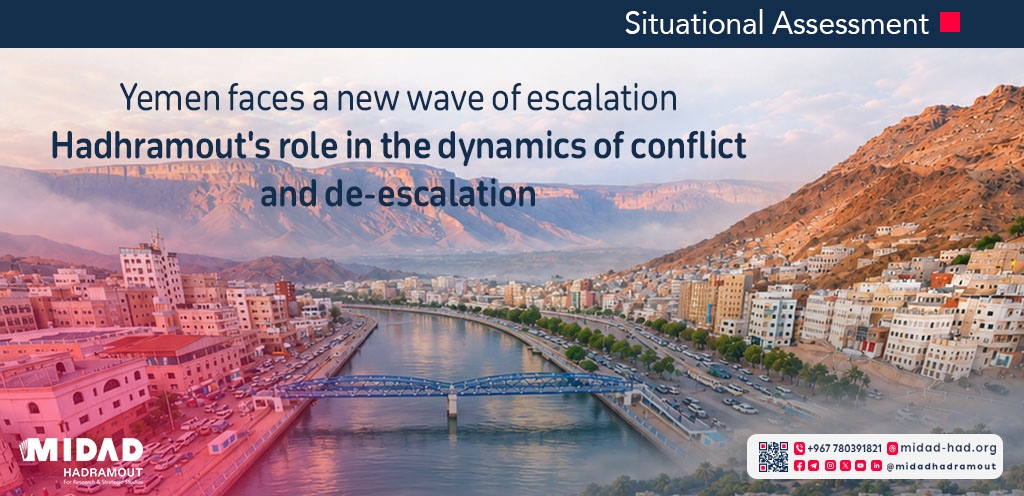
During September and October 2026, Yemen has witnessed a shift in the course of the military confrontation, as the ceasefire that had prevailed since April 2022 began to unravel, combined with changes on the ground along the Red Sea coast, cross-border strikes, and counteroperations announced by the internationally recognized government under the name “Fajr Al-Yemen.” On October 9, the UN envoy confirmed that Yemen had returned to full- scale war. Meanwhile, the October 21 attack on Al-Rayyan Airport—which local authorities accused Ansar Allah group—reflects that the threat is no longer limited to the western fronts but extends to critical infrastructure in Hadhramout and the eastern governorates.
Against this backdrop, Hadhramout is facing an escalation whose impact extends across several interconnected fronts, including direct security risks to facilities, and vital infrastructure with the economic and logistical repercussions of the conflict, increasing pressures on public services, and the humanitarian response to newly displaced persons, alongside a test of the capacity of its institutions and political forces to manage the governorate’s interests without polarization. Hadhramaut’s importance comes from the interplay of its border and coastal areas, its oil facilities, its transportation infrastructure, and its role in reshaping political representation in the south and east.
An analysis of the available evidence indicates that the military confrontation is ongoing, alongside mounting security and economic burdens on Hadhramout; This represents the most critical area to monitor through the end of 2026, while opportunities to contain the escalation remain tied to opening verifiable channels of mediation, protecting civilian infrastructure, and ensuring the continuity of services.
At the local level, the adoption by the Supreme Hadhrami Coordination Council on August 31 of documents and demands regarding representation, wealth management, and the governorate’s powers represents a step toward organizing the Hadhrami vision and strengthening its presence in future settlement negotiations, but it does not reflect a comprehensive consensus or the implementation of those demands. This highlights the need to separate the management of emergency services and security from political rivalry, and to link any national or regional arrangements related to oil or local authority to a comprehensive and transparent Hadrami dialogue.
What has changed? From a state of calm to escalating clashes on several fronts
The Yemeni political and military situation has been undergoing rapid shifts since December 2025, beginning with a change in the balance of power in the southern and eastern governorates, the decline of the Southern Arab Transitional Council’s control following clashes, and the realignment of forces, culminating in the restructuring of the Presidential Leadership Council with the addition of two new members. These developments contributed to a realignment of political and security power centers in Hadhramout, followed by a resurgence of military clashes with Ansar Allah (the Houthis).
In July 2026, disputes over flights to Sana’a and restrictions on transportation intensified, coinciding with an exchange of strikes and escalating tensions in the Red Sea, which put the ceasefire to a real and precarious test. These developments intensified on August 6 and 7, as the National Defense Council confirmed that sites and targets in Marib, Hadhramout, and Shabwah had been struck, confirming that the threats had spread to the eastern governorates.
During September 2026, the escalation took a more dangerous turn as Ansar Allah (the Houthis) advanced along the western coast, in Mokha, and in area around Bab Al-Mandab , thereby reinforcing the link between the military confrontations and the security of maritime corridors, as well as economic and regional interests. The escalation reached a new level in early October when Rashad Al-Alimi, Chairman of the Presidential Leadership Council, announced the launch of military operations under the name “Fajr Al-Yemen.” On October 9, the UN envoy confirmed the resumption of large-scale fighting, the widening of the conflict, and the diminishing prospects for an immediate de-escalation. Meanwhile, during the second half of the same month, attacks extended to civilian facilities and infrastructure outside the traditional front lines; Government reports indicated that the airports in Aden and Al-Rayyan were attacked on October 21, while the Ministry of Transportation reported on October 28 that Aden Airport had once again been targeted. This coincides with an escalation of the humanitarian fallout; according to an update on October 27, the international organization has documented 287,767 individuals among the new waves of displacement linked to the escalation since June 2026.
Taken together, these developments indicate that the conflict has shifted from a ceasefire and peace talks to a broader military confrontation, the repercussions of which are no longer confined to traditional battlefronts but have extended to civilian and vital infrastructure, the economy, and humanitarian operations.
As for Hadhramout, the most notable shift has been its transition from being indirectly affected by the conflict to facing direct security threats, in parallel with its growing political and economic importance in the dynamics of the conflict and the truce.
These facts explain the shift on two levels: the first is geographical; as the center of gravity has shifted from relatively static front lines to the western coast, roads, and airports; and second, political; as the government has declared a broad national goal of restoring authority over all of Yemen, while Ansar Allah (the Houthis) link the confrontation to lifting restrictions imposed on areas under their control and exerting pressure on Riyadh. Amid these two positions, the UN envoy continues to call for de-escalation and a return to the political process.
Trends in political discourse and the positions of influential forces regarding Hadhramout
Official statements reveal divergent positions among political forces regarding security and military developments in Hadhramout; On October 22, 2026, Rashad Al-Alimi, Chairman of the Presidential Leadership Council, affirmed that targeting airports and civilian facilities would not halt Operation “Fajr Al-Yemen,” linking the protection of civilians and the restoration of stability to the continuation of military operations and the extension of state authority. This stance reflects a government approach that places Hadhramout within the framework of the broader national confrontation. At the local level, Salem Al-Khanbashi, a member of the Presidential Leadership Council and governor of Hadhramout, emphasized—following the attack on Al-Rayyan Airport on October 21—the protection of civilian facilities, the strengthening of preparedness, security coordination, and the assurance of continued services, warning of the repercussions of such attacks on the governorate’s security, stability, and the interests of its citizens. This reflects the priority of mitigating the direct effects of the escalation and maintaining institutional and service stability.
In contrast, Hadhramaut Tribes Confederacy’s stance centers on ensuring the governorate’s representation and its rights in political settlements; During his meeting with representatives of the UN Special Envoy’s office in May 2026, the Confederacy’s chairman, Sheikh Amr Bin Habrish, emphasized the need to make the Hadhramout issue a central focus of any just settlement, thereby ensuring an effective political partnership. This stance was reiterated during a meeting with the governor in September, as both sides affirmed the importance of unifying Hadrami positions and strengthening the governorate’s role in the settlement process. As for the Southern Arab Transitional Council, it links its stance toward Hadhramout to its southern political project, affirming the right of the governorate’s residents to manage their own affairs and secure them through local forces. In its statements throughout 2026, it reiterated its rejection of what it describes as “Domination over Hadhramout,” while its October discours focused on popular mobilization and readiness to confront military threats, reflecting the continued overlap between its political objectives and security considerations.
These positions reveal a divergence in the priorities of the influential forces—between restoring state authority, protecting local stability, ensuring Hadrami representation, and advancing the southern political project. This divergence may affect the prospects for formulating a common local stance toward the escalation, as well as Hadhramout’s ability to protect its interests within the frameworks of confrontation and potential settlement.
Track of the Recent Escalation’s Impact on Hadhramout (Direct and Indirect)
The recent military escalation has revealed that security threats have expanded to include civilian and critical infrastructure in Hadhramout, after the main clashes had previously been concentrated on other fronts; On October 21, 2026, Al-Rayyan International Airport was attacked by drones, an attack that government authorities attributed to Ansar Allah (the Houthis), with no casualties reported according to preliminary information. The attack highlighted the vulnerability of air traffic and related services to the developments of the war, especially given that Al-Rayyan Airport had been adopted as an alternative destination for some flights when operations at Aden Airport were disrupted. This indicates a shift in the nature of the security risks facing the governorate—from indirect impact by the war’s repercussions to direct targeting of its facilities—and necessitates strengthening protective measures and ensuring service continuity, even without Hadhramaut becoming a ground combat front.
The resumption and expansion of military operations during September and October 2026 posed additional security challenges for Hadhramout, given the multiplicity of military and security units and the reshuffling of their leadership since the beginning of the year. These recent developments have directly impacted the priorities of the governorate’s security agencies; on October 6, the Security Committee discussed the repercussions of Operation “Fajr Al-Yemen” and the declaration of general mobilization, and emphasized the need to increase readiness, strengthen coordination, and facilitate information sharing among the various units. With the subsequent targeting of Al-Rayyan Airport, the importance of coordination to protect critical infrastructure and facilities has increased. The primary challenge lies in the ability of military and security institutions to respond to new threats within a framework of effective command and coordination, thereby preventing external military pressures from leading to security or institutional instability within the governorate.
The renewed military clashes in September and October 2026 significantly increased the risks associated with the potential resumption of oil exports from Hadhramout, despite the government’s announcement in July of its intention to resume exports, which had been suspended since 2022; The escalation has once again highlighted the security risks surrounding production, export, and transportation facilities, at a time when the infrastructure requires rehabilitation and operational and security arrangements that have not yet been finalized. The continuation of the clashes implies a potential delay in the recovery of oil revenues and, consequently, continued pressure on government resources, funding for services, and salaries. The importance of this issue is growing as Hadhrami stakeholders demand guarantees regarding the governorate’s share of revenues and the mechanism for their distribution. At the national level, on October 7, the International Monetary Fund updated its forecast for the Yemeni economy’s contraction in 2026 to 1.5%, reflecting the fragility of the economic environment amid the escalation; this serves as a direct and indirect measure of the resulting losses in Hadhramout.
The recent military escalation comes at a time when Hadhramout is suffering from disruptions in electricity and basic services, which has increased the likelihood of war-related economic vulnerability; The spread of clashes to the western coast and threats to maritime corridors and airports heighten the risk of disruptions to transportation and supply chains, and add potential pressure on the costs of imports, fuel, and basic commodities. Furthermore, diverting additional government resources to military operations may limit the ability to fund services and address the existing deficit. The most significant impact of the escalation is the potential for a deepening of service and economic crises, making the stability of services such as electricity, fuel availability, and the continued flow of goods important indicators for measuring its actual repercussions on the governorate in the coming period.
The expansion of military clashes since June, and their escalation during September and October 2026, led to new waves of displacement whose impact extended to Hadhramout, the primary host governorate, According to data from the International Organization for Migration as of October 27, displacement linked to the escalation totaled approximately 287,767 individuals nationwide, of whom 2,820 were registered in Hadhramout within the scope of tracking. This flow poses a potential additional strain on health, education, housing, water, and employment services, given the limited local resources and ongoing economic crises. The challenge is not only related to the scale of the displacement but also to the capacity of local institutions and humanitarian partners to respond to the needs of the new arrivals and those of host communities, and to prevent pressures on services and living conditions from escalating into social tensions—while ensuring that displaced persons are protected and not stigmatized or held responsible for existing imbalances.
Recent military and political developments have once again highlighted the importance of Hadhramout’s position in the power structure, security, and the future of the Yemeni settlement, coinciding with the continued proliferation of political agendas within the governorate; Following the establishment of the Hadhramout Supreme Coordination Council in August 2026, a wave of escalation occurred in September and October, putting the ability of Hadhramout’s various factions to unify their priorities to a new test—particularly regarding the protection of the governorate, political representation, and resource management. The military operations also coincided with an escalation in mobilization speech by the Southern Arab Transitional Council and its supporters in Hadhramout, in contrast to the local authority’s focus on security preparedness and institutional stability. This points to the possibility of increased competition over the province’s priorities and its position in any future political or security arrangements. Thus, the impact of the escalation does not lie in the emergence of political disputes, but rather in the increased importance of managing them and preventing them from affecting local coordination, Hadhramout’s ability to protect its interests, and its influence on the paths toward de-escalation and settlement.
It is clear from the preceding analysis that the recent escalation did not create most of the challenges facing Hadhramout, but it did increase its vulnerability to risks and added direct security threats to existing economic, service-related, and political disruptions. Its repercussions in the coming period will be determined by three interrelated factors: the extent of the military confrontation, the capacity of local institutions to manage the crisis, and the level of coordination among Hadrami forces to protect shared interests.
Escalation scenarios through the end of December 2026
Scenario 1: Relative Containment of the Escalation (a path contingent on breaches of the ceasefire)
A decrease in the frequency of cross-regional and cross-border strikes, and the resumption of communication channels with verifiable results (cessation of attacks on airports and ships, humanitarian arrangements, and incident monitoring), while political tensions persist. In Hadhramout, the likelihood of repeated disruptions to air traffic decreases, and the capacity for service planning improves, though financial instability persists.
Achieving this trajectory requires verifiable understandings regarding the cessation of attacks, clear arrangements for the protection of civilian and critical infrastructure, institutional coordination among the responsible units, a mechanism for receiving reports and verifying incidents, as well as economic and humanitarian measures to mitigate the impact of the unrest. Early indicators include a sustained decline in attacks, the continued operation of flights and roads, and the issuance of mutual commitments to de-escalation. This trajectory will be ruled out or weakened if new major attacks occur or existing understandings collapse.
Scenario Two: Continued escalation and indirect exhaustion (current indicators warrant closer monitoring)
This scenario assumes the continuation of military operations nationwide without a political settlement in the near future, the continued disruption of crude oil exports, limited government financial resources, and recurring aerial threats or disruptions to transportation and supply chains—without a sustained shift of large-scale ground combat to Hadhramout. Its conditions are linked to the continuation of local security coordination and limited funding and revenues, while its early indicators include recurring air incidents, rising import costs, persistently poor services, power outages, and a gradual increase in the burden of displacement. This trajectory weakens if a viable ceasefire emerges or if a broad, stable ground front shifts to the east of the country.
Scenario Three: A security explosion and the spread of unrest toward eastern Yemen (the Dangerous Path)
This scenario assumes repeated attacks on civilian or economic facilities in eastern Yemen, or the expansion of disruptions to roads and supply lines, thereby increasing pressure on population movement, services, and local political coordination—without making any prior assumptions about the motives of any party. This scenario requires the convergence of additional indicators, such as an escalation in fighting on the front lines accompanied by repeated attacks on critical infrastructure, a deterioration in institutions’ capacity to respond, prolonged disruption of supply routes, and increased displacement toward specific regions and districts. Indicators of de-escalation include the continuation of political talks while maintaining the essential functions of airports and ports, and the emergence of effective mechanisms for communication, protection, and de-escalation.
Response and De-escalation Options
The analysis indicates that Hadhramout faces overlapping security, economic, and political risks that vary in impact and manageability; these risks are influenced by the course of national military operations, the ability of local institutions to maintain services, and the management of competition over representation, authority, and resources. It is possible to identify preventive response options that do not presuppose a single political path:
First: Protecting Hadhramout requires a shift from the concept of “geographical distance from the front lines” to that of “the continuity of the governorate’s functions under threat,” while keeping public services and oil facilities neutral in the face of partisan and regional rivalries.
Second: Natural resources do not automatically become a stabilizing factor; rather, they require governance and transparent rules for allocating revenues and defining the rights of local communities, along with civilian oversight and transparent monitoring to prevent fuel smuggling or trafficking.
Third: Hadhrami political pluralism may enhance the quality of representation if it helps manage disagreements, or it may hinder decision-making if it turns into a struggle over legitimacy.
Fourth: Explore the establishment of an emergency funding mechanism to ensure the continuity of essential services and emergency response, either through existing institutions or a dedicated mechanism with clearly defined rules for accountability and transparency, in coordination with government agencies and international partners, provided that any independent fund is preceded by an assessment of its legal, financial, and institutional feasibility.
Fifth: National de-escalation and a return to the political process remain essential conditions for protecting domestic gains in the medium term.
References and Authorized Sources
Note: Sources are listed in the order of their use in this paper, distinguishing between primary documents issued by parties and institutions, relatively neutral UN statements, analyses by research centers, and independent journalistic materials.
- UN Special Envoy to Yemen, Security Council Briefing, October 9, 2026 – October 9, 2026 (UN / Primary).
- UN Special Envoy, Security Council briefing, September 10, 2026 – September 10, 2026 (UN / Preliminary).
- Website of the Presidency of the Presidential Leadership Council, Announcement of Operation Fajr Al-Yemen – October 5, 2026 (Government / Direct Statement).
- Yemeni Ministry of the Interior, National Defense Council, and Targeting of Governorates— August 7, 2026 (Government / Official).
- Saba News Agency in Sana’a, statement by Mahdi Al-Mashat—October 13, 2026 (Party to the conflict / Public position).
- Saba News Agency in Sana’a, statement by military spokesperson Yahya Sari’ – October 15, 2026 (party to the conflict / stated position).
- MIDAD Hadhramout Center for Research & Strategic Studies, Political Representation of Hadhramout—September 2025 (opinion poll).
- MIDAD Hadhramout Center for Research & Strategic Studies, Monthly Briefing— September, October 2026 (monthly briefing).
- Hadhramout Governorate Website, Statement Regarding the Targeting of Al-Rayyan Airport—October 21, 2026 (Local Authority / Official Statement).
- Ministry of the Interior, Call from the Chairman of the Leadership Council to the Governor of Hadhramout – October 22, 2026 (Government / Official).
- Hadhramout Governorate website, Outcomes of the Founding Conference of the Supreme Hadhrami Coordination Council – August 31, 2026 (Founding Document / Preliminary).
- Hadhramout Governorate website, Decision to Form the Preparatory Committee for the Coordination Council—July 2, 2026 (Local Decision / Preliminary).
- Ministry of the Interior, Appointment of Leaders of the First Military Region—February 11, 2026 (Government / Official Decision).
- Hadhramout Governorate website, arrangements for securing Seiyun Airport— September 30, 2026 (local authority / preliminary).
- International Organization for Migration, Tracking Displacement Resulting from the Escalation in Western Yemen—Data through October 27, 2026 (UN / Monitoring Data).
- OCHA, Humanitarian Needs and Response Plan for Yemen 2026 — March 29, 2026 (UN / Reference Plan).
- World Bank, Yemen Economic Monitor, Spring 2026 — May 21, 2026 (International / Economic Analysis).
- International Monetary Fund, 2025 Article IV Consultations published in 2026 — April 3, 2026 (International / Economic).
- Sana’a Center for Studies, Yemeni Review, July–September 2026 – October 15, 2026 (Research / Analytical Compilation).
- Sana’a Center for Studies, Politics and Diplomacy, July–September 2026 – October 15, 2026 (Research / Analytical).
- Sana’a Center for Studies, Economy, July–September 2026 – October 15, 2026 (Research/ Economic).
- Sana’a Center for Studies, Return to War – October 15, 2026 (Research / Military Analysis).
- Sana’a Center, Restructuring Security and Military Institutions – July 31, 2026 (Research / Institutional Analysis).
- Middle East Council on International Affairs, The Hormuz and Bab al-Mandab Dilemma –September 30, 2026 (Regional Research / Analysis).
- Chatham House, “The War in Yemen: A Gulf Security Responsibility”—October 14, 2026 (International Research / Analytical Perspective).
- British House of Commons Library, “Yemen 2026: The Collapse of the Transitional Government and the Resurgence of Fighting”—October 5, 2026 (Parliamentary / Analytical Background).
- Security Council Secretariat, Monthly Forecast for Yemen in October – October 2026 (Monitoring / Unofficial UN Analysis).
- Yemeni Ministry of Foreign Affairs, Appeal to the Security Council Following the Aden Airport Attacks—October 29, 2026 (Government / Official Statement).
- Reuters, Attack on Aden Airport Following Evacuation Warning—October 28, 2026 (International Media / Investigative Journalism).
- Reuters, War Strains Hospitals in Yemen – October 29, 2026 (International Media / Investigative Journalism).
- European Commission (ECHO), Additional Funding for the Response in Yemen – October 23, 2026 (Donor Organization / Announcement).
- Hadhramout Governorate website, Flight Diverted to Al-Rayyan — October 7, 2026 (Local Authority / Report).
- Interview with Hadhramout Governor Salim Al-Khanbashi on “Yemen Podcast” (as reported by Yemen Monitor) — June 4, 2026 (Reproduced Interview / Secondary Source).
- Hadhramout Governorate website, statement on oil rights and exports—Sana’a Center analysis—October 15, 2026 (research / secondary reference).
- Hadhramout Governorate website, security statement regarding Seiyun Airport— September 20, 2026 (local authority / statement).
Click here to download the paper


Leave A Comment