

Political Briefing
Hadhramout Governorate is undergoing rapid political developments centered around demands for self-governance, while regional and international diplomatic efforts continue to address the deepening Yemeni crisis. These developments began in early May when Major General Faraj Al-Bahsani, a member of the Presidential Leadership Council (PLC), issued a resolution to establish a special development fund for Hadhramout. The fund is intended to channel local resources toward development and the electricity sector. The decision included provisions to safeguard revenues from locally produced diesel and mazut, as well as the governorate’s share of sovereign resources.
However, on May 11, the Hadhramout Tribes Alliance firmly rejected the resolution. The Alliance’s leader, Sheikh Amr Bin Habrish Al-Ali, dismissed the fund as a “corruption scheme,” and affirmed that the demand for self-rule in Hadhramout reflects “the outcome of broad local consensus and a realistic vision for a comprehensive solution that puts an end to years of marginalization and external control.” In a further escalation, on May 12, Bin Habrish issued a decree to form a specialized team to draft the foundational documents for establishing autonomous governance—political, legal, and constitutional. The team, headed by Dr. Abdulaziz Saleh Saeed Jabir and comprising ten members, was tasked with formulating the legal and constitutional framework for the self-governance project in accordance with international law and the unique characteristics of Hadhramout.
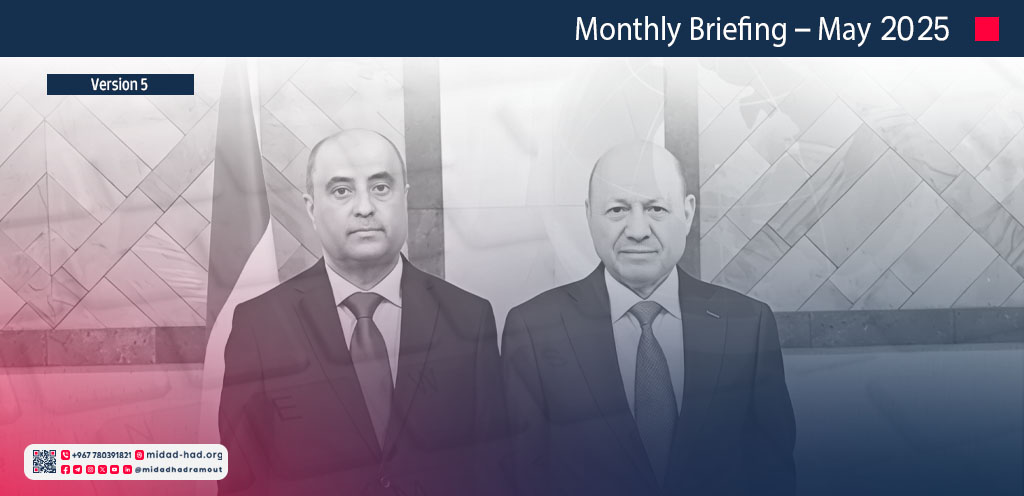
On the governmental front, on May 3, PLC President Rashad Al-Alimi issued a decree appointing Salem Bin Brik as Prime Minister, succeeding Ahmed Bin Mubarak, who was named a presidential advisor. Later, on May 21, President Al-Alimi delivered a significant speech marking the 35th anniversary of Yemeni unification, emphasizing that the southern issue lies at the heart of any just political settlement. He affirmed that the people of the South will determine their political status and shape their future in line with national, regional, and international frameworks. On May 25, UN Envoy Hans Grundberg concluded his visit to Riyadh, stressing that economic stability is a prerequisite for any sustainable political progress. President Al-Alimi arrived in Moscow on May 27 for an official visit at the invitation of Russian President Vladimir Putin to discuss the latest developments in Yemen and to enhance bilateral relations.
Key Developments:
May 3:
- The President of the Presidential Leadership Council (PLC) issued two decrees: the first, he appointed Salem Bin Brik as Prime Minister, while the second reassigned former Prime Minister Ahmed Bin Mubarak as a presidential advisor. The decisions followed tensions between Bin Mubarak and his government, which led to the premature end of his term, less than a year and a half into office.
- In his first statement after the appointment, Bin Mubarak praised Bin Brik’s competence, calling him “a man of state,” and urged full support for the new government. He emphasized that its success depends on receiving adequate constitutional powers, particularly amid growing economic and security challenges.
May 5:
- The PLC held a meeting to discuss the new government’s priorities, including countering economic decline, improving public services, and combating corruption. The meeting also reviewed military conditions and reaffirmed support for the Saudi-Emirati coalition, with a focus on securing fuel supplies and stabilizing the exchange rate.
May 7:
- The National Political Alliance held the Houthis responsible for the devastation in Yemen, labeling Israeli airstrikes on Sanaa Airport and Al-Hodeidah Port as violations of sovereignty. It called for supporting the legitimate government and ending the Houthi coup, stressing that targeting service infrastructure directly harms civilians.
- Houthi spokesman Mohammed Abdul Salam denied that the ceasefire was an initiative by the group, claiming it came in response to a U.S. request conveyed via Omani mediation. He also asserted that Israeli attacks on Yemeni infrastructure had failed and reaffirmed the group’s support for the Palestinian cause.
- Prime Minister Bin Brik met with U.S. Acting Ambassador Jonathan Peachey, calling for the reactivation of USAID support and the resumption of its suspended projects.
May 10:
- Yemeni Foreign Minister Shaea Al-Zandani, in a meeting with UN Envoy Hans Grundberg, stated that the Houthis had rejected all peace initiatives and criticized the international community’s engagement with the group as prolonging the war.
May 11:
- UAE-backed southern forces in Socotra held a graduation ceremony after five months of training. The island’s governor praised the UAE’s role in building southern military capacity.
- The Hadhramout Tribes Alliance rejected the PLC member’s decision to establish a development fund, calling it a “corruption scheme.” Bin Habrish reaffirmed that self-rule is the only viable solution to end marginalization and declared that the tribes would not accept the management of local resources outside the framework of autonomy.
May 12:
- The Hadhramout Tribes Alliance formed a team of ten legal and economic experts to draft the foundational documents for regional self-rule. The initiative seeks to establish a constitutional and political framework granting Hadhramis authority over their own governance and resources.
May 14:
- In a meeting with an EU delegation, the Prime Minister affirmed that restoring state authority and ending the Houthi coup is essential for maritime security. The EU delegation reiterated its support for Yemen’s coast guard operations to combat arms smuggling.
May 15:
- The head of the Islah parliamentary bloc condemned Israeli attacks on Sanaa Airport and Al-Hodeidah Port, accusing the Houthis of turning Yemen into a “regional battleground” through external alliances.
May 19:
- Amnesty International called for an independent investigation into a U.S. airstrike that hit a migrant detention center in Saada on April 28, killing dozens. Satellite imagery revealed Ethiopian migrant casualties, and shrapnel analysis confirmed the use of two GBU-39 bombs. The organization urged the U.S. Congress to review the surge in airstrikes in Yemen, which has surpassed 800 targets since March.
May 21:
- The Yemeni Political Parties Bloc issued a statement on Unity Day affirming that a just resolution to the southern issue is essential for building a federal state. It called for improved services and anti-corruption measures.
- President Rashad Al-Alimi, in his Unity Day address, called for a civil state based on justice and equality. He emphasized that resolving the southern issue requires guarantees for power and wealth sharing. He also reaffirmed his commitment to reforms in the electricity and public services sectors.
- The Yemeni government warned against Houthi efforts to liquidate private banks in areas under their control, describing it as a violation of international law. Information Minister Moammar Al-Eryani labeled participation in such actions as “terrorist financing” and warned of international legal action against those involved.
May 24:
- UN Envoy Hans Grundberg expressed optimism about achieving a comprehensive peace following his visit to Riyadh. He met with Saudi, Yemeni, and Emirati officials to discuss ending the conflict, citing the ceasefire agreement between the Houthis and the U.S. as a real opportunity for negotiated settlement.
May 25:
- The Houthis claimed that U.S.-Israeli airstrikes on the ports of Hodeidah, Salif, and Ras Issa caused total losses of $1.4 billion, including $531 million in direct damages and $856 million in indirect losses. The strikes destroyed docks, power stations, and relief warehouses.
May 27:
- President Rashad Al-Alimi arrived in Moscow for an official visit to meet President Vladimir Putin and other Russian officials. The visit aims to strengthen economic and security cooperation and support peace efforts in Yemen.
May 28:
- Former British diplomat Edmund Fitton-Brown criticized international humanitarian organizations such as Oxfam and OCHA for forming a “humanitarian lobby” that weakens global pressure on the Houthis by overlooking their violations. He called for reviving the military campaign to retake Al-Hodeidah and end the Stockholm Agreement.
May 30:
- President Al-Alimi revealed that the Houthis had forced him to divert a Yemeni plane from Amman back to Sanaa under threat of bombing Aden Airport, which was later struck by Israeli air raids, hampering efforts to resume operations.
- Al-Alimi also stated that Yemen’s classification under Chapter VII of the UN Charter has prevented it from acquiring Russian air defense systems, limiting its ability to respond to aerial attacks.
Economic Summary
In a strategic move to improve financial resource management, Presidential Leadership Council member Major General Faraj Salmeen Al-Bahsani issued directives on May 10 to establish a special fund for the development of Hadhramaut Governorate. The fund aims to preserve the revenues from the sale of locally produced mazut and diesel and redirect them toward development projects—particularly the electricity sector. Al-Bahsani affirmed that this step marks a strategic shift in resource management and the beginning of a new phase of good governance and financial justice.
On the other hand, the Hadhramaut Tribes Alliance criticized the initiative, claiming it falls short of meeting the aspirations of Hadhramaut’s people—particularly the demands of the Alliance and the Hadhramaut Inclusive Conference. They renewed calls for establishing self-governance in the governorate.
On May 3, the Socotra National Conference denounced the repeated hikes in fuel prices, reporting that the cost of twenty liters of petrol or diesel reached 48,000 Yemeni riyals. They demanded that authorities stop this manipulation.
At the governmental level, Prime Minister Salem bin Brik warned on May 11 of worsening economic and living conditions. He called on the international community to support the Yemeni government’s efforts. During a meeting with the European Union delegation, he emphasized that ending the Houthi coup is the only way to eliminate threats to international navigation. He also reiterated calls for U.S. support in addressing economic challenges.
As public anger and hardship intensify, Speaker of Parliament Sultan Al-Barakani officially urged the government to take immediate action to resolve the water crisis in Taiz and electricity outages in Aden. He warned of the consequences of the Yemeni rial’s depreciation on citizens’ livelihoods.
Key Updates:
May 3:
- Socotra Governorate witnessed an unprecedented rise in fuel prices, with 20 liters of petrol priced at 48,000 riyals and a gas cylinder at 60,000 riyals.
May 6:
- The Hadhramaut Tribes Alliance confirmed the continued supply of fuel to power plants despite the crisis, facilitating the delivery of 800,000 liters daily.
May 8:
- Fifteen commercial vessels carrying 200 sailors began moving toward Ras Issa Port after weeks of suspension due to security threats. The fleet included fuel and gas tankers, amid ongoing international maritime warnings about Red Sea tensions.
- UN Envoy Hans Grundberg warned against using the economy as a tool of conflict, noting its devastating impact on Yemenis’ lives. He stressed that the ongoing crisis increases dependency on humanitarian aid amid dwindling funding for relief operations.
May 10:
- Major General Faraj Al-Bahsani issued a decision to establish the Hadhramaut Development Fund, directing revenues from locally sold fuel (mazut and diesel) toward electricity services and development. The decision included transparency measures such as biweekly reporting and tracking fuel movement from source to consumer.
May 11:
- The newly appointed Prime Minister warned of a currency collapse (with the dollar exchange rate hitting 2,500 riyals), blaming Houthi attacks on oil facilities that contribute 75% of the state budget revenue.
May 13:
- Prime Minister Salem bin Brik ordered the provision of 26,000 tons of fuel to power plants in Aden following repeated complaints of blackouts. Coordination was made with Saudi Arabia and the UAE to ensure sustainable supplies, with promises to improve services during the summer.
May 14:
- The UN Envoy warned of Yemen’s economic deterioration as the dollar reached 2,500 riyals and power outages in Aden lasted up to 15 hours per day. He called for the release of Houthi-held detainees and improvement of basic services as confidence-building measures.
May 15:
- During a meeting with the U.S. Ambassador, Prime Minister bin Brik urged for increased economic support to confront the deteriorating situation, with a focus on improving essential services. Discussions also addressed mechanisms to curb Houthi funding sources.
May 16:
- Yemenia Airways announced the resumption of flights from Sana’a to Amman starting May 17, following repairs to damages caused by Israeli strikes. Priority will be given to patients and stranded travelers, with a commitment to safety standards.
- The Prime Minister met with the Secretary-General of the Gulf Cooperation Council to discuss mechanisms to support Yemen’s economy and address Houthi attacks on oil infrastructure. Both sides reaffirmed commitment to a political solution based on the Gulf Initiative.
May 26:
- The Al-Mahrah Health Office issued a circular requiring pharmacies and medical warehouses to obtain licenses for selling medicines and restricted wholesale sales to authorized agencies only.
May 28:
- On May 28, Speaker of Parliament Sultan Al-Barakani urged the Prime Minister to immediately address water outages in Taiz and electricity shortages in Aden, Lahj, and Abyan. He warned of worsening conditions amid rising temperatures and salary delays, holding the government accountable for enforcing accountability.
May 29:
- The international highway between Sana’a and Aden reopened after seven years of closure, marking a significant humanitarian breakthrough aimed at improving economic conditions and easing civilian movement.
In early May, Hadhramout Governorate experienced alarming developments as coastal cities—particularly Mukalla—suffered prolonged power outages coinciding with final exams and extreme heat waves. The outages were attributed to the shutdown of Al-Ahram Power Company due to unpaid government debts. Meanwhile, a massive fire broke out in the “Al-Bilad” area of Sah District in late May, destroying over 150 palm and Sesban (Sesabania) trees. Repeated incidents of fire were reported recently, largely due to the lack of adequate firefighting equipment.
In the Socotra Archipelago, a UNESCO team launched a field investigation in early May to assess environmental violations committed by foreign companies. These violations included encroachments on natural reserves and coastal areas, posing a risk to the island’s status as a World Heritage Site. Reports indicated that local authorities aligned with the UAE sought to obstruct the mission and prevent the team from accessing sensitive sites.
On the human rights front, forty local and international organizations issued a joint statement in early May highlighting ongoing systematic violations against journalists, including arbitrary arrests and unfair trials. More than 2,600 violations were documented over the past decade.
In Shabwah Governorate, authorities detained 200 irregular migrants from Ethiopia and Somalia along its coastline. In a related context, the Houthi group released activist Rabab Al-Mudhwaahi after 11 months of arbitrary detention, during which her mother passed away without the chance to see her.
A government report revealed that 1.1 million displaced persons in Marib suffer from food insecurity, with more than 128,000 families in urgent need of humanitarian assistance.
Key Social and Human Rights Events:
May 2:
• A government report revealed that 1.1 million out of 2.1 million displaced persons in Marib are suffering from food insecurity, with the most vulnerable groups being women, children, and people with disabilities. Over 100,000 families were found in urgent need of assistance.
May 3:
• A massive fire erupted in the “Al-Bilad” area of Sah District, destroying 150 palm and sesban trees. Residents and emergency teams failed to contain the fire due to a lack of firefighting tools.
• UNESCO dispatched a field mission to the Socotra Archipelago to investigate environmental violations caused by foreign companies, including damage to protected reserves and coastal zones.
• A joint statement by 40 human rights organizations confirmed the continuation of systematic violations against journalists in Yemen, including arbitrary arrests, enforced disappearances, and unfair trials. Over 2,600 violations were documented, including death sentences against journalists.
• The Minister of Endowments, Mohammad Shabiba, announced the formation of committees to monitor the quality of services provided to Yemeni pilgrims, stressing zero tolerance for any shortcomings.
May 4:
• Yemeni authorities apprehended 200 irregular migrants from the Horn of Africa along the shores of Radum District in Shabwah—160 men and 40 women from Ethiopia. This followed the arrival of 150 more migrants the day before, amid a growing wave of irregular migration across the Red Sea.
May 5:
• The National Commission documented 258 violations in the first quarter of 2025, including arbitrary arrests and trials in absentia. Journalists reported physical and psychological torture during interrogation sessions.
• The Houthi group released activist Rabab Al-Mudhwaahi, a member of the National Democratic Institute (NDI), after nearly a year in detention. She had been arrested during a crackdown on employees of international organizations in Sanaa, and her mother died during her detention without a chance to see her.
May 6:
• Cities along Hadhramout’s coast, including Mukalla, experienced full blackouts lasting for hours, coinciding with school exams and intense heat.
May 7:
• The International Organization for Migration (IOM) recorded the displacement of 294 individuals (49 families) from Sanaa, Al-Hodeidah, and Taiz to Marib and Taiz due to violence (79%) and economic hardship (21%). The total number of displaced individuals since the start of 2025 reached 5,652, highlighting the worsening humanitarian crisis.
May 8:
• Médecins Sans Frontières (MSF) warned of severe humanitarian consequences following the destruction of Sanaa Airport and Al-Hodeidah Port. The organization noted that the closure of these critical facilities hampers the delivery of food and medicine to 21 million Yemenis who rely on foreign aid.
May 9:
• Minister of Endowments Mohammad Shabiba announced that the transportation of Yemeni pilgrims for Hajj season 1446H would begin on May 13, 2025.
May 12:
• UNICEF, with German funding, launched a program targeting 32 districts across 12 governorates to combat malnutrition among 2.4 million children and 1.5 million women. The program includes distribution of nutritional supplements and strengthening of health and nutrition services.
• Yemeni security authorities in Aden imposed new restrictions on protests, requiring prior approval for any demonstrations. The move came after a women-led protest in Al-Oroudh Square against power outages and deteriorating services.
• The Houthi group refused to bring detained journalist Mohammad Al-Mayyahi to court for his scheduled hearing, with his lawyer calling the absence a clear violation of fair trial standards. Al-Mayyahi has been in detention since September 2024, and his trial is viewed as part of the group’s broader suppression of dissent.
May 14:
• In his briefing to the UN Security Council, the UN Envoy urged the Houthis to change their course and use the Red Sea ceasefire as a chance to refocus on the peace process. He warned of the continued mutual attacks between Houthis and Israel, which have targeted vital civilian infrastructure in Yemen.
May 15:
• The Ministry of Interior announced the arrest of 70 suspects in various criminal cases in one day, including 14 assault cases, 12 thefts, 7 property violations, and cases of threats, slander, breach of trust, fraud, and arms smuggling. Random gunfire was also among the violations.
May 16:
• UN Assistant Secretary-General Thomas Fletcher reported that 2.3 million children are suffering from malnutrition, including 600,000 with life-threatening conditions. He warned of a worsening crisis due to the closure of 400 health facilities from underfunding and called for $2.4 billion to fund relief operations.
May 17:
• Protests erupted across Aden and Abyan due to deteriorating services, including electricity cuts and delayed salaries. The demonstrations occurred amid a fuel crisis that has worsened in recent weeks.
May 19:
• The UN Refugee Agency warned that 40% of displacement sites in Yemen are at risk of fires and floods, particularly in Marib, which hosts 4.8 million displaced people.
May 20:
• Human rights and media organizations condemned threats of arrest targeting journalist Yaseen Al-Aqlani, who had published an investigative report exposing flaws in Yemeni high school examinations held in Egypt.
May 24:
• A peaceful women’s protest in Aden calling for better basic services was violently dispersed by government security forces. The protesters held the Saudi-Emirati coalition and the Presidential Leadership Council responsible for the service collapse. Human rights groups condemned the crackdown as a “moral crime” and linked the protests to power cuts and currency depreciation.
May 26:
• The Yemeni Journalists Syndicate condemned the Houthi trial of journalist Mohammad Al-Mayyahi before a special court after eight months of arbitrary detention. The syndicate denounced the trial as a violation of due process and called on international organizations to intervene. Al-Mayyahi faces charges of spreading “false news” critical of the group.
May 27:
• The Yemeni government issued an urgent appeal for international assistance to combat cholera and fever outbreaks, as record infection rates were recorded in several provinces.
Security and Military Briefing:
On May 9, the governor of the Socotra Archipelago, Engineer Raafat Al-Thuqali, oversaw the graduation of the third batch of UAE-backed Support and Reinforcement Forces after five months of training. He emphasized the UAE’s role in strengthening southern military capabilities. This event was part of broader efforts to bolster security presence on the island.
Meanwhile, regional hostilities escalated with Israeli airstrikes on Al-Hodeidah Port on May 5, involving 30 aircraft and destroying key infrastructure, including the oil refinery and power stations, effectively halting port operations, which serve as the entry point for 80% of Sanaa’s imports. In response, the Houthis declared an “aerial blockade” on Israel by targeting its airports.
Former U.S. President Donald Trump announced a halt to airstrikes in Yemen, claiming the Houthis pledged to stop Red Sea attacks following Omani mediation. However, Israeli bombardment continued, and on May 7, strikes on Sanaa International Airport caused an estimated $500 million in damages, including the destruction of three civilian aircraft.
Locally, on May 12, President Rashad Al-Alimi issued a decree establishing the 8th Military Region, encompassing Ibb, Dhamar, Al-Bayda, and Al-Dhalea, and appointed Major General Hadi Al-Awlaqi as its commander—a move aimed at consolidating government control in liberated areas. On May 30, the King Salman Relief Center extended the Masam demining project for another year with $53 million in funding. As Eid Al-Adha approached, Marib authorities extended curfew hours until 2 a.m. to bolster security measures.
Key Security Events:
May 5:
- Israel launched eight air raids using 30 fighter jets targeting Al-Hodeidah Port and Bajil Cement Factory, in retaliation for a Houthi missile strike on Ben Gurion Airport. The airstrikes caused major infrastructure damage and injured 21 civilians. Houthis vowed retaliation, while international organizations condemned the strikes as violations of international law.
- Houthi military spokesman Yahya Saree announced the imposition of an aerial blockade on Israel, targeting its airports in response to the escalation in Gaza.
May 6:
- The Houthis reported 38 casualties (dead and wounded) from Israeli airstrikes on Sanaa and Amran, targeting a cement factory and power stations. The attacks disrupted operations at Sanaa International Airport. The group labeled the strikes as “deliberate starvation” through the destruction of civilian infrastructure.
- Al-Hodeidah Port was extensively damaged, suspending its operations. Humanitarian organizations warned of a potential famine as 80% of Yemen’s imports pass through the port.
- Former U.S. President Donald Trump confirmed the suspension of U.S. airstrikes in Yemen, citing Houthi commitments to cease maritime attacks in the Red Sea. The announcement followed months of military escalation.
May 7:
- The director of Sana’a International Airport stated that initial losses from Israeli airstrikes reached $500 million, including six destroyed planes—three belonging to Yemen Airways.
May 8:
- The third batch of UAE-backed forces graduated in Socotra after five months of training. The island governor praised the UAE’s role in “building southern forces.”
May 13:
- Masam announced the removal of 1,839 landmines and 26 anti-tank devices within one week, raising the total to 491,983 cleared since the project’s inception.
May 16:
- President Al-Alimi established the 8th Military Region, assigning Major General Hadi Al-Awlaqi as its commander over Ibb, Dhamar, Al-Bayda, and Al-Dhalea, in preparation for potential confrontations with the Houthis.
- The Houthis reported one death and nine injuries from Israeli strikes on Al-Hodeidah and Salif Ports. Israel claimed to have destroyed military installations, with Prime Minister Netanyahu warning of broader military responses.
May 22:
- Defense Minister Mohsen Al-Daeri approved an emergency plan to open main roads linking Houthi and government-controlled areas to facilitate civilian movement and humanitarian aid.
- Taiz hosted the first consultative meeting of local and military resistance councils, calling for escalated military action against the Houthis and emphasizing disarmament as the solution to the crisis.
May 26:
- On May 10, Yemeni naval forces thwarted two attempts to smuggle three million electric detonators and wiring intended for Houthi forces via the Red Sea. The materials were likely meant for explosive-laden boats and minefields.
May 28:
- Yemen Airways confirmed its aircraft are not insured for airports classified as high-risk zones in Yemen, following the destruction of three planes in Israeli strikes estimated at $500 million in losses.
- UN Envoy Hans Grundberg condemned Israeli attacks on Sanaa Airport, warning of worsening humanitarian conditions due to the destruction of infrastructure and restricted access for medical and family reunification travel. He urged de-escalation.
May 29:
- The King Salman Relief Center extended the Masam demining initiative in Yemen for another year with $53 million in new funding, after successfully clearing 495,000 landmines and reducing civilian risks.
May 30:
- Marib’s police extended curfew hours until 2 a.m. during Eid Al-Adha to enhance public safety, urging citizens to comply for their own protection.