

Political Briefing
The Eastern Governorates have seen a series of events in July, starting with the parliament’s decision in early July to send committees to investigate the situation in these governorates. It was not just a routine procedure, but a serious attempt to expose corruption and irregularities in the management of oil resources and public revenues. However, the Southern Transitional Council has rejected this decision from the beginning, considering it interference in its affairs and an attempt to impose political agendas under the cover of parliamentary supervision. This rejection did not remain just a political stance, but turned into actions on the ground.
On July 8, as tensions escalated around the parliamentary committees, an important security incident occurred in Al-Mahra Governorate. Security authorities have arrested Sheikh Muhammad Ahmad Ali Al-Zaidi; a tribal sheikh who supports the Houthis, as he attempted to travel to Oman via the Sarfit border crossing with a diplomatic passport issued by Sana’a. However, the situation did not pass peacefully; it developed into armed clashes that killed Colonel Abdullah Zayed and injured others, leading to weeks of security tensions.
About two weeks later, on July 21, the situation in Hadhramout reached a critical point. When the parliamentary committee arrived in Mukalla to perform its duties, it faced strong resistance from groups supporting the Transitional Council. These groups did not stop at protesting, but surrounded the members of parliament (MPs) in their hotel and forced them to leave. Even worse, the local authorities in the governorate refused to provide protection for the committee. The parliament did not remain silent for long in the face of this development. On July 23 and 24, the Council’s Presidency held urgent meetings in which it decided to suspend the work of all field committees. The parliament did not hide its anger, accusing several parties of misinformation and failing to fulfill their promises, emphasizing that they had promised to support the committees but had done nothing in practice.
At the end of the month, two important developments took place in the Eastern Governorates: First: The releasing of Al-Zaidi in Al-Mahra after intensive tribal mediation that lasted more than twenty days. Second: Prominent figures of Hadhramout have submitted a letter to President; Al-Alimi in which they nominated Issam Habrish to be governor of Hadhramout in an attempt to break the administrative and political deadlock in the governorate after a week of popular protests in many districts of Coast & Wadi Hadhramout.
Apart from the local events, there have been important international developments. On July 14, the UN Security Council decided to extend the UN mission in Hodeidah until January 2026, even though the US wanted to end it because they thought it wasn’t working with the current situation. On July 8, President Al-Alaimi issued a decree extending the work of the Human Rights Violations Investigation Commission for an additional three years, indicating the continuing need for accountability mechanisms in the country.
Top News
Tuesday, July 1
- Hadhramout Tribal Arbitration has called on the Presidential Leadership Council, the government, and local authorities to fulfill their responsibilities toward citizens, take serious action to deal with rising inflation in oil derivatives and foodstuffs, and fix and prevent power cuts that have reached more than 16 hours a day.
Wednesday, July 2
- The Presidency of the House of Representatives approved the formation of three parliamentary committees to conduct field visits to nine governorates to examine the performance of local authorities and review financial and administrative actions. The governorates include Aden, Taiz, Lahj, Al-Dhale, Hadhramout, Al-Mahra, Shabwah, Marib, and Abyan, in order to strengthen parliamentary control and address existing imbalances.
Sunday, July 6
- The Secretary-General of Inclusive Hadhramout Conference; Akram Nasib al-Amri, affirmed his commitment to implementing the Hadhramaut self-rule project and maintaining it as a strategic option. Al-Amri stressed the rejection of any exclusionary approach to political components and the need for consultation with political forces.
- The President of the Presidential Leadership Council emphasized that the Council is committed to transparency regarding the challenges of the current situation, stressing its rejection of any exclusionary discourse. He noted that the economic situation is the biggest challenge at this time.
Tuesday, July 8
- Security forces in Al-Mahra Governorate have arrested Sheikh Muhammad Al-Zaidi While attempting to leave the country with a diplomatic passport via Sarfit Border C
- The President of the Presidential Leadership Council; Rashad al-Alimi, has issued a presidential decree extending the work of the National Commission for the Investigation of Human Rights Violations for three years, starting from August 23, 2025. The decree includes the possibility of extending the period as needed.
- The President of the Presidential Leadership Council has praised the role of the security and military authorities in Al-Mahra in strengthening security and fighting the smuggling of Iranian weapons to the Houthis.
Thursday, July 10:
- The Third Military District Appeals Court in Marib has officially requested the arrest of Hisham Sharaf Abdullah, the former foreign minister in the Houthi government, to stand trial before a military court.
- Israeli Government called on the United States to renew its airstrikes against the Houthis in conjunction with the mutual escalation between the two sides. It justified its request by the increasing number of rockets fired from Yemen and the escalation of attacks on ships.
Saturday, July 12
- The Parliament’s Presidency and the heads of the blocs agreed on the need to resume sessions in order to restore the legislative and supervisory role and activate field committees to monitor the economic and humanitarian situations.
Sunday, July 13
- Hadhramout Tribes Confederacy has warned of a total collapse of livelihoods due to currency corruption, threatening to stop oil supplies from Al-Dhaba to Aden if attempts to smuggle it continue.
Monday, July 14
- The head of the General Council of the People of Al-Mahra and Socotra called on all parties to calm the situation after the arrest of Sheikh Al-Zaidi, and called for a comprehensive agreement to preserve security and protect the social structure.
- The members of the UN Security Council have unanimously voted to extend the UN mission to monitor the implementation of the Stockholm Agreement in the ports of Al-Hodeidah until January 28, 2026, despite US calls to end the mission due to developments on the ground exceeding its powers.
Tuesday, July 15
- President Rashad al-Alimi revealed that a Houthi cell had attempted to assassinate UN envoy; Hans Grundberg, in addition to its responsibility for the assassination of a World Food Programme employee in Taiz.
- The President of the Presidential Leadership Council confirmed the importance of strengthening unity among national forces and focusing on the battle to restore the country during his meeting with leaders of the national resistance led by Tariq Saleh after disputes have escalated in recent times.
Wednesday, July 16
- President Rashad Al-Alimi has issued a resolution appointing Judge; Sahel Mohammad Hamza Nasser as Secretary General of the Supreme Judicial Council.
- Lawyer; Omar Al-Hamiri has criticized the Presidential Council’s authorization of the Supreme Judicial Council to amend the law on court fees, describing the measure as unconstitutional. It should be noted that salaries are low in all government institutions, not just the judicial branch.
Thursday, July 17
- The head of the Supreme Council for National Unity; Ahmed Obaid Bin Dagher, warned that Yemen’s economic collapse has reached dangerous levels that threaten overall stability, during his meeting with the acting US ambassador; Jonathan Bechia.
- The governor of Al-Mahra, Mohammed Ali Yasser, confirmed that the security forces are ready to face any threats to stability, emphasising that the country’s standing is a red line.
Sunday, July 20:
- The Houthi group renewed its attack on UN envoy Hans Grundberg, accusing him of bias toward the legitimate government after he condemned the group for printing new coins. The Houthi Foreign Ministry described the UN statement as confirming the envoy’s absolute bias and in line with the statements of the countries involved in the aggression.
Monday, July 21:
- Members of the Southern Transitional Council surrounded a parliamentary committee at a hotel in Mukalla, preventing it from doing its job of monitoring and providing services. This comes as part of the Transitional Council’s public rejection of forming parliamentary oversight committees.
- The parliamentary committee began its field work in Marib governorate and met with local authority leaders to discuss issues related to the general situation.
- The President of the Presidential Council; Dr. Rashad al-Alimi, emphasized the need to review the UN roadmap with Houthis and said that it must be revised to be more in line with the current regional situation.
Wednesday, July 23
- Hisham Sharaf, former foreign minister in Houthi government, has been released after two weeks of detention in Aden and has departed to Amman.
Thursday, July 24
- The Presidency of the Council of Representatives held the local authority in Hadhramout and the Transitional Council fully responsible for attacking members of the parliamentary oversight committee and preventing them from performing their duties in Mukalla. It accused certain parties of failing to issue effective directives to cooperate with the committees, considering what happened a threat to the country’s concept and a continuation of the logic of disorder.
Saturday, July 26
- The Southern Transitional Council indicated that it would resort to military action to impose the “will of the people of the south,” according to the head of the Transitional Council’s executive body in Hadhramout. He stated that the time had come for decisive intervention by Hadhramout’s Elite forces, supported by southern forces, to enforce a new reality.
Tuesday, July 29
- Sheikh Mohammad Ahmad Al-Zaidi was released under an undisclosed agreement between local authorities in Al-Mahra and tribal mediators. Al-Zaidi had been arrested while attempting to leave the country via Sarfit Border Crossing with a diplomatic passport issued by Houthi authorities.
Wednesday, July 30
- Sheikhs and notables of Hadhramout have submitted an official letter to the President of the Presidential Leadership Council, Rashad al-Alimi, which included the nomination of Issam Habrish Al-Kathiri for the position of governor of Hadhramout with the unanimous approval of tribal and social leaders, warning of the continuing vacancy in the governorate.
- The Speaker of the House of Representatives, Sultan Al-Barakani, criticized the international system during his participation in the Sixth World Conference of Speakers of Parliament in Geneva, describing the world as unstable and unbalanced. He emphasized that major countries monopolize power and violate rights, pointing to what is happening in Palestine and Yemen as examples of such violations.
Thursday, July 31
- Akram Nasib Al-Amri; deputy head of the Consultation and Reconciliation Commission, has announced that he is suspending his work with the commission in protest against the deterioration of security and services in Hadhramout and the security forces’ use of repression against protesters. The decision came after the killing of citizen Mohammad Saeed Yadin in Tarim, demanding that those involved be brought to justice and that urgent measures be taken to restore security and stability.
Economic Summary
In July, Hadhramout Governorate witnessed a number of events related to the economic aspects of the community. On July 16, public transport bus drivers in Mukalla held a general strike to protest the rise in oil prices. The price per gallon of diesel had reached 40,000 riyals, leading to a near-complete breakdown in transportation. The strike was accompanied by the closure of a number of commercial stores as part of growing popular anger against the deterioration of living conditions and the collapse of the national currency. On July 8, President Al-Alaimi also issued a decision to extend the work of the Commission of Investigation into Human Rights Violations for an additional three years, indicating the continuing need for accountability mechanisms in the country. As part of its efforts to uncover corruption, on July 12, Hadhramout Tribal Confederancy announced that it had seized two diesel trucks used to supply electricity to the coast while they were being unloaded illegally at a commercial station in the Zabun area. In Socotra, the Emirati company; Eastern Triangle has continued to increase the prices of petroleum products for the seventh time in just seven months. On July 26, it raised the price of a liter of gasoline to 7,200 Y. R. and a small gas cylinder to 34,000 Y.R.
At the national level, On July 24, Ahmed Ghalib Al-Ma’abqi, Governor of the Central Bank in Aden, has revealed shocking facts about the economic situation, confirming that the revenues of more than 47 government institutions are not being deposited in the bank’s vault and that many governorates are manipulating their resources outside the legal framework. He also revealed that the government has been operating without an official budget since 2019, and that the remaining Saudi deposit does not exceed $25.2 million. In an important development regarding the country’s monetary policy, on July 15, the Houthi authorities announced the printing of a new 200-riyal banknote to replace the damaged one, days after coining a 50-riyal coin. The Central Bank in Aden responded by describing these measures as “a destructive and senseless act” aimed at stealing citizens’ resources. On July 17, UN envoy Hans Grundberg expressed his deep concern, considering this step a violation of the understandings agreed upon in July 2024 regarding economic calm.
In terms of international aid, on July 8, the Yemeni government received a Japanese grant of $2.042 million through World Food Program to provide food aid to about 700,000 of the most vulnerable people, as part of international efforts to deal with the worsening humanitarian crisis in the country.
Top News
Thursday, July 3:
- The Yemeni government has requested urgent financial support from Paris Club Forum to help it control its worsening external debt crisis, which has reached $7.6 billion, noting that 74% of its debt within Paris Club is owed to Russia.
Thursday, July 8:
- The Yemeni government has received a Japanese grant of $2 million in food aid through World Food Programme.
Saturday, July 12:
- Workers in the oil sector suspended oil pumping to Aden for the second time in protest against the government’s failure to respond to their employment demands. It should be noted that the workers complain about the lack of compensation and the non-payment of accumulated dues since the withdrawal of the Austrian company OMV.
Monday, July 14:
- The World Bank renewed its commitment to support the Yemeni government, its development priorities, and institutional capacity building during a meeting between Prime Minister and a World Bank delegation led by Regional Director. The meeting discussed strengthening the partnership and supporting the economic recovery plan.
Wednesday, July 16:
- The Yemeni Council of Ministers has approved an agreement to implement a project to produce domestic gas in Hadhramout Governorate to meet local demand.
Thursday, July 17:
- The Yemeni government has requested urgent financial support from the Saudi-Emirati coalition and the international community to prevent an economic and humanitarian disaster, in light of the collapse of the Yemeni riyal to 900,000 Y.R. per USD.
Monday, July 21:
- The Yemeni Government has accused the Houthi group of earning around $3 billion annually from oil and gas imports and sales, charging customs and tax fees without delivering the revenues to the government treasury, paying employee salaries, or improving services.
Tuesday, July 22:
- Prime Minister Salem Saleh Bin Breik chaired a Council of Ministers meeting in the temporary capital of Aden, focused on discussing the latest economic and service developments and plans coordinated with the Central Bank of Yemen to deal with the decline in the national currency exchange rate and the deterioration of basic services.
Thursday, July 24:
- The Prime Minister has issued a resolution to form a committee to prepare the country’s general budget for the year 2026.
Tuesday, July 29:
- The head of Hadhramout Tribes Confederacy has insisted on activating community control over the electricity fuel file and proposed control mechanisms that include transparent meters on fuel tanks and a daily fuel distribution report. He also demanded that the central authority commit to supporting Hadhramaut’s electricity, similar to other governorates.
Social and Human Rights Briefing:
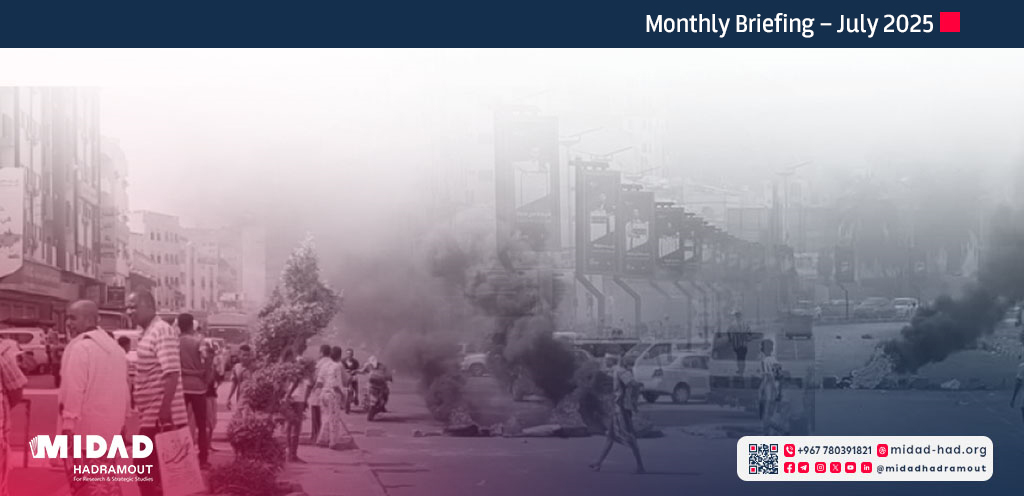
During July, Hadhramout Gov. has witnessed a wide wave of protests that reached its peak on July 28 when protestersbroke into the governorate’s office and closed the port of Mukalla protesting the deterioration of services and power cuts that last more than twelve hours a day. These protests turned violent, resulting in death of Mohammed Saeed Yadin in Tarim city, who was shot by security forces, while two others were wounded in Fawwa, Mukalla, by gunfire from Barashid Brigade Forces. In a related context, the governorate witnessed an escalation against media freedoms; On July 28, military forces kidnapped journalist Abdul Jabbar Omar Bajbir, director of the channel “Aad TV,” without a court order and without providing any explanation, while journalist Mazahim Bajabir was released on July 21 after 33 days of arbitrary detention.
On the labor side, employees and workers of Petromasila (Sector 14) organized a protest on July 19 at Al-Dhabba Oil Field and the export port to demand payment of their financial due since 2015 and a salary increase, accusing the company’s management of prioritizing development projects at the expense of workers’ rights. In Shabwah Governorate, local authorities faced a new challenge with the inflow of about 950 African migrants in two weeks in July. On July 15, 200 Ethiopian migrants arrived boat “Al-Asatara,” prompting authorities to warn of a humanitarian and security crisis that exceeds the governorate’s capabilities.
On the human rights side, the Yemeni Network for Rights and Freedoms released a report on July 2 that it had documented the Houthis blowing up 1,232 homes and buildings in 17 governorates over 10 years, including 987 residential homes, 76 mosques, and 39 schools. In return, On July 3, Human Rights Witnesses documented 20 serious violations committed by US aircraft in Sana’a since the beginning of 2025, including seven cases of civilian killings and the destruction of homes and civilian vehicles, confirming that these violations constitute serious breaches of international humanitarian law.
In Aden, journalist Alaa Al-Sallal was physically assaulted and had his cameras stolen by armed men in the district of Seira on July 18 while filming a field report. These developments show how security and living conditions are getting worse in different parts of Yemen, with more violations against civilians and journalists by all sides in the conflict, and no accountability or rule of law.
Top News
Wednesday, July 2:
- The Saudi authorities have issued a general order prohibiting Yemeni travellers passing through Al-Wadiah Border Crossing from bringing in any foodstuffs or additional supplies, allowing only one medium-sized personal bag.
- The Yemeni Network for Rights and Freedoms has documented the bombing of 1,232 homes and facilities in 17 governorates by the Huthi group over the past ten years. The destroyed properties included 987 residential homes, 76 mosques, 39 schools, and 156 bridges and public roads.
- The Qatar Red Crescent Office in Yemen announced the launch of a new project to improve livelihoods and support the living standards of 4,060 poor families in seven governorates at a total cost of $488,000.
Thursday, July 3:
- A report by Shohood Human Rights has revealed that US aircraft committed 20 violations in the Governorate of Sana’a between January and June 2025, including seven civilian deaths, five injuries, and the destruction of two houses.
- A survey by International Organization for Migration of 99,412 displaced families in Taiz, Lahj, and Marib showed that 74% prefer to remain in their current displacement locations, while 18% expressed a desire to return.
Sunday, July 6:
- A joint analysis by UNICEF and World Food Programme revealed that 2.7 million people in Houthi-controlled areas are suffering from acute malnutrition, including 400,000 in critical condition. The report indicated that 150 out of 215 districts in Houthi-controlled areas are classified as being at risk of food insecurity, while 2.85 million people face the risk of worsening conditions.
Tuesday, July 8:
- The International Organization for Migration has confirmed a 47% increase in the number of internally displaced Yemeni families over the past week, tracking the displacement of 47 families consisting of 182 individuals in several governorates, most prominent among them Marib, Taiz, and Al-
- Security and military reasons accounted for 45% of displacement cases, followed by economic reasons at 34% and natural disasters at 21%.
Friday, July 11:
- Search and rescue teams from Hadhramout Coast Guard have rescued twelve young men from drowning at two different locations off the coast of Mukalla.
Monday, July 14:
- Sixty Yemeni fishermen have returned to Al-Khokha after being detained for several days by Eritrean authorities during fishing. They were subjected to mistreatment and had their boats confiscated while these violations continued without any response from the government.
- Save the Children organization has revealed that 107 civilians, half of them children, were killed or injured by landmines and unexploded ordnance during the first half of 2025.
Tuesday, July 15:
- The Shabwah police announced the arrival of 200 illegal African migrants in the fifth batch during July, bringing the total number to 950 migrants in two weeks. Local authorities have warned of a deterioration in the security and humanitarian situation and called for urgent international intervention to establish equipped reception centers.
Friday, July 18:
- The Journalist; Alaa Al-Sallal got physically attacked and had his cameras taken away while filming a field report in the Seira district of Aden by armed guys from the Southern Transitional Council.
Saturday, July 19:
- A massive fire completely destroyed 18 houses in Deir Al-Hindi Camp for displaced persons in Al-Hodeidah after a gas cylinder exploded and the flames spread to the straw-built houses. The fire caused a humanitarian disaster for dozens of families who lost their homes, but no human casualties were reported.
Sunday, July 20:
- The Capital Media Center has revealed that the Houthis continue to pursue journalists and media professionals in Sana’a, committing 33 crimes and violations during the first half of 2025. The report documented 13 cases of threats and blackmail and eight cases of direct restrictions on media freedom.
- The General Union of Administrative Employees in the Judicial Authority has announced a comprehensive strike in all courts in the liberated governorates in protest against the continued disregard of their rights demands. The decision came after the expiration of a six-month deadline given to the relevant council without any actual implementation of the signed agreements.
- Brussels has announced an urgent grant of €9 million to the World Food Programme to support the most vulnerable groups and prevent the worsening of famine in Yemen, confirming its humanitarian commitment to implement the recommendations of the Seventh Senior Officials Meeting on Yemen.
Monday, July 21:
- The specialized criminal prosecutor’s court in Hadhramout Governorate has released the journalist; Muzahim Bajaber after detaining him for 33 days on cash and commercial bail, following a widespread campaign of solidarity from journalists and human rights activists demanding his release and respect for press freedom.
Wednesday, July 23:
- The Yemeni Network for Rights and Freedoms has observed the Houthi militia kidnapping 83 civilians in Ibb Governorate since March 2025. The network has documented the establishment of twelve secret prisons where psychological and physical torture is practiced, as well as 342 cases of raids on citizens’ homes and 18 cases of robbery.
Friday, July 25:
- The Yemeni Journalists’ Syndicate has condemned the attack on the journalist; Mohammad Al-Hammadi, a correspondent for Suhail TV in Taiz, who was attacked with a sharp tool on his head while returning home, causing him serious bleeding and loss of consciousness. He was taken to hospital.
Sunday, July 27:
- Mukalla city has seen widespread protests, causing most main streets to be closed as citizens express their dissatisfaction with the deterioration of basic services, particularly electricity.
Monday, July 28:
- A special military force kidnapped journalist Abdul Jabbar Omar Bajbir, director of Aad TV and editorial director of its website, from Mukalla and took him to an unknown location.
- Popular protests have spread in Mukalla, with protesters closing the gate to the port of Mukalla and breaking into the governorate headquarters while demanding the removal of the local authorities in a new escalation.
Tuesday, July 29:
- Mukalla has seen unprecedented protests for the third day in a row, which have led to the closure of shops and main streets in response to calls for civil disobedience. The protests spread to Al-Shahr, Al-Ghayl, and Shuhair, with government institutions closed and power cuts lasting for more than 40 hours
- The Hadhramaut Security Committee confirmed its understanding of citizens’ anger over the deterioration of electricity services, denying that there were any deaths or injuries during the protests.
- Seiyun, the largest city in Wadi Hadhramout, also has witnessed angry popular demonstrations protesting the deterioration of living conditions and the collapse of basic services.
Thursday, July 31:
- Mohammed Saeed Yadin has been killed in Tarim during security forces’ breakup of popular protests condemning the deterioration of services and living conditions. Tarim police said the death happened by accident from a warning shot fired while trying to open blocked roads.
- Two protesters in Hadhramout Governorate were wounded by gunfire from the Transitional Council’s Barashid Brigade in Fawa, Mukalla. The clashes between protesters and Barashid Brigade forces took place against a backdrop of escalating popular protests in the cities of Mukalla, Seiyun, and Gail Bawazir, which condemned the deterioration of services and the national currency and demanded the removal of the Governor; Mubkhout Bin Madhi.
Security and Military Briefing:
Hadhramout Governorate has seen some security developments, the most notable of which was a big meeting on July 19 between military and security leaders in the Dhubaisah area to demand the release of Brigadier General; Al-Yameni, describing his arrest as “illegal and based on revenge.” Security tensions escalated in the governorate when the commander of the First Brigade, Brigadier General Al-Jawid Salmin Barashid, survived an assassination attempt on July 25 after leaving Friday prayers. He was subjected to a barrage of gunfire that led to the death of one of his companions. However, forces were able to arrest the shooter after hours of pursuit. In Al-Mahra, the repercussions of the arrest of Houthi loyalist Sheikh; Mohammed Ahmed Ali Al-Zaidi at Sarfit Border Crossing on July 8 continued, leading to clashes that killed Colonel Abdullah Zayed. On July 16, Al-Mahra Governor Mohammed Ali Yasser held an important meeting with elders and prominent figures to contain the tension, emphasizing that Al-Zaidi’s arrest was part of legal proceedings and had no political motive, and that the local authority would not neglect the blood of the martyrs and would continue to pursue those who broke the law.
In an important security development in Yemen, Presidential Leadership Council member Tariq Saleh announced on July 16 that his forces had seized a huge shipment of Iranian weaponsweighting 750 tons that was on its way to Houthis, including missile systems, air defense systems, and drones.
On the military front, on July 25, Saada Governorate witnessed one of the most violent clashes since 2022, when the national army defeated a large-scale Houthi attack on military positions on Alab front. The clashes killed ten soldiers from the national army, while dozens of Houthis were killed or wounded, and three of their military vehicles were destroyed. This escalation threatens the relative calm that has prevailed since April 2022.
On the regional level, Israeli Defense Minister; Yisrael Katz threatened on July 1 to launch a new attack on the Houthi group, saying that “the fate of Sana’a will be similar to that of Tehran.” while the US ambassador in Tel Aviv commented that “perhaps B-2 bombers should visit Yemen.” These threats came after the Houthis launched a missile toward the occupied Palestinian territories.
Top News
Tuesday, July 1:
- The US ambassador in the occupied territory threatened to bomb Yemen with B-2 bombers, and the defense minister of the entity threatened that “Yemen’s fate is Tehran’s fate.”
- Saudi forces have bombed border areas in Saada governorate, targeting Al-Thabit in Qatabar and Baqim districts, as part of a broader pattern of military operations by the Saudi coalition against Houthi areas along the border.
Thursday, July 3:
- Security authorities in Al-Mahra Governorate have announced the arrest of 290 individuals wanted for security and criminal offenses during the first half of 2025 with 89%.
Friday, July 4:
- The government forces have announced that they shot down a drone belonging to the Houthi group on Ragwan front in northern Marib Governorate.
Sunday, July 6:
- Al-Wadiah Border Crossing security force stopped the smuggling of 13,750 Captagon pills while they were being smuggled into Saudi Arabia on a truck coming from Sana’a.
Monday, July 7:
- The Israeli occupation army has announced that it carried out violent attacks targeting the ports of Al-Hodeidah, Ras Isa, Salif, and Ras Al-Kathib Power Station, as well as the cargo ship “Galaxy Leader.”
- The Houthi group announced that the ship “Magic Seas” had sunk completely in the depths of the Red Sea. The group’s military spokesman, Yahya Saree, said that the targeting came in response to violations by the company that owns the ship of the decision to ban access to the ports of occupied Palestine.
Tuesday, July 8:
- The Security Committee in Al-Mahra issued a statement confirming the arrest of Sheikh Mohammad Ahmad Al-Zaidi, who holds a diplomatic passport from the Houthi authorities, at Sarfit Border Crossing while attempting to leave the country to Oman.
Wednesday, July 17:
- A military checkpoint belonging to the 23rd Brigade arrested two individuals in possession of 4,000 Captagon pills hidden inside a Corolla European car in Al-Abr district of Hadhramout.
- A security watch in Al-Qatan district arrested two individuals in Toyota Truck car (Shas) in possession of 32 drug pills.
- The governor of Al-Mahra confirmed that the arrest of Sheikh Al-Zaidi was part of legal proceedings and not politically motivated, following the death of Brigadier General Abdullah Mohammed Zayed in a cowardly ambush in Huf District. He emphasised that the blood of the victims would not be spilled in vain and that the pursuit of lawbreakers would continue.
- The National Resistance Navy seized a shipment of 750 tons of strategic Iranian weapons coming to the Houthis. The shipment included marine and air missile systems, air defense systems, modern radars, drones, and listening devices.
Sunday, July 20:
- An analysis by Musnad Platform revealed suspicious US air movements involving a spy plane in the Red Sea, which happened at the same time as the seizure of an Iranian arms shipment heading to the Houthis, pointing to international intelligence coordination in the operation, even though it wasn’t officially announced.
- Armed clashes have broken out between Houthi militia and residents of Al-Hafra neighborhood in Rada’a, Al-Bayda Governorate, after Houthi elements attempted to kidnap one of the area’s residents.
Monday, July 21:
- The Israeli occupation army launched airstrikes on facilities in Al- Hodeidah Port and the western coast, targeting engineering vehicles, fuel barrels, naval equipment, and other Yemeni infrastructure.
- The Houthi group announced that it had conducted a military operation with five drones targeting Ben Gurion Airport and other vital targets in Israel in response to the Israeli airstrikes on Al-Hodeidah Port, confirming that it would continue its operations until the aggression on Gaza ceased.
Tuesday, July 22:
- The United Nations has confirmed Israeli airstrikes on Al-Hodeidah Port while the UN Mission to support Al-Hodeidah Agreement was conducting watches in the northern parts of the port.
Thursday, July 24:
- Violent explosions rocked an arms and ammunition store belonging to Al-Anad military hub in Lahj.
Friday, July 25:
- The Ministry of Defense called on citizens to avoid desert roads between Al-Jawf, Marib, and Hadhramout, as they are military operation zones.
- Ten members of the government forces were killed early Friday morning while defending against Houthi attack on military positions on the Alab front in Saada. This is the most violent operation since August 2022, threatening the tentative truce declared in April 2022.
- The General Directorate of Criminal Investigation announced that it had detected 5,564 crimes and incidents out of a total of 6,185, representing a detection rate of 90% during the first half of 2025. A total of 5,986 suspects were arrested out of a total of 6,997, representing a rate of 86%. The number of victims reached 5,970, including 308 killed and 636 injured, distributed across the liberated governorates, with Hadhramout Coast at the top with 1,712 crimes.
- A report by the World Food Programme has revealed a sharp deterioration in food insecurity in Yemen. Data from May 2025 showed that 66% of Yemeni households did not meet their minimum food requirements, which is the highest rate for the second month in a row. The rate of food consumption deficiency reached 39%, exceeding the “very high” level in all governorates, with the highest rates in Al-Dhale, Al-Jawf, Amran, Lahj, and Hajjah.
- MASAM project announced that a total of 4,852 lethal substances have been removed since the beginning of July, with 723,609 square meters cleared. Since the project began in 2018, more than 507,500 lethal substances have been identified and destroyed, and 68.7 million square meters have been cleared.
- The Yemeni Ministry of Interior has announced that police in liberated governorates arrested 1,023 suspects for various criminal crimes during the first half of July, including murder, theft, kidnapping, and fraud.