

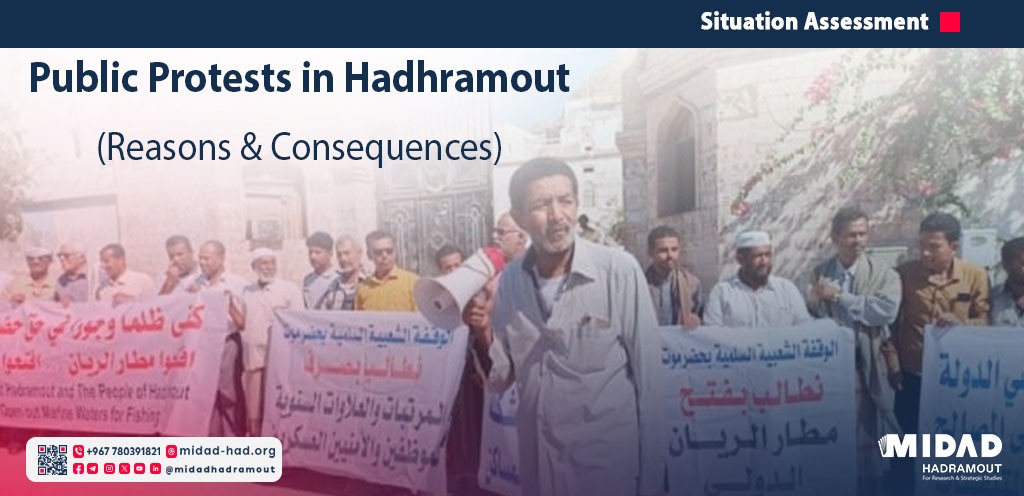
Over the past few months, Hadhramout Governorate has witnessed repeated waves of public protests, which have escalated in recent days and taken various forms, from strikes and sit-ins to roadblocks and suspension of work in some service institutions. The motivations behind these protests differ between economic, political, and social, within a local and regional environment that is unstable. This assessment seeks to analyze the reasons behind the protests, identify influential forces, assess the consequences, and consider possible scenarios.
Mukalla, the capital of Hadhramout Governorate, has witnessed increasing protests that continued at a high pace for several consecutive days, then slowed down but have not completely stopped to date, as a result of power cuts lasting more than 40 hours during a severe heat wave. After the local authority held an emergency meeting on July 27, during which the Director General of Electricity confirmed that the power stations were gradually shutting down completely within less than 24 hours due to a lack of fuel, warning that the cities of Hadhramout coast, especially Mukalla city, be in darkness by the early hours of tomorrow morning, In addition to the economic and living conditions in the governorate, which have recently witnessed a noticeable deterioration, along with a decline in public services, this has exacerbated popular discontent, prompting protesters to take to the streets of the city, block roads, and head towards key government facilities, the port gate, and the General Electricity Corporation building. The wave of protests spread to other major cities on the coast and in Wadi Hadhramout. The gathering of protesters in Mukalla and other cities in Hadhramout reflects the urgent need to take immediate action to address administrative and financial corruption and improve the governorate’s infrastructure. The popular protests in Hadramaut represent a widespread relief valve for critical political, economic, and social demands. These protests could affect not only local stability (services and livelihoods), but also the political and economic landscape in Hadhramout and the liberated areas in general.
Yemen has experienced a steady economic deflation; with real GDP declining by 1.0% in 2024 after contracting by 2.0% in 2023, leading to a sharp decline in per capita income of 54% since 2015, This has been reflected in a decline in purchasing power in areas controlled by the internationally recognized government and inflation exceeding 30% in 2024, with the exchange rate of the riyal falling from 1,540 to 2,065 riyals to a dollar. This has increased pressure on Yemenis’ purchasing power and created a clear economic divide between the legitimate areas and the Houthis, including differences in monetary institutions and exchange rates, deepening tensions and hindering any unified economic policies. Food insecurity has affected around 50–60% of the population, who are now in need of emergency assistance. Some areas are facing severe levels of hunger due to inflation, low incomes, and a 40–65% reduction in food aid. The number of people in need of food aid reached between 18 and 19 million, which is more than half of the country’s population.
The people of Hadhramout have a strong social identity, supported by groups calling for administrative and financial independence, or self-rule, which adds a complex political dimension to the economic crises. Meanwhile, the public protests in Hadhrami cities were met with repression and arrests, causing resentment, a breakdown in public trust in state institutions, and a high level of social tension.
This multidimensional context provides a framework for understanding the motives behind the outbreak of public protests in Hadhramout. It is a product of tragic economic, political, and humanitarian developments, alongside increasing marginalization, weak services despite Hadhramout’s strategic national role, and overlapping social and political demands that cannot be ignored.
The public protests in Hadhramout reflect years of economic, political, and social tensions, which have intensified in light of declining development indicators and worsening living conditions. To explain the reasons behind these protests, it is necessary to analyze the underlying motives behind them, which are divided between direct economic factors affecting citizens’ daily lives, political factors related to public administration, representation of society, and a lack of trust between citizens and the authorities, in addition to social factors arising from demographic, cultural, and tribal transformations. Understanding these motivations will allow for a deeper reading of the situation and help decision-makers identify the most effective interventions to deal with the root causes of the crisis.
- The overall deterioration of the national economy and its local impact:
Deflation of domestic output and purchasing power: The World Bank’s latest assessment reflects that the Yemeni economy is suffering from recurrent deflation; real domestic output is estimated to have deflated by 2% in 2023, then 1% in 2024, while per capita real GDP has declined by about 54–58% since 2015.This drop has really reduced how well families can deal with everyday challenges.
- Collapse of Y.R. and rising inflation:
The exchange rate has fallen and inflation has risen in areas under the internationally recognized government. Inflation has increased to over 30% in 2024, and the exchange rate of the riyal has continuously deteriorated over the past period. Consequently, savings have been eaten and the cost of imported goods has increased. This factor is a direct motivator for protests demanding immediate solutions to the cost of living.
- Energy & Fuel Crisis:
Long power cut-offs and fuel cuts led to public protests in Mukalla after the cut-offs reached 40 hours continuously. The direct cause was fuel shortages, high prices, and supply chain disruptions. These cutoffs affected water, health, and cooling—essential elements of daily life—turning the protests into a public emergency.
- Significant local resources, and unfair distribution of revenues:
The paradox resources for services: Hadhramout is one of Yemen’s most important oil-producing governorates (production estimates reach hundreds of thousands of barrels per day), yet production revenues are not reflected in improved local services, creating a sense of injustice and resentment. This gap between what the governorate produces and what it collects locally fuels public anger.
- Rising goods prices, falling wages, and job losses:
High cost of living, youth unemployment, inflationary pressures, rising fuel and transportation costs, and weak economic activity have led to an increase in the proportion of the population spending a large share of their income on food and energy. Unemployment rates—especially among young people—are high in liberated areas, including Hadhramout, making young people more vulnerable to involvement in protests.
- The impact of shipping disruptions and regional security on goods and imports:
Disruptions to logistics chains, shipping disruptions, and higher insurance and transportation costs due to regional risks affected fuel and goods imports, all of which increased supply shortages and raised local prices, contributing significantly to congestion in coastal cities such as Mukalla.
- Slow Response:
The slow response to the demands of the Hadrami street for more than a year, and the attempt to ignore all protests and statements calling for radical solutions to the suffocating crisis that is ravaging basic and living services, led to an explosion of popular anger.
- Multiple local decision-making centers and power struggles:
- The rise of Hadrami bodies and competition between authorities: Many groups and authorities have appeared, which include tribal, political, and economic figures from Hadhramout, claiming to represent Hadhramout exclusively and to arrange its interests within the Hadhramout and national scene. This competition reopened the issue of powers, resources, and relations with the center, and became a focus of competition with other forces, including Southern Transitional Council.
- The rise of tribal power: Hadhramout Tribal Confederacy under the command of Sheikh Amr Bin Habrish is a decisive local player; he uses economic pressure (gathering near fields or ports) and provides a speech that focuses on “self-rule and resource protection.” This role has grown with decreasing public confidence in the authorities’ ability to improve services.
- Southern Transitional Council, and Power Calculations: The leadership of Southern Transitional Council in Hadhramout has called for a rearrangement of the military presence in Hadhramout, particularly in the valley and desert, with the departure of the First Military Region forces, which would reshape the balance of power locally, feed polarization, and affect the street agenda.
- The tense relationship between local and central authorities, Hadhramout components, and different regional approaches:
- The local authority is in conflict with the tribes. Recent analytical reports describe an “open confrontation” between the local authority led by Governor Mabkhout Ben Madhi on the one hand, and the tribal confederacy led by Ben Habrish on the other, over the control of services and oil resources and the limits of their respective powers. This conflict rapidly translates into public mobilization when service crises (electricity/fuel) occur.
- The fallback in fulfilling the resolutions of the Presidential Leadership Council, which is witnessing conflicting political projects, the head of the Leadership Council, Rashad Al-Alimi, recently renewed the state’s commitment to meet the demands of Hadhramout, considering it a partner in “national reforms.” However, the gap between messages and reality, or the rollback that occurred at the beginning of the year after the announcement of a plan to normalize conditions in Hadhramout Governorate, leaves a wide space for public suspicion and encourages protest.
- The regional scene has become complicated, and the different approaches of Riyadh and Abu Dhabi in Hadhramout have reached the point of conflict over the power, and the division of Hadhramout’s geography in terms of military power between Coast and Wadi (political and military support, and the arrangement of local forces), which is reflected in the positioning of local actors and their choices in managing political, security, and economic issues.
- Resource Governance & Transparency:
- Demanding a “fair share” of oil and gas revenues, local actors (tribal and political bodies) have linked local legitimacy to the amount of revenue Hadhramout receives, making revenue distribution a political rather than an economic issue. This has led to escalating demands for “self-rule” or “expanded local administration” with every service crisis.
- Using oil as a means of pressure, using tribal confederation to oil (disruption, supply blocking) to pressure local and central authorities; to address crises and change administrative path. This political-economic behavior feeds protests when services are exhausted.
- Direct speeches and positions during the protests:
- Statement by local forces calling for restructuring of authority: Forces and parties in Mukalla have declared that Hadhramout is “at a crossroads” and called for restructuring of local authority, hiring of a “consensus” Governor, respect for the right to protest, and development of an urgent plan for managing resources and services. These demands have become part of the popular slogans on the streets.
- The attitude of Governor Makhbout Bin Madhi and his statements at a security meeting that “officials are statesmen and can be replaced by presidential decree, not by street protests,” an indication of his refusal to change the government under pressure from the protests, further intensified the polarization.
- Street protests and international media coverage: News agencies have documented the spread of protests due to a 40-hour power failure, with camping tents installed, roads were blocked, service institutions were surrounded and closed, and there were also condemnations of the persecution of protesters, their arrest, and the use of excessive force to disperse demonstrations, which led to some of them being injured by direct fire and killed in Tareem District. These events have given the protest a political character that goes beyond the immediate demand for service.
- Statements by Hadhramout Tribal Confederancy, which are successive statements holding the authorities responsible for mismanagement and demanding options for “self-rule” and protection of the protesters’ rights, while calling for restraint in the field to avoid targeting public property.
- The impact of security and military attraction on local politics:
- The slowdown in officially recruiting new members of Hadhramout within the Ministry of Defense and the Interior Ministry, and enabling them to take charge of security and military affairs, is a demand of all Hadhramout residents, regardless of their membership. This creates a permanent opportunity to raise the issue of the presence of non-Hadhramout formations within the Second Military Region on the Hadhramout coast, as well as formations from outside Hadhramout in the first military region in Wadi Hadhramout, whose removal has become a recurring political demand among Hadhramout parties with southern membership in their speeches, and is used as a negotiating point to reshape the security maps in Wadi and Desert. The most prominent of these calls was a speech by Al-Zubaidi, the transitional president of Wadi Hadhramout, in which he said: There is a southern force of 300,000 soldiers coming to restore the south, and the statement by Al-Mohammadi, head of the executive body of the local leadership of the Southern Transitional Council in Hadhramout Governorate, in which he stressed that “the time has come for decisive intervention by Hadhramout Elite Forces, supported by the southern armed forces, to protect the Hadhramout structure and enforce a reality that reflects the public will expressed by the people of Hadhramout on various occasions, , especially their demand to get back their sovereign decision-making power and end the guardianship imposed by outside forces.” This tension feeds into the narrative of “underrepresentation” and drives crowds to protest whenever the cost-of-living crisis grows worse.
- Demographic pressure and young people leading the protest action:
- The majority of young people: Yemen is a young society (according to recent international indicators, around 41% of the population is under the age of 15), which means a large youth base in Hadhramout with increasing expectations from the country, services, and income opportunities—especially since this group lost its dreams after the 2011 youth revolution, which was related to its success—and uses modern organizational tools (such as social media platforms) that accelerate street mobilization.
- Activating youth activities, research studies are documenting the transformation of young people into important social/civil actors after 2011, but with obstacles to coordination and fragmentation in frameworks and resources, which makes waves of protest tend to be momentary and escalate in connection with service crises.
- Displacement and pressure on cities and services:
- Focusing on internaly displaced persons (IDPs) around urban centers: Displacement Tracking Matrix (DTM) – International Organization for Migration (IOM) shows continued internal displacement movements in 2024–2025, including displacement to relatively safer eastern governorates. These movements add pressure on housing, water, and electricity, and multiply competition for local resources.
- The falling of basic services motivates protest, with each wave of long power cut-offs (more than 19 hours/day in Mukalla); Residents’ complaints about water shortages and difficulty getting healthcare are increasing, shifting the narrative from “poverty/high prices” to “dignity/basic rights,” a social framing that deepens public anger.
- Weak food security and poverty raise the level of demands:
- Increase in livelihood vulnerability: UN speeches and statements warn of a humanitarian funding gap that is affecting nutrition programs and keeping millions of Yemenis (including the people of Hadhramout) in poverty, which increases the likelihood of social dissatisfaction turning into organized protest.
- Critical malnutrition indicators on the Yemeni coast ( even though the peak is in the west), recent warnings linking funding shortages to deteriorating indicators, which has psychological and social repercussions on families living in camps near Mukalla.
- The rural-urban gap and the erosion of institutional trust:
- No territorial equality: The feeling of marginalization is particularly evident in rural Hadhramout—especially in oil exploration areas—compared to the governorate center. With every service crisis, the narrative of “we have the resources, but not the services” is repeated, and complaints about living conditions become a unifying social narrative adopted by tribal and youth groups.
- Erosion of Public Trust: Such arrests and violations against journalists during coverage of protests motivate the perception that institutional channels are not responding, leading to a preference for the streets and tents as a means of exerting pressure.
- Social Incubators: A tribe, unions, women, and civil society:
- A tribe as a recruitment incubator: The statements of Hadhramout Tribal Confedrecy have used the speech of “protecting social peace” and “the rights of protesters” while demanding broader local administration; this language gives the protest social legitimacy and provides it with symbolic protection.
- Unions and vocational sectors: The actions taken by teachers’ unions (red badges/irregular strikes) in protest against wages and the erosion of living conditions show that the protest is not only “youthful” but also socially and socially occupational, extending within the family and school.
- Women, and civil society: Forming women’s/community networks in Hadhramout that promote cohesion, provide small services in times of crisis, and drive the speech of rights and transparency despite limited funding.
- Social media as a tool for organization and expansion:
- Digital Recruitment: During July–August 2025, calls for strikes, tent camps, and roadblocks have appeared through intensive campaigns on social media platforms, with live broadcasts from Mukalla and other cities. These tools have reduced the time needed for organization and expanded the circle of participation, and international coverage has reflected this momentum.
The consequences of the public protests in Hadhramout are multidimensional, as they go beyond group demands to exert pressure on the political, economic, and social structure of the governorate. These consequences are crossed with regional and local reactions, so it’s really important to read and understand them to come up with a realistic approach to managing and containing the crisis.
- Economic Consequences:
- Paralyzing commercial and service activities: The protests and closing of main roads, especially in Mukalla city and surrounding areas, have disrupted the movement of goods and reduced activity in ports and major markets.
- Increasing charges of living on workers: Some companies and factories have suspended operations due to insecurity and restrictions on the movement of workers, leading to temporary stops for a number of employees, particularly in the fishing and port sectors.
- Risks to investment and enhancing an environment of investment instability: Negative messages confirm that continued instability will lead to escape of local and foreign capital, especially in the oil and service sectors.
- Political Consequences:
- Trust erodes between streets and local authority: Strong criticism has appeared in public speech against the Governor and local authority leaders, accusing them of being unable to solve the economic situation. Some political groups have taken advantage of this to strenethen their presence on the streets and ride the wave of popular protests.
- The rise of social and political components; They have issued a lot of statements describing the protests as a “legitimate right in the face of corruption and mismanagement,” calling for “accelerating administrative reform and fighting financial corruption,” which has turned them into negotiating fronts with the government, giving them additional public legitimacy.
- Activating tribal pressure tools: Hadhramout Tribal Confederancy has announced its support for the people’s demands and threatened “escalatory measures” if demands for improved living conditions and distribution of oil revenues are not fulfilled.
- Increasing the chances of reshaping local alliances: Recent events may pave the way for a redrawing of the political map in Hadhramout, including the repositioning of some parties and components within new alliances.
- Implications for national balance: All efforts attempted to calm the situation and promote dialogue in an attempt to contain the situation and prevent the Governorate from sliding into open political conflict between local forces and the central authority.
- Social Consequences:
- Increasing social attraction: The division between those who support and those who are against the protests has deepened the attraction within Hadhramout society, especially among urban elites and tribal leaders.
- Erosion of traditional community support: The pressures of daily life have contributed to the weakening of social support networks and increased individuality in dealing with crises.
- Internal displacement: Partial displacement from some of the most unstable areas, particularly from Mukalla to villages and rural areas, to avoid direct contact with violent events.
- Reshaping Public Awareness: These events have contributed to raising the level of demands on the streets and shifting the popular discourse from limited service demands to broader political demands related to the distribution of power and wealth.
Analyses show that the complex consequneces of these protests will affect Hadramaut in the short and medium term through:
- Strengthening the presence of non-governmental actors on the ground.
- Reducing the capacity of local authorities to manage resources independently.
- Open the door to regional and international mediation if the crisis escalates, especially with Hadhramout’s connection to oil interests and its strategic location.
Based on current data; the attitudes of the actors involved, and the level of public interaction with political, economic, and social changes. In the context of Hadhramout, possible scenarios are greatly impacted by the local security and economic situation, the extent of regional and international intervention, and the governorate’s location as a vital geopolitical focal point in Yemen.
Scenario One: Continuing escalation, protests turning into an organized movement
The public movement continues to grow, with protests spreading geographically from Mukalla city and coastal areas to districts in Wadi and desert of Hadhramout Gov., and turning economic demands into more explicit political demands, including changes in local government administration and possibly calls for the redistribution of powers and resources.
- Speeches by the Hadhramout Tribal Confedracy and the components demanding that the local authority respond to their demands or otherwise “rights will be taken by force.”
- Failure of any effective dialogue so far between the local authorities and social and political components.
- The possibility of expanding civil disobedience and roadblocks.
- Increasing pressure on local forces and coalition forces to directly engage.
- Opening the door for non-traditional political forces to lead the stage.
Scenario Two: Alleviation using transitional solutions
The local authority, in coordination with the central government and the Arab coalition, will launch a package of economic measures to contain the protests, such as supporting oil derivative prices, providing relief aid, and conducting urgent service projects.
- The speech of the Hadhramout Governor, in which he emphasized that “our hands are extended to unite the ranks and speak with one voice with our brothers in the plateau, in Wadi, and in all the districts of Hadhramout, so any interest of Hadhramout is an interest for all of us.”
- The actions of community committees and leaders to provide community support to ease tensions.
- The intensity of the demonstrations temporarily decreased, especially with the economic reforms launched by Prime Minister; Salem Bin Brik.
- The fundamental causes of the crisis remain unresolved, which could lead to renewed protests in the future.
- Strengthening the image of local authorities as a party capable of responding, even if only partially.
Scenario Three: Political containment through partnerships with active components
Local authorities are working to integrate tribal, political, and social components into the local decision-making process by forming joint committees or advisory authorities, which reduces the intensity of direct confrontation.
- Issuing calls for “a comprehensive dialogue to include all Hadhramout components.”
- Statements by political and social figures about “the need to build a unified Hadhrami attitude.”
- Previous relatively successful experiences in calming tensions through participatory processes (Inclusive Hadhramout Conference and Hadhramout National Council).
- Gradually reduce the level of public tension.
- The rise of a relatively unified leadership in Hadhramout.
- The possibility of creating a negotiating environment with the central government regarding powers and resources.
Scenario Four: A decisive security intervention to end the protests
Military and security forces are taking strict measures to break up protests, impose a state of emergency, or restrict movement in areas of tension.
- Political and economic solutions have failed to contain the crisis, with various military formations within the Governorate (Hadhrami and non-Hadhrami) supported by local and regional parties with conflicting interests in Wadi and Coast of Hadhramout.
- The excuse of fears that the protests could be taken advantage of by armed groups or outside forces.
- Pressure from regional parties to maintain the stability of ports and supply lines, and to push some security and social leaders who belong to them to take on new roles and positions.
- Decrease in the level of demonstrations due to security response.
- The possibility of rising tensions in the long term and growing public anger.
- Negative impact on the image of local authorities regionally and internationally.
‘’The protests in Hadhramout reflect a mix of livelihood demands and political discontent, in a context of local and regional instability. To deal with these protests, we need a comprehensive approach that takes into account the economic, social, and political dimensions, while making sure to keep things stable and stop the crisis from being used by people who might want to drag it out or use it to push their own agendas’’.
- 1) https://www.facebook.com/HadhramautGov/posts/pfbid02KbwwVcYRrC8zLgJBJjRw1XeGXoZyxBYqLpfPaHaQEPqSRXCHb532bZgYmV2Wh3Ubl?rdid=wiw9z4YTZRH3xx7K
- 2) https://www.albankaldawli.org/ar/news/press-release/2024/06/26/yemen-s-economy-faces-mounting-crises-report
- 3) https://www.albankaldawli.org/ar/news/press-release/2025/06/02/economic-fragmentation-and-external-shocks-hamper-yemen-s-recovery-path
- 4) https://reliefweb.int/report/yemen/yemen-food-security-outlook-livelihoods-suffer-deteriorating-economic-conditions-nationwide-october-2024-may-2025
- 5) https://midad-had.org/?p=1636
- 6) https://www.albankaldawli.org/ar/country/yemen/overview
- 7) https://reliefweb.int/report/yemen/electricity-collapse-triggers-mass-protests-hadhramauts-coastal-capital?utm_source=chatgpt.com
- 8) https://www.theguardian.com/global-development/2025/jul/10/yemen-refugee-families-war-poverty-hunger-aid-cut-millions-camps?utm_source=chatgpt.com
- 9) https://mei.edu/publications/hadramawt-national-council-strategic-move-or-tactical-reaction?utm_source=chatgpt.com
- 10) https://midad-had.org/?p=1251
- 11) https://midad-had.org/?p=1397
- 12) https://www.yemenmonitor.com/en/Details/ArtMID/908/ArticleID/146965?utm_source=chatgpt.com
- 13) https://www.facebook.com/sabasayuon/posts/pfbid0BDy9GYucGiiTqoEFizmtQbNXf3nUvnX5b3MUhPfAyG3EV3fY2xAeWYxgbK2UuPcxl?rdid=9AXXhytQsLmjVkhP
- 14) https://en.barran.press/news/topic/6854?utm_source=chatgpt.com
- 15) https://www.facebook.com/watch/?v=1453048409047968&rdid=3ezvfdgysNsnY4Tp
- 16) https://www.facebook.com/Hadramout.Confederacy/posts/pfbid0UDhXu4nVaJjeDD294AMgKu3EjNpGS9LT7cQ2CtAJ5W9JFvVHpc5beMbWUuHu5C7xl?rdid=jqm5ZMdrwrpth21F
- 17) https://www.facebook.com/Hadramout.Confederacy/posts/pfbid02mvPBcMnhatioqd7qLtbwewFfUKTVgxJfsY5k9zUaGuyuah4rPdUe7fmf1yyHVnc4l?rdid=ZUw9MJgCODz6fXTw
- 18) https://www.facebook.com/watch/?v=1689766494999582
- 19) https://www.facebook.com/permalink.php?story_fbid=pfbid02Q5ywAzF2NVt3qzfceDLaGzut8RN46N9S22MmCAnQgMHKjwVMKHVgPny4ykYgoaGPl&id=100059276124263&mibextid=wwXIfr&rdid=UWf7TiFFhPJAVPAa
- 20) https://www.unfpa.org/data/world-population/YE?utm_source=chatgpt.com
- 21) https://sanaacenter.org/publications/main-publications/23258#utm_source=chatgpt.com
- 22) https://data.humdata.org/dataset/yemen-displacement-daily-tracking-idps-returnees-iom-dtm?utm_source=chatgpt.com
- 23) https://www.reuters.com/business/healthcare-pharmaceuticals/funding-shortages-may-halt-global-child-malnutrition-programs-world-food-2025-03-26/?utm_source=chatgpt.com
- 24) https://www.theguardian.com/global-development/2025/jul/10/yemen-refugee-families-war-poverty-hunger-aid-cut-millions-camps?utm_source=chatgpt.com
- 25) https://midad-had.org/?p=1857&lang=en
- 26) https://staging.arabtradeunion.org/?p=95003&utm_source=chatgpt.com
- 27) https://www.facebook.com/Hadramout.Confederacy/posts/pfbid0rc6g4aq2xoARsoANgjVUpxSLSSAHSwCMaWmLGLJAQLL6Uc2PsZcJNvwe2YNTpmfml?rdid=9l6DZytB0hHreXsJ
- 28) https://www.facebook.com/HadhramautGov/posts/pfbid02c3o3ZmiL9EMbqNxmctxVbpfbZHhwB94sY7iQhUYwjf1bG43PmkaYhEbax3ybfH7Wl?rdid=sH8KClWZqCmR1lyf
Midad Center